Thank you for visiting SNEWPapers!
Sign up free
Editorial
October 18, 1842
The Guard
Holly Springs, Marshall County, Mississippi
What is this article about?
This editorial reflects on the arduous life of a newspaper editor, highlighting challenges like writing on exhausted political topics, balancing party expectations, public criticism, and lack of appreciation, often leading to the paper's demise.
Clipping
OCR Quality
98%
Excellent
Full Text
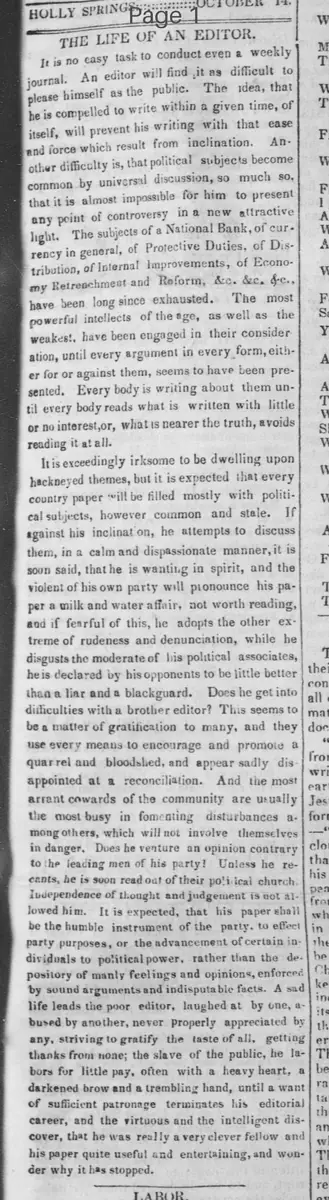
THE LIFE OF AN EDITOR.
It is no easy task to conduct even a weekly journal. An editor will find it as difficult to please himself as the public. The idea, that he is compelled to write within a given time, of itself, will prevent his writing with that ease and force which result from inclination. Another difficulty is, that political subjects become common by universal discussion, so much so, that it is almost impossible for him to present any point of controversy in a new attractive light. The subjects of a National Bank, of currency in general, of Protective Duties, of Distribution, of Internal Improvements, of Economy Retrenchment and Reform, &c. &c. &c., have been long since exhausted. The most powerful intellects of the age, as well as the weakest, have been engaged in their consideration, until every argument in every form, either for or against them, seems to have been presented. Every body is writing about them until every body reads what is written with little or no interest, or, what is nearer the truth, avoids reading it at all.
It is exceedingly irksome to be dwelling upon hackneyed themes, but it is expected that every country paper will be filled mostly with political subjects, however common and stale. If against his inclination, he attempts to discuss them, in a calm and dispassionate manner, it is soon said, that he is wanting in spirit, and the violent of his own party will pronounce his paper a milk and water affair, not worth reading, and if fearful of this, he adopts the other extreme of rudeness and denunciation, while he disgusts the moderate of his political associates, he is declared by his opponents to be little better than a liar and a blackguard. Does he get into difficulties with a brother editor? This seems to be a matter of gratification to many, and they use every means to encourage and promote a quarrel and bloodshed, and appear sadly disappointed at a reconciliation. And the most arrant cowards of the community are usually the most busy in fomenting disturbances among others, which will not involve themselves in danger. Does he venture an opinion contrary to the leading men of his party? Unless he recants, he is soon read out of their political church. Independence of thought and judgement is not allowed him. It is expected, that his paper shall be the humble instrument of the party, to effect party purposes, or the advancement of certain individuals to political power, rather than the depository of manly feelings and opinions, enforced by sound arguments and indisputable facts. A sad life leads the poor editor, laughed at by one, abused by another, never properly appreciated by any, striving to gratify the taste of all, getting thanks from none; the slave of the public, he labors for little pay, often with a heavy heart, a darkened brow and a trembling hand, until a want of sufficient patronage terminates his editorial career, and the virtuous and the intelligent discover, that he was really a very clever fellow and his paper quite useful and entertaining, and wonder why it has stopped.
It is no easy task to conduct even a weekly journal. An editor will find it as difficult to please himself as the public. The idea, that he is compelled to write within a given time, of itself, will prevent his writing with that ease and force which result from inclination. Another difficulty is, that political subjects become common by universal discussion, so much so, that it is almost impossible for him to present any point of controversy in a new attractive light. The subjects of a National Bank, of currency in general, of Protective Duties, of Distribution, of Internal Improvements, of Economy Retrenchment and Reform, &c. &c. &c., have been long since exhausted. The most powerful intellects of the age, as well as the weakest, have been engaged in their consideration, until every argument in every form, either for or against them, seems to have been presented. Every body is writing about them until every body reads what is written with little or no interest, or, what is nearer the truth, avoids reading it at all.
It is exceedingly irksome to be dwelling upon hackneyed themes, but it is expected that every country paper will be filled mostly with political subjects, however common and stale. If against his inclination, he attempts to discuss them, in a calm and dispassionate manner, it is soon said, that he is wanting in spirit, and the violent of his own party will pronounce his paper a milk and water affair, not worth reading, and if fearful of this, he adopts the other extreme of rudeness and denunciation, while he disgusts the moderate of his political associates, he is declared by his opponents to be little better than a liar and a blackguard. Does he get into difficulties with a brother editor? This seems to be a matter of gratification to many, and they use every means to encourage and promote a quarrel and bloodshed, and appear sadly disappointed at a reconciliation. And the most arrant cowards of the community are usually the most busy in fomenting disturbances among others, which will not involve themselves in danger. Does he venture an opinion contrary to the leading men of his party? Unless he recants, he is soon read out of their political church. Independence of thought and judgement is not allowed him. It is expected, that his paper shall be the humble instrument of the party, to effect party purposes, or the advancement of certain individuals to political power, rather than the depository of manly feelings and opinions, enforced by sound arguments and indisputable facts. A sad life leads the poor editor, laughed at by one, abused by another, never properly appreciated by any, striving to gratify the taste of all, getting thanks from none; the slave of the public, he labors for little pay, often with a heavy heart, a darkened brow and a trembling hand, until a want of sufficient patronage terminates his editorial career, and the virtuous and the intelligent discover, that he was really a very clever fellow and his paper quite useful and entertaining, and wonder why it has stopped.
What sub-type of article is it?
Press Freedom
Partisan Politics
What keywords are associated?
Editorial Life
Journalism Challenges
Political Topics
Party Pressures
Press Independence
Public Ingratitude
What entities or persons were involved?
Editors
The Public
Political Parties
Editorial Details
Primary Topic
Challenges Of Editorial Life
Stance / Tone
Sympathetic Critique Of Public And Party Pressures On Editors
Key Figures
Editors
The Public
Political Parties
Key Arguments
- conducting a journal is difficult due to time constraints and pleasing the public
- political subjects are exhausted and uninteresting
- editors face criticism for moderate or extreme tones
- public encourages editor quarrels but fears involvement
- independence leads to expulsion from party
- editors serve as party tools rather than independent voices
- editors endure abuse and lack appreciation until their paper fails