Thank you for visiting SNEWPapers!
Sign up free
Norwich Bulletin
Norwich, New London County, Connecticut
What is this article about?
Senator Dixon, Roosevelt's campaign manager, issues a call for a Progressive Party national convention in Chicago on Aug. 5, 1912, signed by supporters from 40 states. General Sickles pledges support to Roosevelt for the new party. (187 chars)
Clipping
OCR Quality
Full Text
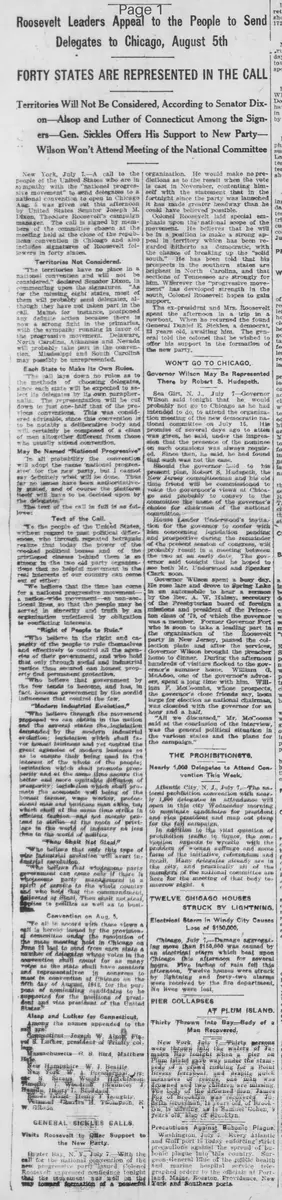
FORTY STATES ARE REPRESENTED IN THE CALL
Territories Will Not Be Considered, According to Senator Dixon—Alsop and Luther of Connecticut Among the Signers—Gen. Sickles Offers His Support to New Party—Wilson Won't Attend Meeting of the National Committee
New York, July 7.—A call to the people of the United States who are in sympathy with the national progressive movement to send delegates to a national convention to open in Chicago Aug. 5 was given out this afternoon by United States Senator Joseph M. Dixon, Theodore Roosevelt's campaign manager. The call is signed by members of the committee chosen at the meeting held at the close of the republican convention in Chicago and also includes signatures of Roosevelt followers in forty states.
Territories Not Considered.
The territories have no place in a national convention and will not be considered," declared Senator Dixon, in commenting upon the signatures. "As for the missing eight states, most of them will probably send delegates, although they have not taken part in the call. Maine, for instance, postponed any definite action because there is now a strong fight in the primaries, with the sympathy running in favor of the progressive movement. Delaware, North Carolina, Arkansas and Nevada will probably take part in the convention. Mississippi and South Carolina may possibly be unrepresented.
Each State to Make Its Own Rules.
The call lays down no rules as to the methods of choosing delegates, since each state will be expected to select its delegates by its own paraphernalia. The representation will be cut down to just one-half that of the previous conventions. This was considered advisable, since this convention is to be notably a deliberative body and will certainly be composed of a class of men altogether different from those who usually attend convention.
May Be Named "National Progressive"
In all probability the convention will adopt the name national progressive for the new party, but I cannot say definitely what will be done. Thus far no issues have been authoritatively stated, and of course the platform will have to be decided upon by the delegates."
The text of the call in full is as follows:
Text of the Call.
To the people of the United States, without regard to past political differences, who through repeated betrayals realize that today the power of the entrenched political bosses and of the privileged classes behind them is so strong in the two old party organizations that no helpful movement in the real interests of our country can come out of either:
We believe that the time has come for a national progressive movement—a nation-wide movement—on non-sectional lines, so that the people may be served in sincerity and truth by an organization unfettered by obligation to conflicting interests.
"Right of People to Rule."
Who believe in the right and capacity of the people to rule themselves and effectively to control all the agencies of their government, and who hold that only through social and industrial justice thus secured can honest property and permanent protection.
"Who believe that government by the few tends to become, and has, in fact become government by the sordid influences that control the few.
"Modern Industrial Evolution,"
Who believe through the movement proposed we can obtain in the nation and the several states the legislation demanded by the modern industrial evolution: legislation which shall favor honest business and yet control the great agencies of modern business so as to ensure their being used in the interest of the whole of the people; legislation which shall promote prosperity and at the same time secure the better and more equitable diffusion of prosperity; legislation which shall promote the economic well being of the honest farmer, wage worker, professional man and business man alike, by which shall at the same time strike in efficient fashion—and not merely pretend to strike—at the roots of privilege in the world of industry no less than in the world of politics.
"Thou Shalt Not Steal!"
We believe that only this type of industrial evolution will avert industrial revolution.
Who believe that wholesome party government can come only if there is wholesome party management in a spirit of service to the whole country and who hold that the commandment, uttered at Sinai, Thou shalt not steal, lies to politics as well as to business.
Convention on Aug. 5,
We all in accord with these views a call is hereby issued by the provisional committee under the resolution of the mass meeting held in Chicago on June 22 last to send from each state a number of delegates whose votes in the convention shall count for as many votes as the state shall have senators and representatives in congress to meet in convention at Chicago on the 5th day of August, 1912, for the purpose of nominating candidates to be supported for the positions of president and vice president of the United States."
Alsop and Luther for Connecticut,
Among the names appended to the call:
Connecticut—Joseph W. Alsop, S. Luther, president of Trinity college;
Massachusetts—S. S. Bird, Matthew...
New Hampshire W. J. Beattie;
New York W. N. Brendergast; J. H. Hullason; Woodrow Chauncey; J. Hazen; Henry T. Finnegan;
Rhode Island—Henry F. Boutwell;
Vermont—Charles H. Thompson, E. W. Gibson.
GENERAL SICKLES CALLS
Visits Roosevelt to Offer Support to the New Party.
Oyster Bay, N. Y., July 7.—With the call for the national convention of the new progressive party issued, Colonel Roosevelt expressed confidence tonight that the movement was well on the way to transformation of a party organization. He would make no predictions as to the result when the vote is cast in November, contenting himself with the statement that in the fortnight since the party was launched it has made greater headway than he could have believed possible.
Colonel Roosevelt laid special emphasis upon the national scope of the movement. He believes that he will be in a position to make a strong appeal in territory which has been regarded hitherto as democratic with the chance of breaking up the "solid south." He has been told that his prospects in the southern states are brightest in North Carolina, and that sections of Tennessee are strongly for him. Wherever the "progressive movement" has developed strength in the south, Colonel Roosevelt hopes to gain support.
The ex-president and Mrs. Roosevelt spent the afternoon in a trip in a rowboat. When he returned he found General Daniel E. Sickles, a democrat, 83 years old, awaiting him. The general told the colonel that he wished to offer his support in the formation of the new party.
What sub-type of article is it?
What themes does it cover?
What keywords are associated?
What entities or persons were involved?
Where did it happen?
Story Details
Key Persons
Location
Chicago, New York, Oyster Bay, N.Y.
Event Date
July 7, 1912
Story Details
Senator Joseph M. Dixon issues a call for a national progressive convention in Chicago on August 5, 1912, signed by Roosevelt supporters from forty states, excluding territories. The convention aims to nominate presidential and vice-presidential candidates. General Daniel E. Sickles visits Theodore Roosevelt at Oyster Bay to offer support for the new party.