Thank you for visiting SNEWPapers!
Sign up free
Editorial
July 4, 1804
Virginia Argus
Richmond, Virginia
What is this article about?
An editorial in The Democrat critiques Harrison G. Otis's speech in the Massachusetts General Court, accusing him of sowing discord by attacking the federal administration's influence, particularly Virginia's, and defending Jefferson and Madison while highlighting federalist inconsistencies on issues like the Louisiana Purchase.
Clipping
OCR Quality
95%
Excellent
Full Text
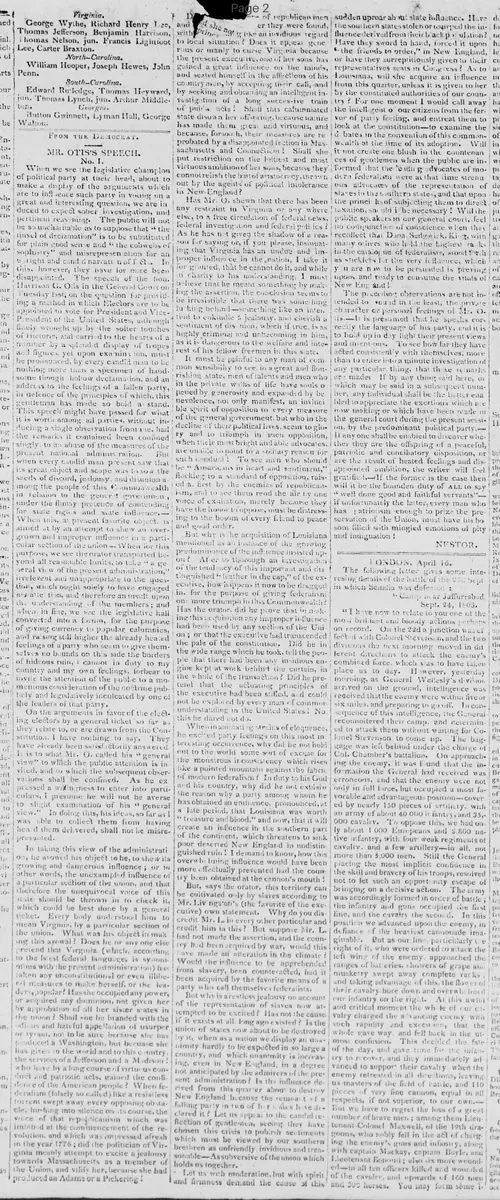
From The Democrat.
MR. OTIS'S SPEECH.
No. I.
When we see the legislative champion of political party at their head, about to make a display of the arguments which are to influence such party in voting on a great and interesting question, we are induced to expect sober investigation, and pertinent reasoning. The public will not be so uncharitable as to suppose that "the tinsel of declamation" is to be substituted for plain good sense and "the cobwebs of sophistry" and misrepresentation for an upright and candid narration of facts. In this, however, they have for once been disappointed. The speech of the hon. Harrison G. Otis in the General Court on Tuesday last, on the question for providing a method in which Electors are to be appointed to vote for President and Vice-President of the United States, although finely wrought up by the softer touches of rhetoric, and carried to the hearts of a number by a splendid display of tropes and figures, yet upon examination, must be pronounced, by every candid man to be nothing more than a specimen of handsome though hollow declamation, and an address to the feelings of a fallen party, in defence of the principles of which, this gentleman has made so bold a stand.
This speech might have passed for what it is worth among all parties, without inducing a single observation from me, had the remarks it contained been confined singly, to an abuse of the measures of the present national administration.
But when every candid man present saw that its great object and scope was to sow the seeds of discord, jealousy, and disunion among the people of this Commonwealth in relation to the general government, under the flimsy pretence of contending for state rights and state influence.-- Then this, at present favorite object, is aimed at by an attempt to shew an overgrown and improper influence in a particular section of the union-- then for this purpose, we see the orator transported beyond all reasonable limits, to take "a general view of the present administration," irrelevant and unappropriate to the question, which ought solely to have engaged his attention, and therefore an insult upon the understanding of the members; and which, in fine, we see the legislative hall converted into a forum, for the purpose of giving currency to popular calumnies, and raising still higher the already heated feelings of a party who seem to give themselves no bounds on this side the borders of hideous ruin, I cannot in duty to my country and my own feelings, forbear to invite the attention of the public to a momentous consideration of the doctrine publicly and legislatively inculcated by one of the leaders of that party.
On the arguments in favor of the electing electors by a general ticket so far as they relate to, or are drawn from the Constitution. I have nothing, to say. They have already been satisfactorily answered. It is to what Mr. O. called his "general view" to which the public attention is invited, and to which the subsequent observations shall be confined. As he expressed a willingness to enter into particulars, I presume he will not be averse to slight examination of his "general view." In doing this, his ideas, so far as I was able to collect them from having heard them delivered, shall not be misrepresented.
In taking this view of the administration, he avowed his object to be, to shew its growing and dangerous influence; or in other words, the unexampled influence of a particular section of the union, and that therefore the unequivocal voice of this state should be thrown in to check it, which could be best done by a general ticket. Every body understood him to mean Virginia, by a particular section of the union. What was his object in making this avowal? Does he or any one else pretend that Virginia (which, according to the latest federal language, is synonymous with the present administration) has taken any unconstitutional or even illiberal measures to make herself, or her leader, popular? Has she occupied any power, or acquired any dominion, not given her by approbation of all her sister states in the union? Shall she be branded with the odious and hateful appellation of usurper or tyrant, not to be sure because she has introduced a Washington, but because she has given to the world and to this country, the services of a Jefferson and a Madison! who have by a long course of virtuous conduct and patriotic acts, gained the confidence of the American people? When federalism (falsely so called) like a resistless torrent swept away every opposing obstacle, laughing into silence on its course, the voice of that republicanism which was imbodied at the commencement of the revolution, and which was impressed afresh in the year 1776; did the politician of Virginia meanly attempt to excite a jealousy towards Massachusetts as a member of the Union, and vilify her, because she had produced an Adams or a Pickering: or they were found, with reference to local situation? Does it appear generous or manly to curse Virginia because the present executive, one of her sons, has gained a great influence on the minds, and seated himself in the affections of his countrymen, by accepting their call, and by seeking and obtaining an intelligent investigation of a long successive train of public acts? Shall this calumniated state disown her offspring, because nature has made them great, and virtuous, and because, forsooth, their measures are reprobated by a disappointed faction in Massachusetts and Connecticut! Shall she put restriction on the loftiest and most virtuous ambition of her sons, because they cannot relish the bait of aristocracy, thrown out by the agents of political intolerance in New-England?
Has Mr. O. shewn that there has been any restraint in Virginia or any where else, to a free circulation of federal news, federal investigation and federal politics? As he has not given the shadow of a reason for saying or, if you please, insinuating that Virginia has an undue and improper influence in the nation, I take it for granted, that he cannot do it, and while in charity to his understanding. I must believe that he meant something by making the assertion. the conclusion seems to be irresistible that there was something lurking behind--something like an intention to enkindle a jealousy, and cherish a sentiment of disunion, which if true, is as highly criminal and unbecoming in him, as it is dangerous to the welfare and interest of his fellow freemen in this state.
It must be painful to any man of common sensibility to see, in a great and flourishing state, men of talents and men who in the private walks of life have souls opened by generosity and expanded by benevolence, not only manifest, an invincible spirit of opposition to every measure of the general government. but who in the decline of their political lives, seem to glory and to triumph in such opposition, when their most bright and able advocates, are unable to point to a solitary reason for such conduct! To see men who should be "Americans in heart and sentiment," flocking to a standard of opposition, raised first by the enemies of republicanism, and to see them rend the air by one voice of exultation, merely because they have the honor to oppose, must be distressing to the bosom of every friend to peace and good order.
But why is the acquisition of Louisiana mentioned as an instance of the growing predominance of the influence insisted upon? After so thorough an investigation of the tendency of this important and this "distinguished" feather in the cap," of the executive, how happens it now to be dragged in. for the purpose of giving federalism on more triumph in this Commonwealth? Has the orator, did he prove that in making this acquisition any improper influence had been used by any section of the Union; or that the executive had transcended the pale of the constitution. Did he in the wide range which he took, tell the people that there had been any insidious engine kept at work behind the curtain, in the whole of the transaction? Did he pretend that the actuating principles of the executive had been stifled, and could not be explored by every man of common understanding in the United States! No this he dared not do.
When in animated strains of eloquence, he excited party feelings on this most interesting occurrence, why did he not hold out to the world some sort of excuse for the monstrous inconsistency which rises like a pointed mountain against the fabric of modern federalism? In duty to his God and his country, why did he not explain the reason why a party among whom he has obtained an eminence, pronounced, at a late period, that Louisiana was worth "treasure and blood," and now, that it will create an influence in the southern part of the continent, which threatens to sink poor deserted New England in undistinguished ruin! I demand to know, how this overwhelming influence would have been more effectually prevented had the country been obtained at the cannon's mouth!
But, says the orator, this territory can be cultivated only by slaves according to Mr. Livingston's (the favorite of the executive) own statement. Why do you dis-credit Mr. L. in every other particular and credit him in this? But suppose Mr. L. had not made the assertion, and the country had been acquired by war, would this have made an alteration in the climate? Would the influence to be apprehended from slavery, be encountered, had it been acquired by the favorite means of a party who call themselves federalists.
But why is a restless jealousy on account of the representation of slaves now attempted to be excited? Has not the cause if it exists at all. long ago existed? Is the union of states now about to be destroyed by it, when as a nation we display an unanimity hardly to be expected in so large a country, and which unanimity is increasing, even in New England, in a degree not anticipated by the admirers of the present administration? Is the influence derived from this quarter about to destroy New England because the remnant of a falling party in two of her states have declared it? Let us appeal. to the candid reflection of gentlemen, seeing they have chosen this crisis to publish sentiments which must be viewed by our southern brethren as unfriendly, invidious and treasonable--As subversive of the union which holds us together.
Let us with moderation, but with spirit and firmness demand the cause of this sudden uproar about state influence. Have the southern states stolen or usurped the influence derived from their black population? Have they sword in hand, forced it upon "the friends to order," in New England, or have they surreptitiously given to their representatives seats in Congress? As to Louisiana, will she acquire an influence from this quarter, unless it is given to her by the constituted authorities of our country? For one moment I would call away the intelligent of our citizens from the fever of party feeling. and entreat them to look at the constitution--to examine the debates in the convention of this commonwealth at the time of its adoption. Will it not create one blush in the countenances of gentlemen when the public are informed that the would be advocates of modern federalism were at that time strenuous advocates of the representation of slaves in the southern states, and that upon the principle of subjecting them to direct taxation, should it be necessary! Will the public speakers in our general court, feel no compunction of conscience when they recollect that Dana. Sedgwick. King, with many others who held the highest ranks in the catalogue of federalists, stood forth as sticklers for the very influence, which you are now to be persuaded is preying upon, and ready to consume the vitals of New England!
The preceding observations are not intended to wound in the least, the private character or personal feelings of Mr. Otis.--It is presumed that he speaks correctly the language of his party, and it is to hold up in day light their present views and intentions. To see how far they have acted consistently with themselves, more than to enter into a minute investigation of any particular thing, that these remarks are made If by any thing said here, on which may be said in a subsequent number, any individual shall be the better enabled to appreciate the exertions which are now making or which have been made in the general court during the present session, by the predominant political party.-- It any one shall be enabled to discover whether they are the offspring of a peaceful, patriotic and conciliatory disposition, or are the result of heated feelings and disappointed ambition, the writer will feel gratified.--If the former is the case then will it be the bounden duty of ALL to say "well done good and faithful servants" if unfortunately the latter, every man who has patriotism enough to prize the preservation of the Union, must have his bosom filled with mingled emotions of pity and indignation!
NESTOR.
MR. OTIS'S SPEECH.
No. I.
When we see the legislative champion of political party at their head, about to make a display of the arguments which are to influence such party in voting on a great and interesting question, we are induced to expect sober investigation, and pertinent reasoning. The public will not be so uncharitable as to suppose that "the tinsel of declamation" is to be substituted for plain good sense and "the cobwebs of sophistry" and misrepresentation for an upright and candid narration of facts. In this, however, they have for once been disappointed. The speech of the hon. Harrison G. Otis in the General Court on Tuesday last, on the question for providing a method in which Electors are to be appointed to vote for President and Vice-President of the United States, although finely wrought up by the softer touches of rhetoric, and carried to the hearts of a number by a splendid display of tropes and figures, yet upon examination, must be pronounced, by every candid man to be nothing more than a specimen of handsome though hollow declamation, and an address to the feelings of a fallen party, in defence of the principles of which, this gentleman has made so bold a stand.
This speech might have passed for what it is worth among all parties, without inducing a single observation from me, had the remarks it contained been confined singly, to an abuse of the measures of the present national administration.
But when every candid man present saw that its great object and scope was to sow the seeds of discord, jealousy, and disunion among the people of this Commonwealth in relation to the general government, under the flimsy pretence of contending for state rights and state influence.-- Then this, at present favorite object, is aimed at by an attempt to shew an overgrown and improper influence in a particular section of the union-- then for this purpose, we see the orator transported beyond all reasonable limits, to take "a general view of the present administration," irrelevant and unappropriate to the question, which ought solely to have engaged his attention, and therefore an insult upon the understanding of the members; and which, in fine, we see the legislative hall converted into a forum, for the purpose of giving currency to popular calumnies, and raising still higher the already heated feelings of a party who seem to give themselves no bounds on this side the borders of hideous ruin, I cannot in duty to my country and my own feelings, forbear to invite the attention of the public to a momentous consideration of the doctrine publicly and legislatively inculcated by one of the leaders of that party.
On the arguments in favor of the electing electors by a general ticket so far as they relate to, or are drawn from the Constitution. I have nothing, to say. They have already been satisfactorily answered. It is to what Mr. O. called his "general view" to which the public attention is invited, and to which the subsequent observations shall be confined. As he expressed a willingness to enter into particulars, I presume he will not be averse to slight examination of his "general view." In doing this, his ideas, so far as I was able to collect them from having heard them delivered, shall not be misrepresented.
In taking this view of the administration, he avowed his object to be, to shew its growing and dangerous influence; or in other words, the unexampled influence of a particular section of the union, and that therefore the unequivocal voice of this state should be thrown in to check it, which could be best done by a general ticket. Every body understood him to mean Virginia, by a particular section of the union. What was his object in making this avowal? Does he or any one else pretend that Virginia (which, according to the latest federal language, is synonymous with the present administration) has taken any unconstitutional or even illiberal measures to make herself, or her leader, popular? Has she occupied any power, or acquired any dominion, not given her by approbation of all her sister states in the union? Shall she be branded with the odious and hateful appellation of usurper or tyrant, not to be sure because she has introduced a Washington, but because she has given to the world and to this country, the services of a Jefferson and a Madison! who have by a long course of virtuous conduct and patriotic acts, gained the confidence of the American people? When federalism (falsely so called) like a resistless torrent swept away every opposing obstacle, laughing into silence on its course, the voice of that republicanism which was imbodied at the commencement of the revolution, and which was impressed afresh in the year 1776; did the politician of Virginia meanly attempt to excite a jealousy towards Massachusetts as a member of the Union, and vilify her, because she had produced an Adams or a Pickering: or they were found, with reference to local situation? Does it appear generous or manly to curse Virginia because the present executive, one of her sons, has gained a great influence on the minds, and seated himself in the affections of his countrymen, by accepting their call, and by seeking and obtaining an intelligent investigation of a long successive train of public acts? Shall this calumniated state disown her offspring, because nature has made them great, and virtuous, and because, forsooth, their measures are reprobated by a disappointed faction in Massachusetts and Connecticut! Shall she put restriction on the loftiest and most virtuous ambition of her sons, because they cannot relish the bait of aristocracy, thrown out by the agents of political intolerance in New-England?
Has Mr. O. shewn that there has been any restraint in Virginia or any where else, to a free circulation of federal news, federal investigation and federal politics? As he has not given the shadow of a reason for saying or, if you please, insinuating that Virginia has an undue and improper influence in the nation, I take it for granted, that he cannot do it, and while in charity to his understanding. I must believe that he meant something by making the assertion. the conclusion seems to be irresistible that there was something lurking behind--something like an intention to enkindle a jealousy, and cherish a sentiment of disunion, which if true, is as highly criminal and unbecoming in him, as it is dangerous to the welfare and interest of his fellow freemen in this state.
It must be painful to any man of common sensibility to see, in a great and flourishing state, men of talents and men who in the private walks of life have souls opened by generosity and expanded by benevolence, not only manifest, an invincible spirit of opposition to every measure of the general government. but who in the decline of their political lives, seem to glory and to triumph in such opposition, when their most bright and able advocates, are unable to point to a solitary reason for such conduct! To see men who should be "Americans in heart and sentiment," flocking to a standard of opposition, raised first by the enemies of republicanism, and to see them rend the air by one voice of exultation, merely because they have the honor to oppose, must be distressing to the bosom of every friend to peace and good order.
But why is the acquisition of Louisiana mentioned as an instance of the growing predominance of the influence insisted upon? After so thorough an investigation of the tendency of this important and this "distinguished" feather in the cap," of the executive, how happens it now to be dragged in. for the purpose of giving federalism on more triumph in this Commonwealth? Has the orator, did he prove that in making this acquisition any improper influence had been used by any section of the Union; or that the executive had transcended the pale of the constitution. Did he in the wide range which he took, tell the people that there had been any insidious engine kept at work behind the curtain, in the whole of the transaction? Did he pretend that the actuating principles of the executive had been stifled, and could not be explored by every man of common understanding in the United States! No this he dared not do.
When in animated strains of eloquence, he excited party feelings on this most interesting occurrence, why did he not hold out to the world some sort of excuse for the monstrous inconsistency which rises like a pointed mountain against the fabric of modern federalism? In duty to his God and his country, why did he not explain the reason why a party among whom he has obtained an eminence, pronounced, at a late period, that Louisiana was worth "treasure and blood," and now, that it will create an influence in the southern part of the continent, which threatens to sink poor deserted New England in undistinguished ruin! I demand to know, how this overwhelming influence would have been more effectually prevented had the country been obtained at the cannon's mouth!
But, says the orator, this territory can be cultivated only by slaves according to Mr. Livingston's (the favorite of the executive) own statement. Why do you dis-credit Mr. L. in every other particular and credit him in this? But suppose Mr. L. had not made the assertion, and the country had been acquired by war, would this have made an alteration in the climate? Would the influence to be apprehended from slavery, be encountered, had it been acquired by the favorite means of a party who call themselves federalists.
But why is a restless jealousy on account of the representation of slaves now attempted to be excited? Has not the cause if it exists at all. long ago existed? Is the union of states now about to be destroyed by it, when as a nation we display an unanimity hardly to be expected in so large a country, and which unanimity is increasing, even in New England, in a degree not anticipated by the admirers of the present administration? Is the influence derived from this quarter about to destroy New England because the remnant of a falling party in two of her states have declared it? Let us appeal. to the candid reflection of gentlemen, seeing they have chosen this crisis to publish sentiments which must be viewed by our southern brethren as unfriendly, invidious and treasonable--As subversive of the union which holds us together.
Let us with moderation, but with spirit and firmness demand the cause of this sudden uproar about state influence. Have the southern states stolen or usurped the influence derived from their black population? Have they sword in hand, forced it upon "the friends to order," in New England, or have they surreptitiously given to their representatives seats in Congress? As to Louisiana, will she acquire an influence from this quarter, unless it is given to her by the constituted authorities of our country? For one moment I would call away the intelligent of our citizens from the fever of party feeling. and entreat them to look at the constitution--to examine the debates in the convention of this commonwealth at the time of its adoption. Will it not create one blush in the countenances of gentlemen when the public are informed that the would be advocates of modern federalism were at that time strenuous advocates of the representation of slaves in the southern states, and that upon the principle of subjecting them to direct taxation, should it be necessary! Will the public speakers in our general court, feel no compunction of conscience when they recollect that Dana. Sedgwick. King, with many others who held the highest ranks in the catalogue of federalists, stood forth as sticklers for the very influence, which you are now to be persuaded is preying upon, and ready to consume the vitals of New England!
The preceding observations are not intended to wound in the least, the private character or personal feelings of Mr. Otis.--It is presumed that he speaks correctly the language of his party, and it is to hold up in day light their present views and intentions. To see how far they have acted consistently with themselves, more than to enter into a minute investigation of any particular thing, that these remarks are made If by any thing said here, on which may be said in a subsequent number, any individual shall be the better enabled to appreciate the exertions which are now making or which have been made in the general court during the present session, by the predominant political party.-- It any one shall be enabled to discover whether they are the offspring of a peaceful, patriotic and conciliatory disposition, or are the result of heated feelings and disappointed ambition, the writer will feel gratified.--If the former is the case then will it be the bounden duty of ALL to say "well done good and faithful servants" if unfortunately the latter, every man who has patriotism enough to prize the preservation of the Union, must have his bosom filled with mingled emotions of pity and indignation!
NESTOR.
What sub-type of article is it?
Partisan Politics
Constitutional
What keywords are associated?
Otis Speech
Electoral Electors
Virginia Influence
Louisiana Purchase
Federalist Inconsistency
Union Preservation
State Rights
What entities or persons were involved?
Harrison G. Otis
Jefferson
Madison
Virginia
Massachusetts
New England
Federalists
Dana
Sedgwick
King
Editorial Details
Primary Topic
Critique Of Harrison G. Otis's Speech On Electoral Method And Virginia's Influence
Stance / Tone
Defense Of Federal Administration And Union Against Federalist Discord
Key Figures
Harrison G. Otis
Jefferson
Madison
Virginia
Massachusetts
New England
Federalists
Dana
Sedgwick
King
Key Arguments
Otis's Speech Promotes Discord And Disunion Under Pretense Of State Rights
Virginia's Influence Is Legitimate And Earned Through Virtuous Leaders
Federalists Inconsistently Oppose Louisiana Purchase After Initially Valuing It
Historical Federalist Support For Slave Representation Contradicts Current Complaints
Otis's Rhetoric Insults The Legislature And Excites Party Feelings Without Substance