Thank you for visiting SNEWPapers!
Sign up free
Editorial
March 30, 1902
The Morning Astorian
Astoria, Clatsop County, Oregon
What is this article about?
This editorial reflects on the deeper religious significance of Easter, portraying it as a celebration of Christ's resurrection not as a mere miracle against death, but as a miracle of grace offering forgiveness and new life to sinners, emphasizing divine love's triumph over humanity's greatest sin.
Clipping
OCR Quality
98%
Excellent
Full Text
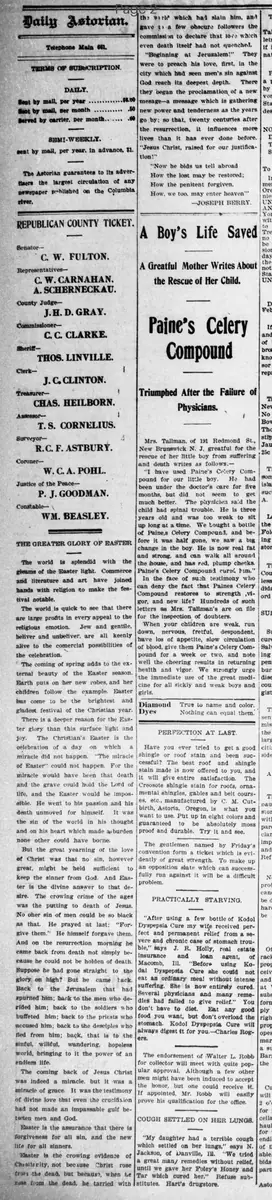
THE GREATER GLORY OF EASTER
The world is splendid with the gleams of the Easter light. Commerce and literature and art have joined hands with religion to make the festival notable.
The world is quick to see that there are large profits in every appeal to the religious emotion. Jew and gentile, believer and unbeliever, are all keenly alive to the commercial possibilities of the celebration.
The coming of spring adds to the external beauty of the Easter season. Earth puts on her new robes, and her children follow the example. Easter has come to be the brightest and gladdest festival of the Christian year.
There is a deeper reason for the Easter glory than this surface light and joy. The Christian's Easter is the celebration of a day on which a miracle did not happen. "The miracle of Easter" could not happen. For the miracle would have been that death and the grave could hold the Lord of life, and the Easter would be impossible. He went to his passion and his death unmoved for himself. It was the sin of the world in his thought and on his heart which made a burden none other could have borne.
But the great yearning of the love of Christ was that no sin, however great, might be held sufficient to keep the sinner from God. And Easter is the divine answer to that desire. The crowning crime of the ages was the putting to death of Jesus. No other sin of men could be so black as that. He prayed at last: "Forgive them." He himself forgave them. And on the resurrection morning he came back from death not simply because he could not be holden of death. Suppose he had gone straight to the glory on high? But he came back. Back to the Jerusalem that had spurned him; back to the men who derided him; back to the soldiers who buffeted him; back to the priests who accused him; back to the disciples who fled from him; back, that is to the sinful, willful, wandering, hopeless world, bringing to it the power of an endless life.
The coming back of Jesus Christ was indeed a miracle, but it was a miracle of grace. It was the testimony of divine love that even the crucifixion had not made an impassable gulf between men and God.
Easter is the assurance that there is forgiveness for all sin, and the new life for all sinners. Easter is the crowning evidence of Christianity, not because Christ rose from the dead, but because, when he rose from the dead, he tarried with the world which had slain him, and gave to a few obscure followers the commission to declare that love which even death itself had not quenched.
"Beginning at Jerusalem!" They were to preach his love, first, in the city which had seen men's sin against God reach its deepest depth. There they began the proclamation of a new message-a message which is gathering new power and tenderness as the years go by: so that, twenty centuries after the resurrection, it influences more lives than it has ever done before.
"Jesus Christ, raised for our justification!"
"Now he bids us tell abroad
How the lost may be restored:
How the penitent forgiven,
How, we too, may enter heaven"
-JOSEPH BERRY.
The world is splendid with the gleams of the Easter light. Commerce and literature and art have joined hands with religion to make the festival notable.
The world is quick to see that there are large profits in every appeal to the religious emotion. Jew and gentile, believer and unbeliever, are all keenly alive to the commercial possibilities of the celebration.
The coming of spring adds to the external beauty of the Easter season. Earth puts on her new robes, and her children follow the example. Easter has come to be the brightest and gladdest festival of the Christian year.
There is a deeper reason for the Easter glory than this surface light and joy. The Christian's Easter is the celebration of a day on which a miracle did not happen. "The miracle of Easter" could not happen. For the miracle would have been that death and the grave could hold the Lord of life, and the Easter would be impossible. He went to his passion and his death unmoved for himself. It was the sin of the world in his thought and on his heart which made a burden none other could have borne.
But the great yearning of the love of Christ was that no sin, however great, might be held sufficient to keep the sinner from God. And Easter is the divine answer to that desire. The crowning crime of the ages was the putting to death of Jesus. No other sin of men could be so black as that. He prayed at last: "Forgive them." He himself forgave them. And on the resurrection morning he came back from death not simply because he could not be holden of death. Suppose he had gone straight to the glory on high? But he came back. Back to the Jerusalem that had spurned him; back to the men who derided him; back to the soldiers who buffeted him; back to the priests who accused him; back to the disciples who fled from him; back, that is to the sinful, willful, wandering, hopeless world, bringing to it the power of an endless life.
The coming back of Jesus Christ was indeed a miracle, but it was a miracle of grace. It was the testimony of divine love that even the crucifixion had not made an impassable gulf between men and God.
Easter is the assurance that there is forgiveness for all sin, and the new life for all sinners. Easter is the crowning evidence of Christianity, not because Christ rose from the dead, but because, when he rose from the dead, he tarried with the world which had slain him, and gave to a few obscure followers the commission to declare that love which even death itself had not quenched.
"Beginning at Jerusalem!" They were to preach his love, first, in the city which had seen men's sin against God reach its deepest depth. There they began the proclamation of a new message-a message which is gathering new power and tenderness as the years go by: so that, twenty centuries after the resurrection, it influences more lives than it has ever done before.
"Jesus Christ, raised for our justification!"
"Now he bids us tell abroad
How the lost may be restored:
How the penitent forgiven,
How, we too, may enter heaven"
-JOSEPH BERRY.
What sub-type of article is it?
Moral Or Religious
What keywords are associated?
Easter
Resurrection
Christian Forgiveness
Divine Grace
Religious Celebration
What entities or persons were involved?
Jesus Christ
Disciples
God
Editorial Details
Primary Topic
Deeper Glory Of Easter As Miracle Of Grace And Forgiveness
Stance / Tone
Inspirational Affirmation Of Christian Redemption
Key Figures
Jesus Christ
Disciples
God
Key Arguments
Easter's True Glory Lies In Christ's Return As A Miracle Of Grace Offering Forgiveness
Christ's Resurrection Bridges The Gulf Between Sinful Humanity And God
The Message Of Divine Love Began In Jerusalem And Continues To Influence Lives Today
Easter Assures New Life And Justification For All Sinners