Thank you for visiting SNEWPapers!
Sign up free
The Nashville Daily Union
Nashville, Davidson County, Tennessee
What is this article about?
The Nashville Union reports on a Confederate Senate debate from September 30, 1862, condemning Lincoln's Emancipation Proclamation as a violation of warfare, advocating retaliatory measures like raising the black flag and war of extermination against invaders.
Clipping
OCR Quality
Full Text
For Freedom and Nationality.
S. C. MERCER, Editor.
SUNDAY EVENING, OCTOBER 12, 1862.
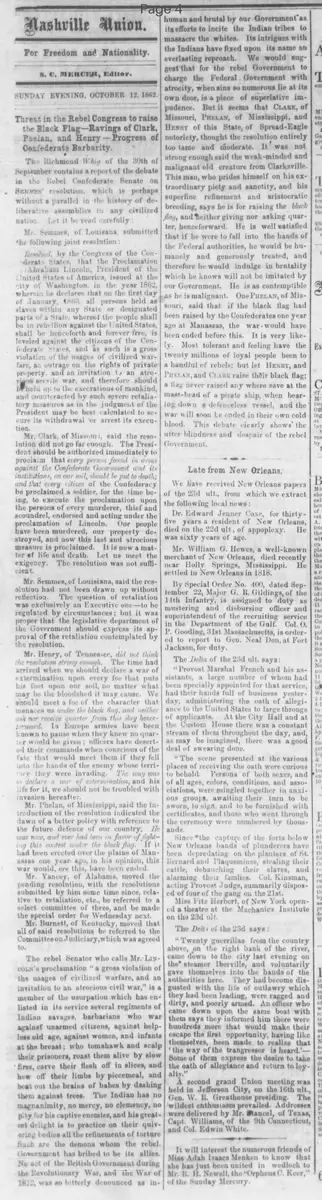
Threat in the Rebel Congress to raise the Black Flag—Ravings of Clark, Phelan, and Henry—Progress of Confederate Barbarity.
The Richmond Whig of the 30th of September contains a report of the debate in the Rebel Confederate Senate on Semmes' resolution, which is perhaps without a parallel in the history of deliberative assemblies in any civilized nation. Let it be read carefully.
Mr. Semmes, of Louisiana, submitted the following joint resolution:
Resolved, by the Congress of the Confederate States, that the Proclamation of Abraham Lincoln, President of the United States of America, issued at the city of Washington, in the year 1862, wherein he declares that on the first day of January, 1863, all persons held as slaves within any State or designated parts of a State, whereof the people shall be in rebellion against the United States, shall be henceforth and forever free, is levelled against the citizens of the Confederate States, and as such is a gross violation of the usages of civilized warfare, an outrage on the rights of private property, and an invitation to an atrocious servile war, and therefore should be held up to the execrations of mankind, and counteracted by such severe retaliatory measures as in the judgment of the President may be best calculated to secure its withdrawal or arrest its execution.
Mr. Clark, of Missouri, said the resolution did not go far enough. The President should be authorized immediately to proclaim that every person found in arms against the Confederate Government and its institutions, on our soil, should be put to death; and that every citizen of the Confederacy be proclaimed a soldier, for the time being, to execute the proclamation upon the persons of every murderer, thief and scoundrel, enlisted and acting under the proclamation of Lincoln. Our people have been murdered, our property destroyed, and now this last and atrocious measure is proclaimed. It is now a matter of life and death. Let us meet the exigency. The resolution was not sufficient.
Mr. Semmes, of Louisiana, said the resolution had not been drawn up without reflection. The question of retaliation was exclusively an Executive one—to be regulated by circumstances; but it was proper that the legislative department of the Government should express its approval of the retaliation contemplated by the resolution.
Mr. Henry, of Tennessee, did not think the resolution strong enough. The time had arrived when we should declare a war of extermination upon every foe that puts his foot upon our soil, no matter what may be the bloodshed it may cause. We should meet a foe of the character that menaces us under the black flag, and neither ask nor receive quarter from this day henceforward. In Europe armies have been known to pause when they knew no quarter would be given; officers have deserted their commands when conscious of the fate that would meet them if they fell into the hands of the enemy whose territory they were invading. The way was to declare a war of extermination, and his life for it, we should not be troubled with invasion hereafter.
Mr. Phelan, of Mississippi, said the introduction of the resolution indicated the dawn of a better policy with reference to the future defence of our country. He was now, and ever had been in favor of fighting this contest under the black flag. If it had been erected over the plains of Manassas one year ago, in his opinion, this war would, ere this, have been ended.
Mr. Yancey, of Alabama, moved the pending resolution, with the resolutions submitted by him some time since, relative to retaliation, etc., be referred to a select committee of three, and be made the special order for Wednesday next.
Mr. Burnett, of Kentucky, moved that all of said resolutions be referred to the Committee on Judiciary, which was agreed to.
The rebel Senator who calls Mr. Lincoln's proclamation "a gross violation of the usages of civilized warfare, and an invitation to an atrocious civil war," is a member of the usurpation which has enlisted in its service several regiments of Indian savages, barbarians who war against unarmed citizens, against helpless old age, against women, and infants at the breast; who tomahawk and scalp their prisoners, roast them alive by slow fires, carve their flesh off in slices, and hew off their limbs by piecemeal, and beat out the brains of babes by dashing them against trees. The Indian has no magnanimity, no mercy, no clemency, no pity for his captive enemies, and his greatest delight is to practice on their quivering bodies all the refinements of torture. Such are the demons whom the rebel Government has bribed to be its allies.
No act of the British Government during the Revolutionary War, and the War of 1812, was so bitterly denounced as inhuman and brutal by our Government as its efforts to incite the Indian tribes to massacre the whites. Its intrigues with the Indians have fixed upon its name an everlasting reproach. We would suggest that for the rebel Government to charge the Federal Government with atrocity, when sins so numerous lie at its own door, is a piece of superlative impudence. But it seems that Clark, of Missouri, Phelan, of Mississippi, and Henry of this State, of Spread-Eagle notoriety, thought the resolution entirely too tame and moderate. It was not strong enough said the weak-minded and malignant old creature from Clarksville. This man, who prides himself on his extraordinary piety and sanctity, and his superfine refinement and aristocratic breeding, says he is for raising the black flag, and neither giving nor asking quarter, henceforward. He is well satisfied that if he were to fall into the hands of the Federal authorities, he would be humanely and generously treated, and therefore he would indulge in brutality which he knows will not be imitated by our Government. He is as contemptible as he is malignant. One Phelan, of Missouri, said that if the black flag had been raised by the Confederates one year ago at Manassas, the war would have been ended before this. It is very likely. Most tolerant and feeling have the twenty millions of loyal people been to a handful of rebels; but let Henry, and Phelan, and Clark raise their black flag; a flag never raised anywhere save at the mast-head of a pirate ship, when bearing down a defenceless vessel, and the war will soon be ended in their own cold blood. This debate clearly shows the utter blindness and despair of the rebel Government.
What sub-type of article is it?
What keywords are associated?
What entities or persons were involved?
Where did it happen?
Domestic News Details
Primary Location
Richmond
Event Date
September 30, 1862
Key Persons
Outcome
resolutions referred to the committee on judiciary.
Event Details
Confederate Senate debate on Semmes' resolution condemning Lincoln's Emancipation Proclamation as a violation of civilized warfare and calling for retaliatory measures. Senators Clark, Henry, and Phelan advocated for stronger actions, including authorizing the President to proclaim death for enemies in arms, declaring every citizen a soldier to execute such orders, and fighting under the black flag with no quarter given or asked, aiming for a war of extermination against invaders.