Thank you for visiting SNEWPapers!
Sign up free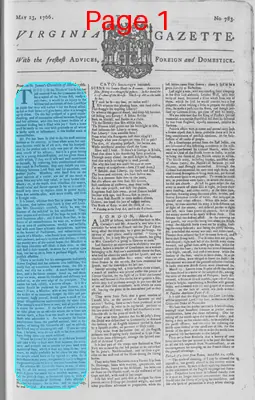
The Virginia Gazette
Richmond, Williamsburg, Richmond County, Virginia
What is this article about?
Commentary from March 1766 on the anticipated swift repeal of the Stamp Act by the House of Lords, praising Mr. Pitt's role in reconciliation with British colonies, urging scrutiny of Mr. Grenville's conduct, and warning against future ministerial follies that nearly led to hostilities.
Clipping
OCR Quality
Full Text
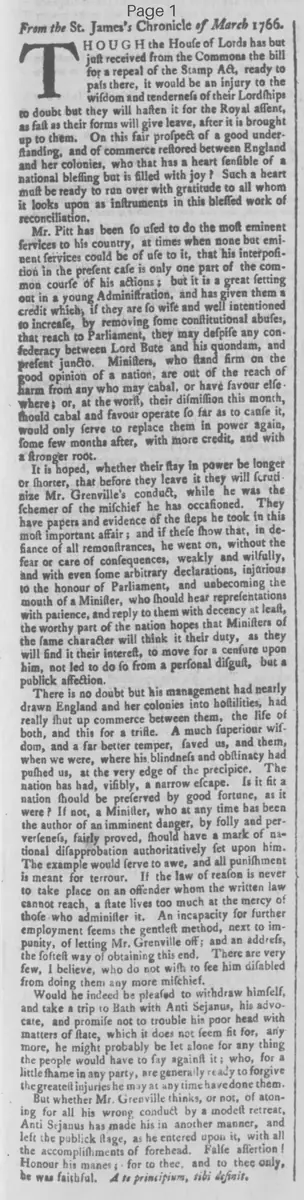
THOUGH the House of Lords has but just received from the Commons the bill for a repeal of the Stamp Act, ready to pass there, it would be an injury to the wisdom and tenderness of their Lordships to doubt but they will hasten it for the Royal assent, as fast as their forms will give leave, after it is brought up to them. On this fair prospect of a good understanding, and of commerce restored between England and her colonies, who that has a heart sensible of a national blessing but is filled with joy? Such a heart must be ready to run over with gratitude to all whom it looks upon as instruments in this blessed work of reconciliation.
Mr. Pitt has been so used to do the most eminent services to his country, at times when none but eminent services could be of use to it, that his interposition in a young Administration, and has given them a common course of his actions; but it is a great setting in the present case is only one part of the commendation which, if they are so wise and well intentioned to increase, by removing some constitutional abuses, that reach to Parliament, they may despise any confederacy between Lord Bate and his quondam, and present juncture. Ministers, who stand firm on the good opinion of a nation, are out of the reach of harm from any who may cabal, or have favour elsewhere; or, at the worst, their dismission this month, should cabal and favour operate so far as to cause it, would only serve to replace them in power again, some few months after, with more credit, and with a stronger root.
It is hoped, whether their stay in power be longer or shorter, that before they leave it they will scrutinize Mr. Grenville's conduct, while he was the schemer of the mischief he has occasioned. They have papers and evidence of the steps he took in this most important affair; and if these show that, in defiance of all remonstrances, he went on, without the fear or care of consequences, weakly and wilfully, and with even some arbitrary declarations, injurious to the honour of Parliament, and unbecoming the mouth of a Minister, who should hear representations with patience, and reply to them with decency at least, the same character will think it their duty, as they the worthy part of the nation hopes that Ministers of will find it their interest, to move for a censure upon him, not led to do so from a personal disgust, but a publick affection.
There is no doubt but his management had nearly drawn England and her colonies into hostilities, had really shut up commerce between them, the life of both, and this for a trifle. A much superior wisdom, and a far better temper, saved us, and them, when we were, where his blindness and obstinacy had pushed us, at the very edge of the precipice. The nation has had, visibly, a narrow escape. Is it fit a nation should be preserved by good fortune, as it were? If not, a Minister, who at any time has been the author of an imminent danger, by folly and perverseness, fairly proved, should have a mark of national disapprobation authoritatively set upon him.
The example would serve to awe, and all punishment is meant for terror. If the law of reason is never to take place on an offender whom the written law cannot reach, a state lives too much at the mercy of those who administer it. An incapacity for further employment seems the gentlest method, next to impunity, of letting Mr. Grenville off; and an address, the softest way of obtaining this end. There are very few, I believe, who do not wish to see him disabled from doing them any more mischief.
Would he indeed be pleased to withdraw himself, and take a trip to Bath with Anti Sejanus, his advocate, and promise not to trouble his poor head with matters of state, which it does not seem fit for, any more, he might probably be let alone for any thing the people would have to say against it; who, for a little shame in any party, are generally ready to forgive the greatest injuries he may at any time have done them.
But whether Mr. Grenville thinks, or not, of atoning for all his wrong conduct by a modest retreat, Anti Sejanus has made his in another manner, and left the publick stage, as he entered upon it, with all the accomplishments of forehead. False assertion! Honour his manes; for to thee, and to thee only, be was faithful. A te principium, sibi finis.
What sub-type of article is it?
What keywords are associated?
What entities or persons were involved?
Where did it happen?
Foreign News Details
Primary Location
England And Her Colonies
Event Date
March 1766
Key Persons
Outcome
anticipated repeal of the stamp act leading to restored commerce and reconciliation between england and her colonies; call for censure of mr. grenville to prevent future ministerial misconduct.
Event Details
The House of Lords is expected to quickly pass the bill repealing the Stamp Act received from the Commons. Mr. Pitt's interposition in the young Administration is praised for aiding reconciliation. Ministers are urged to scrutinize and censure Mr. Grenville's role in scheming the Stamp Act, which nearly caused hostilities and shut commerce with the colonies. Grenville's obstinacy is criticized, and an address for his incapacity in future employment is suggested. Anti Sejanus is mentioned as having left the public stage.