Thank you for visiting SNEWPapers!
Sign up free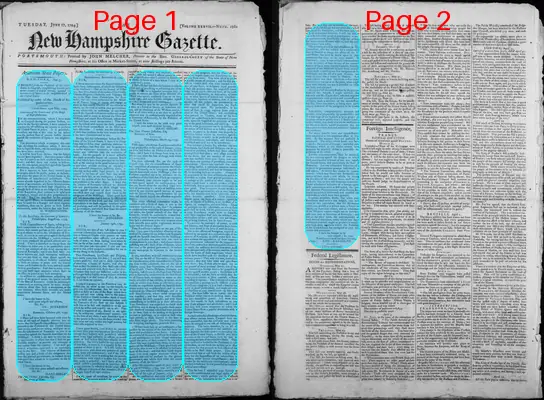
The New Hampshire Gazette
Portsmouth, Rockingham County, New Hampshire
What is this article about?
President Washington's 1794 message to Congress transmits documents on threats of unauthorized expeditions against Spanish territories near the US, particularly incited by French agents in Kentucky targeting New Orleans. Includes correspondence with Gov. Isaac Shelby urging legal prevention to maintain peace and Mississippi navigation negotiations.
Merged-components note: This is a single continuous document from President Washington and related correspondence, spanning pages 1 and 2, with explicit '(To be continued)' indicator.
Clippings
1 of 2
OCR Quality
Full Text
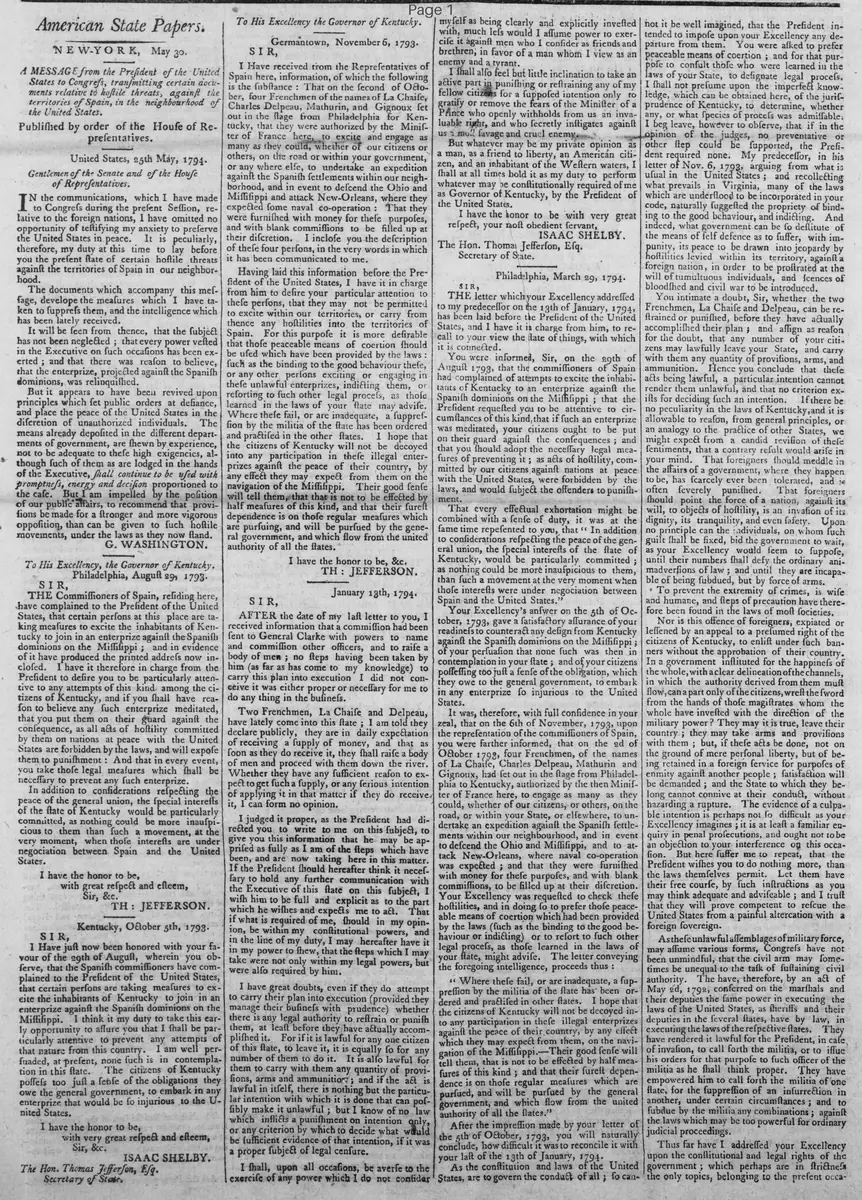
NEW YORK, May 30.
A MESSAGE from the President of the United States to Congress, transmitting certain documents relative to hostile threats, against the territories of Spain, in the neighbourhood of the United States.
Published by order of the House of Representatives.
United States, 25th May, 1794.
Gentlemen of the Senate and of the House of Representatives.
IN the communications, which I have made to Congress during the present Session, relative to the foreign nations, I have omitted no opportunity of testifying my anxiety to preserve the United States in peace. It is peculiarly, therefore, my duty at this time to lay before you the present state of certain hostile threats against the territories of Spain in our neighbourhood.
The documents which accompany this message, develope the measures which I have taken to suppress them, and the intelligence which has been lately received.
It will be seen from thence, that the subject has not been neglected; that every power vested in the Executive on such occasions has been exerted; and that there was reason to believe, that the enterprize, projected against the Spanish dominions, was relinquished.
But it appears to have been revived upon principles which set public orders at defiance, and place the peace of the United States in the discretion of unauthorized individuals. The means already deposited in the different departments of government, are shown by experience, not to be adequate to these high exigencies, although such of them as are lodged in the hands of the Executive, shall continue to be used with promptness, energy and decision proportioned to the case. But I am impelled by the position of our public affairs, to recommend that provisions be made for a stronger and more vigorous opposition, than can be given to such hostile movements, under the laws as they now stand.
G. WASHINGTON.
To His Excellency, the Governor of Kentucky.
Philadelphia, August 29, 1793.
SIR,
THE Commissioners of Spain, residing here, have complained to the President of the United States, that certain persons at this place are taking measures to excite the inhabitants of Kentucky to join in an enterprize against the Spanish dominions on the Mississippi; and in evidence of it have produced the printed address now enclosed. I have it therefore in charge from the President to desire you to be particularly attentive to any attempts of this kind among the citizens of Kentucky, and if you shall have reason to believe any such enterprize meditated, that you put them on their guard against the consequence, as all acts of hostility committed by them on nations at peace with the United States are forbidden by the laws, and will expose them to punishment: And that in every event, you take those legal measures which shall be necessary to prevent any such enterprize.
In addition to considerations respecting the peace of the general union, the special interests of the state of Kentucky would be particularly committed, as nothing could be more inauspicious to them than such a movement, at the very moment, when those interests are under negotiation between Spain and the United States.
I have the honor to be, with great respect and esteem,
Sir, &c.
TH: JEFFERSON.
Kentucky, October 5th, 1793.
SIR,
I Have just now been honored with your favor of the 29th of August, wherein you observe, that the Spanish commissioners have complained to the President of the United States, that certain persons are taking measures to excite the inhabitants of Kentucky to join in an enterprize against the Spanish dominions on the Mississippi. I think it my duty to take this early opportunity to assure you that I shall be particularly attentive to prevent any attempts of that nature from this country. I am well persuaded, at present, none such is in contemplation in this state. The citizens of Kentucky possess too just a sense of the obligations they owe the general government, to embark in any enterprize that would be so injurious to the United States.
I have the honor to be, with very great respect and esteem,
Sir, &c.
ISAAC SHELBY.
The Hon. Thomas Jefferson, Esq. Secretary of State.
To His Excellency the Governor of Kentucky.
Germantown, November 6, 1793.
SIR,
I Have received from the Representatives of Spain here, information, of which the following is the substance: That on the second of October, four Frenchmen of the names of La Chaise, Charles Delpeau, Mathurin, and Gignoux set out in the stage from Philadelphia for Kentucky, that they were authorized by the Minister of France here, to excite and engage as many as they could, whether of our citizens or others, on the road or within your government, or any where else, to undertake an expedition against the Spanish settlements within our neighbourhood, and in event to descend the Ohio and Mississippi and attack New-Orleans, where they expected some naval co-operation: That they were furnished with money for these purposes, and with blank commissions to be filled up at their discretion. I enclose you the description of these four persons, in the very words in which it has been communicated to me.
Having laid this information before the President of the United States, I have it in charge from him to desire your particular attention to these persons, that they may not be permitted to excite within our territories, or carry from thence any hostilities into the territories of Spain. For this purpose it is more desirable that those peaceable means of coercion should be used which have been provided by the laws: such as the binding to the good behaviour these, or any other persons exciting or engaging in these unlawful enterprizes, indicting them, or resorting to such other legal process, as those learned in the laws of your state may advise.
Where these fail, or are inadequate, a suppression by the militia of the state has been ordered and practised in the other states. I hope that the citizens of Kentucky will not be decoyed into any participation in these illegal enterprizes against the peace of their country, by any effect they may expect from them on the navigation of the Mississippi. Their good sense will tell them, that that is not to be effected by half measures of this kind, and that their surest dependence is on those regular measures which are pursuing, and will be pursued by the general government, and which flow from the united authority of all the states.
I have the honor to be, &c.
TH: JEFFERSON.
January 18th, 1794.
SIR,
AFTER the date of my last letter to you, I received information that a commission had been sent to General Clarke with powers to name and commission other officers, and to raise a body of men; no steps having been taken by him (as far as has come to my knowledge) to carry this plan into execution I did not conceive it was either proper or necessary for me to do any thing in the business.
Two Frenchmen, La Chaise and Delpeau, have lately come into this state; I am told they declare publicly, they are in daily expectation of receiving a supply of money, and that as soon as they do receive it, they shall raise a body of men and proceed with them down the river.
Whether they have any sufficient reason to expect to get such a supply, or any serious intention of applying it in that manner if they do receive it, I can form no opinion.
I judged it proper, as the President had directed you to write to me on this subject, to give you this information that he may be apprised as fully as I am of the steps which have been, and are now taking here in this matter.
If the President should hereafter think it necessary to hold any further communication with the Executive of this state on this subject, I wish him to be full and explicit as to the part which he wishes and expects me to act. That if what is required of me, should in my opinion, be within my constitutional powers, and in the line of my duty, I may hereafter have it in my power to show, that the steps which I may take were not only within my legal powers, but were also required by him.
I have great doubts, even if they do attempt to carry their plan into execution (provided they manage their business with prudence) whether there is any legal authority to restrain or punish them, at least before they have actually accomplished it. For if it is lawful for any one citizen of this state, to leave it, it is equally so for any number of them to do it. It is also lawful for them to carry with them any quantity of provisions, arms and ammunition; and if the act is lawful in itself, there is nothing but the particular intention with which it is done that can possibly make it unlawful; but I know of no law which inflicts a punishment on intention only, or any criterion by which to decide what would be sufficient evidence of that intention, if it was a proper subject of legal censure.
I shall, upon all occasions, be averse to the exercise of any power which I do not consider myself as being clearly and explicitly invested with, much less would I assume power to exercise it against men who I consider as friends and brethren; in favor of a man whom I view as an enemy and a tyrant.
I shall also feel but little inclination to take an active part in punishing or restraining any of my fellow citizens for a supposed intention only to gratify or remove the fears of the Minister of a Prince who openly withholds from us an invaluable right, and who secretly instigates against us a most savage and cruel enemy.
But whatever may be my private opinion as a man, as a friend to liberty, an American citizen, and an inhabitant of the Western waters, I shall at all times hold it as my duty to perform whatever may be constitutionally required of me as Governor of Kentucky, by the President of the United States.
I have the honor to be with very great respect, your most obedient servant,
ISAAC SHELBY.
The Hon. Thomas Jefferson, Esq. Secretary of State.
Philadelphia, March 29, 1794.
SIR,
THE letter which your Excellency addressed to my predecessor on the 13th of January, 1794, has been laid before the President of the United States, and I have it in charge from him, to recall to your view the state of things, with which it is connected.
You were informed, Sir, on the 29th of August 1793, that the commissioners of Spain had complained of attempts to excite the inhabitants of Kentucky to an enterprize against the Spanish dominions on the Mississippi; that the President requested you to be attentive to circumstances of this kind, that if such an enterprize was meditated, your citizens ought to be put on their guard against the consequences; and that you should adopt the necessary legal measures of preventing it; as acts of hostility, committed by our citizens against nations at peace with the United States, were forbidden by the laws, and would subject the offenders to punishment.
That every effectual exhortation might be combined with a sense of duty, it was at the same time repeated to you, that "In addition to considerations respecting the peace of the general union, the special interests of the state of Kentucky, would be particularly committed; as nothing could be more inauspicious to them, than such a movement at the very moment when those interests were under negotiation between Spain and the United States."
Your Excellency's answer on the 5th of October, 1793, gave a satisfactory assurance of your readiness to counteract any design from Kentucky against the Spanish dominions on the Mississippi; of your persuasion that none such was then in contemplation in your state: and of your citizens possessing too just a sense of the obligation, which they owe to the general government, to embark in any enterprize so injurious to the United States.
It was, therefore, with full confidence in your zeal, that on the 6th of November, 1793, upon the representation of the commissioners of Spain, you were farther informed, that on the 2d of October 1793, four Frenchmen, of the names of La Chaise, Charles Delpeau, Mathurin and Gignoux, had set out in the stage from Philadelphia to Kentucky, authorized by the then Minister of France here, to engage as many as they could, whether of our citizens, or others, on the road, or within your State, or elsewhere, to undertake an expedition against the Spanish settlements within our neighbourhood, and in event to descend the Ohio and Mississippi, and to attack New-Orleans, where naval co-operation was expected; and that they were furnished with money for these purposes, and with blank commissions, to be filled up at their discretion.
Your Excellency was requested to check these hostilities, and in doing so to prefer those peaceable means of coercion which had been provided by the laws (such as the binding to the good behaviour or indicting) or to resort to such other legal process, as those learned in the laws of your state, might advise. The letter conveying the foregoing intelligence, proceeds thus:
"Where these fail, or are inadequate, a suppression by the militia of the state has been ordered and practised in other states. I hope that the citizens of Kentucky will not be decoyed into any participation in these illegal enterprizes against the peace of their country, by any effect which they may expect from them, on the navigation of the Mississippi.--Their good sense will tell them, that is not to be effected by half measures of this kind; and that their surest dependence is on those regular measures which are pursued, and will be pursued by the general government, and which flow from the united authority of all the states."
After the impression made by your letter of the 5th of October, 1793, you will naturally conclude, how difficult it was to reconcile it with your last of the 13th of January, 1794.
As the constitution and laws of the United States, are to govern the conduct of all; so cannot it be well imagined, that the President intended to impose upon your Excellency any departure from them. You were asked to prefer peaceable means of coercion; and for that purpose to consult those who were learned in the laws of your State, to designate legal process.
I shall not presume upon the imperfect knowledge, which can be obtained here, of the jurisprudence of Kentucky, to determine, whether any, or what species of process was admissible: I beg leave, however to observe, that if in the opinion of the judges, no preventative or other step could be supported, the President required none. My predecessor, in his letter of Nov. 6, 1793, arguing from what is usual in the United States; and recollecting what prevails in Virginia, many of the laws which are understood to be incorporated in your code, naturally suggested the propriety of binding to the good behaviour, and indicting. And indeed, what government can be so destitute of the means of self defence as to suffer, with impunity, its peace to be drawn into jeopardy by hostilities levied within its territory, against foreign nation, in order to be prostrated at the will of tumultuous individuals, and licences of bloodshed and civil war to be introduced.
You intimate a doubt, Sir, whether the two Frenchmen, La Chaise and Delpeau, can be restrained or punished, before they have actually accomplished their plan; and assign as reason for the doubt, that any number of your citizens may lawfully leave your State, and carry with them any quantity of provisions, arms, and ammunition. Hence you conclude that these acts being lawful, a particular intention cannot render them unlawful, and that no criterion exists for deciding such an intention. If there be no peculiarity in the laws of Kentucky, and it is allowable to reason, from general principles, or an analogy to the practice of other States, we might expect from a candid revision of these sentiments, that a contrary result would arise in your mind. That foreigners should meddle in the affairs of a government, where they happen to be, has scarcely ever been tolerated, and is often severely punished. That foreigners should point the force of a nation, against its will, to objects of hostility, is an invasion of its dignity, its tranquility, and even safety. Upon no principle can the individuals, on whom such guilt shall be fixed, bid the government to wait, as your Excellency would seem to suppose. until their numbers shall defy the ordinary admonitions of law; and until they are incapable of being subdued, but by force of arms.
To prevent the extremity of crimes, is wise and humane, and steps of precaution have therefore been found in the laws of most societies.
Nor is this offence of foreigners, expiated or lessened by an appeal to a presumed right of the citizens of Kentucky, to enlist under such banners without the approbation of their country.
In a government instituted for the happiness of the whole, with a clear delineation of the channels, in which the authority derived from them must flow, can a part only of the citizens, wrest the sword from the hands of those magistrates whom the whole have invested with the direction of the military power? They may it is true, leave their country; they may take arms and provisions with them; but, if these acts be done, not on the ground of mere personal liberty, but of being retained in a foreign service for purposes of enmity against another people; satisfaction will be demanded; and the State to which they belong cannot connive at their conduct, without hazarding a rupture. The evidence of a culpable intention is perhaps not so difficult as your Excellency imagines; it is at least a familiar enquiry in penal prosecutions, and ought not to be an objection to your interference on this occasion. But here suffer me to repeat, that the President wishes you to do nothing more, than the laws themselves permit. Let them have their free course, by such instructions as you may think adequate and advisable; and I trust that they will prove competent to rescue the United States from a painful altercation with a foreign sovereign.
As the unlawful assemblages of military force, may assume various forms, Congress have not been unmindful, that the civil arm may sometimes be unequal to the task of sustaining civil authority. They have, therefore, by an act of May 2d, 1792, conferred on the marshals and their deputies the same power in executing the laws of the United States, as sheriffs and their deputies in the several states, have by law, in executing the laws of the respective states. They have rendered it lawful for the President, in case of invasion, to call forth the militia, or to issue his orders for that purpose to such officer of the militia as he shall think proper. They have empowered him to call forth the militia of one state, for the suppression of an insurrection in another, under certain circumstances; and to subdue by the militia any combinations; against the laws which may be too powerful for ordinary judicial proceedings.
Thus far have I addressed your Excellency upon the constitutional and legal rights of the government; which perhaps are in strictness the only topics, belonging to the present occasion.
Union. But as it may not be known that the navigation of the Mississippi has occupied the earliest labours of the Executive, and has been pursued with an unremitted sincerity, I will lay before you a sketch of the pending negotiation, as may be communicated, consistently with the respect due to the nation in treaty with us, and the rules observed in such cases.
The primary object in the instructions to Mr. Carmichael, who has resided for a considerable time at Madrid as charge d'affaires of the United States, has been to throw open to your commerce that river to its very mouth. In December, 1791, it was verbally communicated to the Secretary of State by one of the commissioners of Spain here, that his Catholic Majesty, apprised of our solicitude to have some arrangements made respecting our free navigation of the Mississippi, and the use of a port thereon, was ready to enter into a treaty at Madrid. And great indeed was their solicitude.--For although this overture was not as to the place, what might have been desired, yet was it attended to without delay and accepted.
As a proof of the interest taken by the government on this subject, I might mention, that not only was Mr. Carmichael, who had acquired an acquaintance with persons and circumstances in Spain, made a member of the commission, but Mr. Short was added, as being more particularly informed of the navigation to be treated of.
Instructions, comprehensive, accurate and forcible, were prepared by my predecessor: and if at this stage of the business it were proper to develope them to public view; I should expect, with certainty, that those who are the most ardent for the main object, would pronounce that the Executive has been deficient neither in vigilance nor exertions.
For many months have our commissioners been employed in this important affair at Madrid. At this moment they are probably so employed. The delays which forms may have created: the events of Europe: and other considerations which at this season cannot, with propriety be detailed, dictate a peaceable expectation of the result.
Let this communication, then be received, sir, as a warning against the dangers to which these unauthorised schemes of war may expose the United States, and particularly the state of Kentucky. Let not unfounded suspicions of a tardiness in government prompt individuals to rash efforts. In which they cannot be countenanced; which may thwart any favourable advances of their cause; and which, by seizing the direction of the military force, must be repressed by law, or they will terminate in anarchy.
Under whatsoever auspices of a foreign-agent, these commotions were at first raised, the present Minister Plenipotentiary of the French Republic has publicly disavowed, and recalled the commissions which have been granted.
I cannot, therefore, doubt, that when your Excellency shall review this subject, you will come to this conclusion, that the sentiments which you profess as a private man, a friend to liberty, an American citizen, and an inhabitant of the Western waters--ought not to interfere with your duty as Governor of Kentucky; and that on the other hand, the contemplation of those several characters, under which you have considered yourself, ought to produce a compliance with those measures which the President of the United States has consigned to your discretion and execution.
I have the honour to be with respect; sir, your Excellency's most obedient servant,
(Copy.)
EDM : RANDOLPH.
(To be continued)
What sub-type of article is it?
What themes does it cover?
What keywords are associated?
What entities or persons were involved?
Where did it happen?
Story Details
Key Persons
Location
Kentucky, Philadelphia, Mississippi River, New Orleans, Spanish Dominions
Event Date
1793 1794
Story Details
Official correspondence documents US government efforts to prevent unauthorized French-incited expeditions from Kentucky against Spanish territories on the Mississippi, including New Orleans, emphasizing legal suppression and ongoing diplomatic negotiations for Mississippi navigation rights.