Thank you for visiting SNEWPapers!
Sign up free
Story
August 19, 1868
The Southern Enterprise
Greenville, Greenville County, South Carolina
What is this article about?
Horatio Seymour's letter from Utica, August 4, 1868, accepts the Democratic nomination for U.S. President, endorses the party's platform, and critiques Republican congressional actions, advocating for peace, order, and restoration of the Union.
Clipping
OCR Quality
98%
Excellent
Full Text
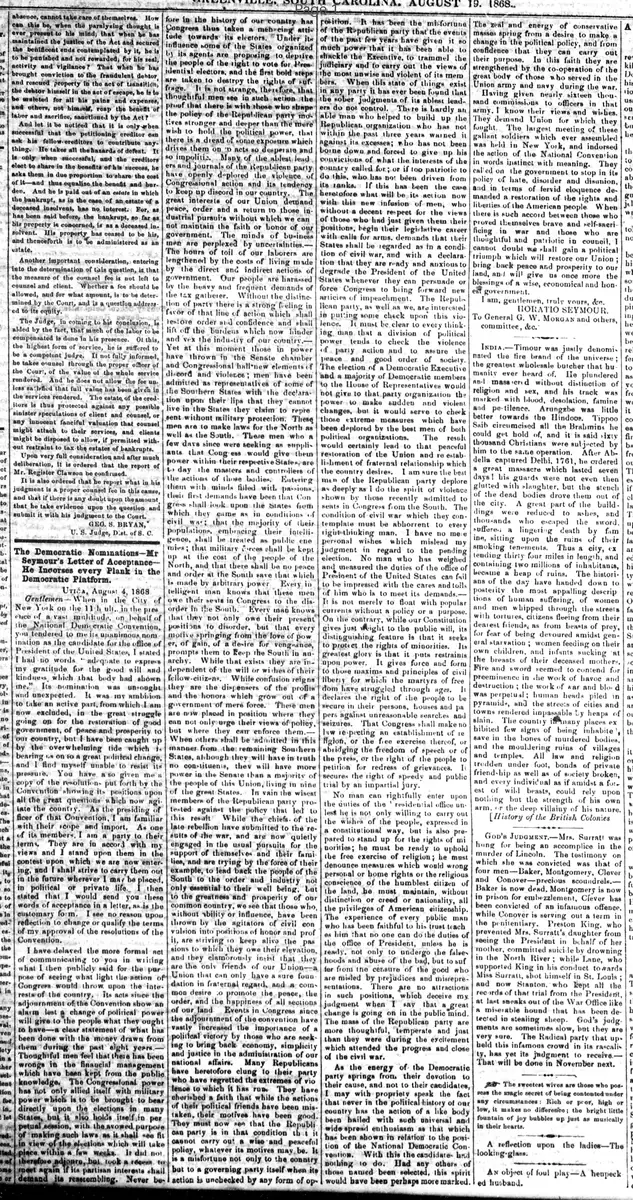
The Democratic Nominations—Mr. Seymour's Letter of Acceptance—
He Endorses every Plank in the Democratic Platform.
Utica, August 4, 1868.
Gentlemen—When in the City of New York on the 11th ult., in the presence of a vast multitude, on behalf of the National Democratic Convention, you tendered to me its unanimous nomination as the candidate for the office of President of the United States, I stated I had no words adequate to express my gratitude for the good will and kindness which that body had shown me. Its nomination was unsought and unexpected. It was my ambition to take an active part, from which I am now excluded, in the great struggle going on for the restoration of good government, of peace and prosperity to our country, but I have been caught up by the overwhelming tide which is bearing us on to a great political change, and I find myself unable to resist its pressure. You have also given me a copy of the resolutions put forth by the Convention showing its positions upon all the great questions which now agitate the country. As the presiding officer of that Convention, I am familiar with their scope and import. As one of its members, I am a party to their terms. They are in accord with my views and I stand upon them in the contest upon which we are now entering, and I shall strive to carry them out in the future wherever I may be placed, in political or private life. I then stated that I would send you these words of acceptance in a letter, as is the customary form. I see no reason upon reflection to change or qualify the terms of my approval of the resolutions of the Convention.
I have delayed the more formal act of communicating to you in writing what I then publicly said for the purpose of seeing what light the action of Congress would throw upon the interests of the country. Its acts since the adjournment of the Convention show an alarm lest a change of political power will give to the people what they ought to have—a clear statement of what has been done with the money drawn from them during the past eight years. Thoughtful men feel that there has been wrongs in the financial management which have been kept from the public knowledge. The Congressional power has not only allied itself with military power which is to be brought to bear directly upon the elections in many States, but it also holds itself in perpetual session, with the avowed purpose of making such laws as it shall see fit in view of the elections which will take place within a few weeks. It did not, therefore, adjourn, but took a recess, to meet again if its partisan interests shall demand its reassembling. Never before in the history of our country has Congress thus taken a menacing attitude towards its electors. Under its influence some of the States organized by its agents are proposing to deprive the people of the right to vote for Presidential electors, and the first bold steps are taken to destroy the rights of suffrage. It is not strange, therefore, that thoughtful men see in such action the proof that there is with those who shape the policy of the Republican party motives stronger and deeper than the mere wish to hold the political power, that there is a dread of some exposure which drives them on to acts so desperate and so impolitic. Many of the ablest leaders and journals of the Republican party have openly deplored this violence of Congressional action and its tendency to keep up discord in our country. The great interests of our Union demand peace, order and a return to those industrial pursuits without which we can not maintain the faith or honor of our government. The minds of business men are perplexed by uncertainties. The hours of toil of our laborers are lengthened by the costs of living made by the direct and indirect actions of government. Our people are harassed by the heavy and frequent demands of the tax gatherer. Without the distinction of party there is a strong feeling in favor of that line of action which shall restore order and confidence and shall lift off the burdens which now hinder and vex the industry of our country.
Yet at this moment those in power have thrown in the Senate chamber and Congressional hall new elements of discord and violence: men have been admitted as representatives of some of the Southern States with the declaration upon their lips that they 'cannot live in the States they claim to represent without military protection.' These men are to make laws for the North as well as the South. These men who a few days since were seeking as suppliants that Congress would give them power within their respective States, are to-day the masters and controllers of the actions of those bodies. Entering them with minds filled with passions, their first demands have been that Congress shall look upon the States from which they came as in conditions of civil war; that the majority of their populations, embracing their intelligence, shall be treated as public enemies; that military forces shall be kept up at the cost of the people of the North, and that there shall be no peace and order at the South save that which is made by arbitrary power. Every intelligent man knows that these men owe their seats in Congress to the disorder in the South. Every man knows that they not only owe their present positions to disorder, but that every motive springing from the love of power, of gain, of a desire for vengeance, prompts them to keep the South in anarchy. While that exists they are independent of the will or wishes of their fellow-citizens. While confusion reigns they are the dispensers of the profits and the honors which grow out of a government of mere force. These men are now placed in position where they can not only urge their views of policy, but where they can enforce them. When others shall be admitted in this manner from the remaining Southern States, although they will have in truth no constituents, they will have more power in the Senate than a majority of the people of this Union, living in nine of the great States. In vain the wisest members of the Republican party protested against the policy that led to this result. While the chiefs of the late rebellion have submitted to the results of the war, and are now quietly engaged in the usual pursuits for the support of themselves and their families, and are trying by the force of their example, to lead back the people of the South to the order and industry not only essential to their well being, but to the greatness and prosperity of our common country, we see that those who, without ability or influence, have been thrown by the agitators of civil convulsion into positions of honor and profit, are striving to keep alive the passions to which they owe their elevation, and they clamorously insist that they are the only friends of our Union—a Union that can only have a sure foundation in fraternal regard, and a common desire to promote the peace, the order, and the happiness of all sections of our land. Events in Congress since the adjournment of the convention have vastly increased the importance of a political victory by those who are seeking to bring back economy, simplicity and justice in the administration of our national affairs. Many Republicans have heretofore clung to their party who have regretted the extremes of violence to which it has run. They have cherished a faith that while the actions of their political friends have been mistaken, their motives have been good. They must now see that the Republican party is in that condition that it cannot carry out a wise and peaceful policy, whatever its motives may be. It is a misfortune not only to the country but to that party itself that the events of the past few years have given it so much power that it has been able to shackle the Executive, to trammel the judiciary and to carry out the views of the most unwise and violent of its members. When this state of things exist in any party it has ever been found that the sober judgments of its ablest leaders do not control. There is hardly an able man who helped to build up the Republican organization who has not within the past three years warned it against its excesses; he has not been borne down and forced to give up his convictions of what the interests of the country called for; or if too patriotic to do this, who has not been driven from its ranks. If this has been the case heretofore what will be its action now with this new infusion of men, who without a decent respect for the views of those who had just given them their positions, begin their legislative career with calls for arms, demands that their States shall be regarded as in a condition of civil war, and with a declaration that they are ready and anxious to degrade the President of the United States whenever they can persuade or force Congress to bring forward new articles of impeachment. The Republican party, as well as we, are interested in putting some check upon this violence. It must be clear to every thinking man, that a division of political power tends to check the violence of party action and to assure the peace and good order of society. The election of a Democratic Executive and a majority of Democratic members to the House of Representatives would not give to that party organization the power to make sudden and violent changes, but it would serve to check those extreme measures which have been deplored by the best men of both political organizations. The result would certainly lead to that peaceful restoration of the Union and re-establishment of fraternal relationship which the country desires. I am sure the best men of the Republican party deplore as deeply as I do the spirit of violence shown by those recently admitted to seats in Congress from the South. The condition of civil war which they contemplate must be abhorrent to every right thinking man. I have no mere personal wishes which mislead my judgment in regard to the pending election. No man who has weighed and measured the duties of the office of President of the United States can fail to be impressed with the cares and toils of him who is to meet its demands. It is not merely to float with popular currents without a policy or a purpose. On the contrary, while our Constitution gives just weight to the public will, its distinguishing feature is that it seeks to protect the rights of minorities. Its greatest glory is that it puts restraints upon power. It gives force and form to those maxims and principles of civil liberty for which the martyrs of freedom have struggled through ages. It declares the right of the people to be secure in their persons, houses and papers against unreasonable searches and seizures. That Congress shall make no law respecting an establishment of religion, or the free exercise thereof, or abridging the freedom of speech or of the press, or the right of the people to petition for redress of grievances. It secures the right of speedy and public trial by an impartial jury.
No man can rightfully enter upon the duties of the Presidential office unless he is not only willing to carry out the wishes of the people, expressed in a constitutional way, but is also prepared to stand up for the rights of minorities; he must be ready to uphold the free exercise of religion; he must denounce measures which would wrong personal or home rights or the religious conscience of the humblest citizen of the land, he must maintain, without distinction of creed or nationality, all the privileges of American citizenship. The experience of every public man who has been faithful to his trust teaches him that no one can do the duties of the office of President, unless he is ready, not only to undergo the falsehoods and abuse of the bad, but to suffer from the censure of the good who are misled by prejudices and misrepresentations. There are no attractions in such positions, which deceive my judgment when I say that a great change is going on in the public mind. The mass of the Republican party are more thoughtful, temperate and just than they were during the excitement which attended the progress and close of the civil war.
As the energy of the Democratic party springs from their devotion to their cause, and not to their candidates, I may with propriety speak the fact that never in the political history of our country has the action of a like body been hailed with such universal and wide spread enthusiasm as that which has been shown in relation to the position of the National Democratic Convention. With this the candidates had nothing to do. Had any others of those named been selected, this spirit would have been perhaps more marked.
The zeal and energy of conservative masses spring from a desire to make a change in the political policy, and from confidence that they can carry out their purpose. In this faith they are strengthened by the co-operation of the great body of those who served in the Union army and navy during the war. Having given nearly sixteen thousand commissions to officers in that army, I know their views and wishes. They demand Union for which they fought. The largest meeting of these gallant soldiers which ever assembled was held in New York, and indorsed the action of the National Convention in words instinct with meaning. They called on the government to stop in its policy of hate, disorder and disunion, and in terms of fervid eloquence demanded a restoration of the rights and liberties of the American people. When there is such accord between those who proved themselves brave and self-sacrificing in war and those who are thoughtful and patriotic in council, I cannot doubt we shall gain a political triumph which will restore our Union; bring back peace and prosperity to our land, and will give us once more the blessings of a wise, economical and honest government.
I am, gentlemen, truly yours, &c.
HORATIO SEYMOUR.
To General G. W. Morgan and others, committee, &c.
He Endorses every Plank in the Democratic Platform.
Utica, August 4, 1868.
Gentlemen—When in the City of New York on the 11th ult., in the presence of a vast multitude, on behalf of the National Democratic Convention, you tendered to me its unanimous nomination as the candidate for the office of President of the United States, I stated I had no words adequate to express my gratitude for the good will and kindness which that body had shown me. Its nomination was unsought and unexpected. It was my ambition to take an active part, from which I am now excluded, in the great struggle going on for the restoration of good government, of peace and prosperity to our country, but I have been caught up by the overwhelming tide which is bearing us on to a great political change, and I find myself unable to resist its pressure. You have also given me a copy of the resolutions put forth by the Convention showing its positions upon all the great questions which now agitate the country. As the presiding officer of that Convention, I am familiar with their scope and import. As one of its members, I am a party to their terms. They are in accord with my views and I stand upon them in the contest upon which we are now entering, and I shall strive to carry them out in the future wherever I may be placed, in political or private life. I then stated that I would send you these words of acceptance in a letter, as is the customary form. I see no reason upon reflection to change or qualify the terms of my approval of the resolutions of the Convention.
I have delayed the more formal act of communicating to you in writing what I then publicly said for the purpose of seeing what light the action of Congress would throw upon the interests of the country. Its acts since the adjournment of the Convention show an alarm lest a change of political power will give to the people what they ought to have—a clear statement of what has been done with the money drawn from them during the past eight years. Thoughtful men feel that there has been wrongs in the financial management which have been kept from the public knowledge. The Congressional power has not only allied itself with military power which is to be brought to bear directly upon the elections in many States, but it also holds itself in perpetual session, with the avowed purpose of making such laws as it shall see fit in view of the elections which will take place within a few weeks. It did not, therefore, adjourn, but took a recess, to meet again if its partisan interests shall demand its reassembling. Never before in the history of our country has Congress thus taken a menacing attitude towards its electors. Under its influence some of the States organized by its agents are proposing to deprive the people of the right to vote for Presidential electors, and the first bold steps are taken to destroy the rights of suffrage. It is not strange, therefore, that thoughtful men see in such action the proof that there is with those who shape the policy of the Republican party motives stronger and deeper than the mere wish to hold the political power, that there is a dread of some exposure which drives them on to acts so desperate and so impolitic. Many of the ablest leaders and journals of the Republican party have openly deplored this violence of Congressional action and its tendency to keep up discord in our country. The great interests of our Union demand peace, order and a return to those industrial pursuits without which we can not maintain the faith or honor of our government. The minds of business men are perplexed by uncertainties. The hours of toil of our laborers are lengthened by the costs of living made by the direct and indirect actions of government. Our people are harassed by the heavy and frequent demands of the tax gatherer. Without the distinction of party there is a strong feeling in favor of that line of action which shall restore order and confidence and shall lift off the burdens which now hinder and vex the industry of our country.
Yet at this moment those in power have thrown in the Senate chamber and Congressional hall new elements of discord and violence: men have been admitted as representatives of some of the Southern States with the declaration upon their lips that they 'cannot live in the States they claim to represent without military protection.' These men are to make laws for the North as well as the South. These men who a few days since were seeking as suppliants that Congress would give them power within their respective States, are to-day the masters and controllers of the actions of those bodies. Entering them with minds filled with passions, their first demands have been that Congress shall look upon the States from which they came as in conditions of civil war; that the majority of their populations, embracing their intelligence, shall be treated as public enemies; that military forces shall be kept up at the cost of the people of the North, and that there shall be no peace and order at the South save that which is made by arbitrary power. Every intelligent man knows that these men owe their seats in Congress to the disorder in the South. Every man knows that they not only owe their present positions to disorder, but that every motive springing from the love of power, of gain, of a desire for vengeance, prompts them to keep the South in anarchy. While that exists they are independent of the will or wishes of their fellow-citizens. While confusion reigns they are the dispensers of the profits and the honors which grow out of a government of mere force. These men are now placed in position where they can not only urge their views of policy, but where they can enforce them. When others shall be admitted in this manner from the remaining Southern States, although they will have in truth no constituents, they will have more power in the Senate than a majority of the people of this Union, living in nine of the great States. In vain the wisest members of the Republican party protested against the policy that led to this result. While the chiefs of the late rebellion have submitted to the results of the war, and are now quietly engaged in the usual pursuits for the support of themselves and their families, and are trying by the force of their example, to lead back the people of the South to the order and industry not only essential to their well being, but to the greatness and prosperity of our common country, we see that those who, without ability or influence, have been thrown by the agitators of civil convulsion into positions of honor and profit, are striving to keep alive the passions to which they owe their elevation, and they clamorously insist that they are the only friends of our Union—a Union that can only have a sure foundation in fraternal regard, and a common desire to promote the peace, the order, and the happiness of all sections of our land. Events in Congress since the adjournment of the convention have vastly increased the importance of a political victory by those who are seeking to bring back economy, simplicity and justice in the administration of our national affairs. Many Republicans have heretofore clung to their party who have regretted the extremes of violence to which it has run. They have cherished a faith that while the actions of their political friends have been mistaken, their motives have been good. They must now see that the Republican party is in that condition that it cannot carry out a wise and peaceful policy, whatever its motives may be. It is a misfortune not only to the country but to that party itself that the events of the past few years have given it so much power that it has been able to shackle the Executive, to trammel the judiciary and to carry out the views of the most unwise and violent of its members. When this state of things exist in any party it has ever been found that the sober judgments of its ablest leaders do not control. There is hardly an able man who helped to build up the Republican organization who has not within the past three years warned it against its excesses; he has not been borne down and forced to give up his convictions of what the interests of the country called for; or if too patriotic to do this, who has not been driven from its ranks. If this has been the case heretofore what will be its action now with this new infusion of men, who without a decent respect for the views of those who had just given them their positions, begin their legislative career with calls for arms, demands that their States shall be regarded as in a condition of civil war, and with a declaration that they are ready and anxious to degrade the President of the United States whenever they can persuade or force Congress to bring forward new articles of impeachment. The Republican party, as well as we, are interested in putting some check upon this violence. It must be clear to every thinking man, that a division of political power tends to check the violence of party action and to assure the peace and good order of society. The election of a Democratic Executive and a majority of Democratic members to the House of Representatives would not give to that party organization the power to make sudden and violent changes, but it would serve to check those extreme measures which have been deplored by the best men of both political organizations. The result would certainly lead to that peaceful restoration of the Union and re-establishment of fraternal relationship which the country desires. I am sure the best men of the Republican party deplore as deeply as I do the spirit of violence shown by those recently admitted to seats in Congress from the South. The condition of civil war which they contemplate must be abhorrent to every right thinking man. I have no mere personal wishes which mislead my judgment in regard to the pending election. No man who has weighed and measured the duties of the office of President of the United States can fail to be impressed with the cares and toils of him who is to meet its demands. It is not merely to float with popular currents without a policy or a purpose. On the contrary, while our Constitution gives just weight to the public will, its distinguishing feature is that it seeks to protect the rights of minorities. Its greatest glory is that it puts restraints upon power. It gives force and form to those maxims and principles of civil liberty for which the martyrs of freedom have struggled through ages. It declares the right of the people to be secure in their persons, houses and papers against unreasonable searches and seizures. That Congress shall make no law respecting an establishment of religion, or the free exercise thereof, or abridging the freedom of speech or of the press, or the right of the people to petition for redress of grievances. It secures the right of speedy and public trial by an impartial jury.
No man can rightfully enter upon the duties of the Presidential office unless he is not only willing to carry out the wishes of the people, expressed in a constitutional way, but is also prepared to stand up for the rights of minorities; he must be ready to uphold the free exercise of religion; he must denounce measures which would wrong personal or home rights or the religious conscience of the humblest citizen of the land, he must maintain, without distinction of creed or nationality, all the privileges of American citizenship. The experience of every public man who has been faithful to his trust teaches him that no one can do the duties of the office of President, unless he is ready, not only to undergo the falsehoods and abuse of the bad, but to suffer from the censure of the good who are misled by prejudices and misrepresentations. There are no attractions in such positions, which deceive my judgment when I say that a great change is going on in the public mind. The mass of the Republican party are more thoughtful, temperate and just than they were during the excitement which attended the progress and close of the civil war.
As the energy of the Democratic party springs from their devotion to their cause, and not to their candidates, I may with propriety speak the fact that never in the political history of our country has the action of a like body been hailed with such universal and wide spread enthusiasm as that which has been shown in relation to the position of the National Democratic Convention. With this the candidates had nothing to do. Had any others of those named been selected, this spirit would have been perhaps more marked.
The zeal and energy of conservative masses spring from a desire to make a change in the political policy, and from confidence that they can carry out their purpose. In this faith they are strengthened by the co-operation of the great body of those who served in the Union army and navy during the war. Having given nearly sixteen thousand commissions to officers in that army, I know their views and wishes. They demand Union for which they fought. The largest meeting of these gallant soldiers which ever assembled was held in New York, and indorsed the action of the National Convention in words instinct with meaning. They called on the government to stop in its policy of hate, disorder and disunion, and in terms of fervid eloquence demanded a restoration of the rights and liberties of the American people. When there is such accord between those who proved themselves brave and self-sacrificing in war and those who are thoughtful and patriotic in council, I cannot doubt we shall gain a political triumph which will restore our Union; bring back peace and prosperity to our land, and will give us once more the blessings of a wise, economical and honest government.
I am, gentlemen, truly yours, &c.
HORATIO SEYMOUR.
To General G. W. Morgan and others, committee, &c.
What sub-type of article is it?
Historical Event
Biography
What themes does it cover?
Justice
Triumph
Moral Virtue
What keywords are associated?
Democratic Nomination
Horatio Seymour
Presidential Acceptance
Republican Criticism
Union Restoration
Congressional Actions
Civil War Aftermath
What entities or persons were involved?
Horatio Seymour
General G. W. Morgan
Where did it happen?
Utica, New York
Story Details
Key Persons
Horatio Seymour
General G. W. Morgan
Location
Utica, New York
Event Date
August 4, 1868
Story Details
Horatio Seymour accepts the Democratic nomination for President, endorses the platform, delays response to observe Congress, criticizes Republican policies on finances, elections, and Southern representation, advocates for constitutional rights, peace, and Union restoration, supported by Union veterans.