Thank you for visiting SNEWPapers!
Sign up free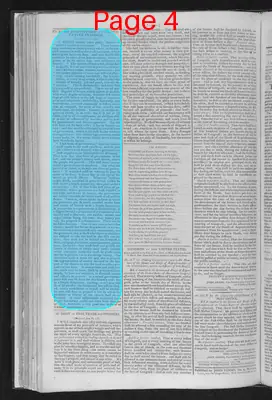
Editorial
October 14, 1789
Gazette Of The United States
New York, New York County, New York
What is this article about?
This editorial continuation critiques an author's views on luxury leading to tyranny, arguing that human nature inherently tends toward tyranny regardless of luxury. It defends mixed government as best for restraining luxury and securing liberty, contrasting it with simple democracy where luxury and emulation flourish unchecked, using Athens as an example.
Clipping
OCR Quality
98%
Excellent
Full Text
The Right Constitution of a Commonwealth.
WEALTH EXAMINED,
(in continuation.)
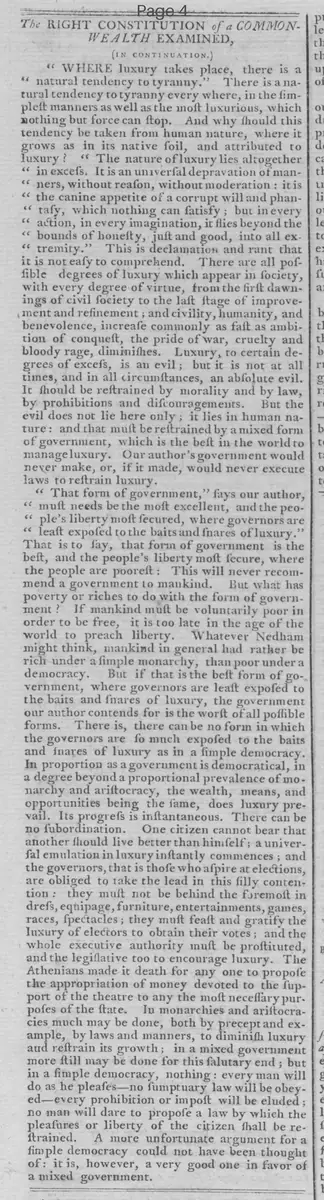
"WHERE luxury takes place, there is a natural tendency to tyranny." There is a natural tendency to tyranny every where, in the simplest manners as well as the most luxurious, which nothing but force can stop. And why should this tendency be taken from human nature, where it grows as in its native soil, and attributed to luxury? "The nature of luxury lies altogether in excess. It is a universal depravation of manners, without reason, without moderation: it is the canine appetite of a corrupt will and phantasy, which nothing can satisfy; but in every action, in every imagination, it flies beyond the bounds of honesty, just and good, into all extremity." This is declamation and rant that it is not easy to comprehend. There are all possible degrees of luxury which appear in society, with every degree of virtue, from the first dawnings of civil society to the last stage of improvement and refinement; and civility, humanity, and benevolence, increase commonly as fast as ambition of conquest, the pride of war, cruelty and bloody rage, diminishes. Luxury, to certain degrees of excess, is an evil; but it is not at all times, and in all circumstances, an absolute evil. It should be restrained by morality and by law, by prohibitions and discouragements. But the evil does not lie here only; it lies in human nature: and that must be restrained by a mixed form of government, which is the best in the world to manage luxury. Our author's government would never make, or, if it made, would never execute laws to restrain luxury.
"That form of government," says our author, "must needs be the most excellent, and the people's liberty most secured, where governors are least exposed to the baits and snares of luxury." That is to say, that form of government is the best, and the people's liberty most secure, where the people are poorest: This will never recommend a government to mankind. But what has poverty or riches to do with the form of government? If mankind must be voluntarily poor in order to be free, it is too late in the age of the world to preach liberty. Whatever Nedham might think, mankind in general had rather be rich under a simple monarchy, than poor under a democracy. But if that is the best form of government, where governors are least exposed to the baits and snares of luxury, the government our author contends for is the worst of all possible forms. There is, there can be no form in which the governors are so much exposed to the baits and snares of luxury as in a simple democracy. In proportion as a government is democratical, in a degree beyond a proportional prevalence of monarchy and aristocracy, the wealth, means, and opportunities being the same, does luxury prevail. Its progress is instantaneous. There can be no subordination. One citizen cannot bear that another should live better than himself: a universal emulation in luxury instantly commences; and the governors, that is those who aspire at elections, are obliged to take the lead in this silly contention: they must not be behind the foremost in dress, equipage, furniture, entertainments, games, races, spectacles; they must feast and gratify the luxury of electors to obtain their votes; and the whole executive authority must be prostituted, and the legislative too to encourage luxury. The Athenians made it death for any one to propose the appropriation of money devoted to the support of the theatre to any the most necessary purposes of the state. In monarchies and aristocracies much may be done, both by precept and example, by laws and manners, to diminish luxury and restrain its growth; in a mixed government more still may be done for this salutary end; but in a simple democracy, nothing: every man will do as he pleases—no sumptuary law will be obeyed—every prohibition or impost will be eluded; no man will dare to propose a law by which the pleasures or liberty of the citizen shall be restrained. A more unfortunate argument for a simple democracy could not have been thought of: it is, however, a very good one in favor of a mixed government.
WEALTH EXAMINED,
(in continuation.)
"WHERE luxury takes place, there is a natural tendency to tyranny." There is a natural tendency to tyranny every where, in the simplest manners as well as the most luxurious, which nothing but force can stop. And why should this tendency be taken from human nature, where it grows as in its native soil, and attributed to luxury? "The nature of luxury lies altogether in excess. It is a universal depravation of manners, without reason, without moderation: it is the canine appetite of a corrupt will and phantasy, which nothing can satisfy; but in every action, in every imagination, it flies beyond the bounds of honesty, just and good, into all extremity." This is declamation and rant that it is not easy to comprehend. There are all possible degrees of luxury which appear in society, with every degree of virtue, from the first dawnings of civil society to the last stage of improvement and refinement; and civility, humanity, and benevolence, increase commonly as fast as ambition of conquest, the pride of war, cruelty and bloody rage, diminishes. Luxury, to certain degrees of excess, is an evil; but it is not at all times, and in all circumstances, an absolute evil. It should be restrained by morality and by law, by prohibitions and discouragements. But the evil does not lie here only; it lies in human nature: and that must be restrained by a mixed form of government, which is the best in the world to manage luxury. Our author's government would never make, or, if it made, would never execute laws to restrain luxury.
"That form of government," says our author, "must needs be the most excellent, and the people's liberty most secured, where governors are least exposed to the baits and snares of luxury." That is to say, that form of government is the best, and the people's liberty most secure, where the people are poorest: This will never recommend a government to mankind. But what has poverty or riches to do with the form of government? If mankind must be voluntarily poor in order to be free, it is too late in the age of the world to preach liberty. Whatever Nedham might think, mankind in general had rather be rich under a simple monarchy, than poor under a democracy. But if that is the best form of government, where governors are least exposed to the baits and snares of luxury, the government our author contends for is the worst of all possible forms. There is, there can be no form in which the governors are so much exposed to the baits and snares of luxury as in a simple democracy. In proportion as a government is democratical, in a degree beyond a proportional prevalence of monarchy and aristocracy, the wealth, means, and opportunities being the same, does luxury prevail. Its progress is instantaneous. There can be no subordination. One citizen cannot bear that another should live better than himself: a universal emulation in luxury instantly commences; and the governors, that is those who aspire at elections, are obliged to take the lead in this silly contention: they must not be behind the foremost in dress, equipage, furniture, entertainments, games, races, spectacles; they must feast and gratify the luxury of electors to obtain their votes; and the whole executive authority must be prostituted, and the legislative too to encourage luxury. The Athenians made it death for any one to propose the appropriation of money devoted to the support of the theatre to any the most necessary purposes of the state. In monarchies and aristocracies much may be done, both by precept and example, by laws and manners, to diminish luxury and restrain its growth; in a mixed government more still may be done for this salutary end; but in a simple democracy, nothing: every man will do as he pleases—no sumptuary law will be obeyed—every prohibition or impost will be eluded; no man will dare to propose a law by which the pleasures or liberty of the citizen shall be restrained. A more unfortunate argument for a simple democracy could not have been thought of: it is, however, a very good one in favor of a mixed government.
What sub-type of article is it?
Constitutional
Moral Or Religious
What keywords are associated?
Mixed Government
Simple Democracy
Luxury And Tyranny
Government Forms
Sumptuary Laws
Human Nature
What entities or persons were involved?
Nedham
Athenians
Editorial Details
Primary Topic
Critique Of Luxury's Role In Government And Advocacy For Mixed Government Over Simple Democracy
Stance / Tone
Argumentative Defense Of Mixed Government Against Simple Democracy
Key Figures
Nedham
Athenians
Key Arguments
Human Nature Inherently Tends To Tyranny, Not Just Luxury.
Luxury Exists In Degrees And Can Coexist With Virtue; It Should Be Restrained By Mixed Government.
Simple Democracy Exposes Governors Most To Luxury's Snares, Leading To Emulation And Unrestrained Excess.
Mixed Government Best Manages Luxury Through Laws And Manners.
Athenians Exemplified Democracy's Prioritization Of Luxury Over State Needs.