Thank you for visiting SNEWPapers!
Sign up free
Literary
April 22, 1828
Lancaster Gazette
Lancaster, Worcester County, Massachusetts
What is this article about?
Biographical sketch of explorer John Ledyard, born 1751 in Groton, CT, covering his education at Dartmouth, adventurous escape by canoe, brief theological studies, sea voyages, enlistment, and joining Captain Cook's third voyage, abstracted from Jared Sparks' recent biography, highlighting his romantic genius and American enterprise.
Clipping
OCR Quality
95%
Excellent
Full Text
BIOGRAPHICAL.
JOHN LEDYARD.
A life of this celebrated traveller, by Jared Sparks, has recently been presented to the publick, and few works of the kind have been better received or excited more general interest. The style of narration is admirably simple and unaffected, and the just and impartial exposition which it affords of the character of Mr. Ledyard reflects credit on the biographer and his remarkable subject. All Americans who feel the pride of enterprise, (and who does not?) will derive great satisfaction from the perusal of this volume. With this impression, and presuming that there are few of our readers into whose hands the book may not fall, we have taken some pains to abstract from it the following brief sketch of the prominent features of Mr. Ledyard's eventful life: which hereafter we shall make extracts in further illustration of his character:
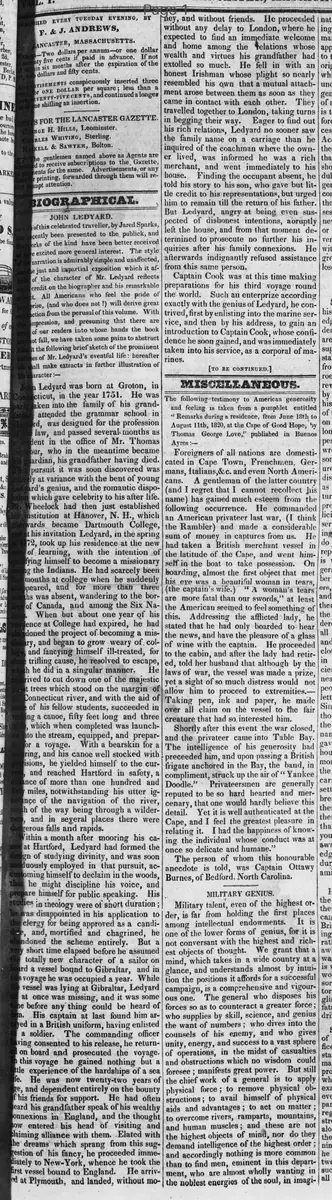
John Ledyard was born at Groton, in Connecticut, in the year 1751. He was taken into the family of his grandfather, and attended the grammar school in Groton. He was designed for the profession of law, and passed several months as a student in the office of Mr. Thomas Grosvenor, who in the meantime became his guardian, his grandfather having died. But in this pursuit it was soon discovered was wholly at variance with the bent of young Ledyard's genius, and the romantic disposition which gave celebrity to his after life. President Wheelock had then just established his institution at Hanover, N. H., which afterwards became Dartmouth College, and at his invitation Ledyard, in the spring of 1772, took up his residence at the new seat of learning, with the intention of qualifying himself to become a missionary among the Indians. He had scarcely been three months at college when he suddenly disappeared, and for more than three months was absent, wandering to the borders of Canada, and among the Six Nations. When but about one year of his residence at College had expired, he had abandoned the project of becoming a missionary, and began to grow weary of college discipline, and fancying himself ill-treated, for trifling cause, he resolved to escape, which he did in a singular manner. He contrived to cut down one of the majestic white trees which stood on the margin of Connecticut river, and with the aid of some of his fellow students, succeeded in forming a canoe, fifty feet long and three feet wide, which when completed was launched into the stream, equipped, and prepared for a voyage. With a bearskin for a covering, and his canoe well stocked with provisions, he yielded himself to the current, and reached Hartford in safety, a distance of more than one hundred and fifty miles, notwithstanding his utter ignorance of the navigation of the river, much of the way being through a wilderness, and in several places there were dangerous falls and rapids. Within a month after mooring his canoe at Hartford, Ledyard had formed the design of studying divinity, and was soon assiduously employed in that pursuit, accustomed himself to declaim in the woods, that he might discipline his voice, and prepare himself for public speaking. His studies in theology were of short duration; he was disappointed in his application to the clergy for being approved as a candidate, and, mortified and chagrined, he abandoned the scheme entirely. But a very short time elapsed before he assumed a totally new character of a sailor on board a vessel bound to Gibraltar, and in this voyage he was occupied a year. While the vessel was lying at Gibraltar, Ledyard at once was missing, and it was some time before any thing could be heard of him. His captain at last found him arrayed in a British uniform, having enlisted as a soldier. The commanding officer having consented to his release, he returned on board and prosecuted the voyage. In this voyage he gained nothing but a little experience of the hardships of a sea life. He was now twenty-two years of age, and dependent entirely on the bounty of his friends for support. He had often heard his grandfather speak of his wealthy connexions in England, and the thought now entered his head of visiting and claiming alliance with them. Elated with the dreams which sprang from this suggestion of his fancy, he proceeded immediately to New-York, whence he took the first vessel bound to England. He arrived at Plymouth, and landed, without money, and without friends. He proceeded without any delay to London, where he expected to find an immediate welcome and home among the relations whose wealth and virtues his grandfather had extolled so much. He fell in with an honest Irishman whose plight so nearly resembled his own that a mutual attachment arose between them as soon as they came in contact with each other. They travelled together to London, taking turns in begging their way. Eager to find out his rich relations, Ledyard no sooner saw the family name on a carriage than he inquired of the coachman where the owner lived, was informed he was a rich merchant, and went immediately to his house. Finding the occupant absent, he told his story to his son, who gave but little credit to his representations, but urged him to remain till the return of his father. But Ledyard, angry at being even suspected of dishonest intentions, abruptly left the house, and from that moment determined to prosecute no further his inquiries after his family connexions. He afterwards indignantly refused assistance from this same person. Captain Cook was at this time making preparations for his third voyage round the world. Such an enterprize according exactly with the genius of Ledyard, he contrived, first by enlisting into the marine service, and then by his address, to gain an introduction to Captain Cook, whose confidence he soon gained, and was immediately taken into his service, as a corporal of marines.
[TO BE CONTINUED.]
JOHN LEDYARD.
A life of this celebrated traveller, by Jared Sparks, has recently been presented to the publick, and few works of the kind have been better received or excited more general interest. The style of narration is admirably simple and unaffected, and the just and impartial exposition which it affords of the character of Mr. Ledyard reflects credit on the biographer and his remarkable subject. All Americans who feel the pride of enterprise, (and who does not?) will derive great satisfaction from the perusal of this volume. With this impression, and presuming that there are few of our readers into whose hands the book may not fall, we have taken some pains to abstract from it the following brief sketch of the prominent features of Mr. Ledyard's eventful life: which hereafter we shall make extracts in further illustration of his character:
John Ledyard was born at Groton, in Connecticut, in the year 1751. He was taken into the family of his grandfather, and attended the grammar school in Groton. He was designed for the profession of law, and passed several months as a student in the office of Mr. Thomas Grosvenor, who in the meantime became his guardian, his grandfather having died. But in this pursuit it was soon discovered was wholly at variance with the bent of young Ledyard's genius, and the romantic disposition which gave celebrity to his after life. President Wheelock had then just established his institution at Hanover, N. H., which afterwards became Dartmouth College, and at his invitation Ledyard, in the spring of 1772, took up his residence at the new seat of learning, with the intention of qualifying himself to become a missionary among the Indians. He had scarcely been three months at college when he suddenly disappeared, and for more than three months was absent, wandering to the borders of Canada, and among the Six Nations. When but about one year of his residence at College had expired, he had abandoned the project of becoming a missionary, and began to grow weary of college discipline, and fancying himself ill-treated, for trifling cause, he resolved to escape, which he did in a singular manner. He contrived to cut down one of the majestic white trees which stood on the margin of Connecticut river, and with the aid of some of his fellow students, succeeded in forming a canoe, fifty feet long and three feet wide, which when completed was launched into the stream, equipped, and prepared for a voyage. With a bearskin for a covering, and his canoe well stocked with provisions, he yielded himself to the current, and reached Hartford in safety, a distance of more than one hundred and fifty miles, notwithstanding his utter ignorance of the navigation of the river, much of the way being through a wilderness, and in several places there were dangerous falls and rapids. Within a month after mooring his canoe at Hartford, Ledyard had formed the design of studying divinity, and was soon assiduously employed in that pursuit, accustomed himself to declaim in the woods, that he might discipline his voice, and prepare himself for public speaking. His studies in theology were of short duration; he was disappointed in his application to the clergy for being approved as a candidate, and, mortified and chagrined, he abandoned the scheme entirely. But a very short time elapsed before he assumed a totally new character of a sailor on board a vessel bound to Gibraltar, and in this voyage he was occupied a year. While the vessel was lying at Gibraltar, Ledyard at once was missing, and it was some time before any thing could be heard of him. His captain at last found him arrayed in a British uniform, having enlisted as a soldier. The commanding officer having consented to his release, he returned on board and prosecuted the voyage. In this voyage he gained nothing but a little experience of the hardships of a sea life. He was now twenty-two years of age, and dependent entirely on the bounty of his friends for support. He had often heard his grandfather speak of his wealthy connexions in England, and the thought now entered his head of visiting and claiming alliance with them. Elated with the dreams which sprang from this suggestion of his fancy, he proceeded immediately to New-York, whence he took the first vessel bound to England. He arrived at Plymouth, and landed, without money, and without friends. He proceeded without any delay to London, where he expected to find an immediate welcome and home among the relations whose wealth and virtues his grandfather had extolled so much. He fell in with an honest Irishman whose plight so nearly resembled his own that a mutual attachment arose between them as soon as they came in contact with each other. They travelled together to London, taking turns in begging their way. Eager to find out his rich relations, Ledyard no sooner saw the family name on a carriage than he inquired of the coachman where the owner lived, was informed he was a rich merchant, and went immediately to his house. Finding the occupant absent, he told his story to his son, who gave but little credit to his representations, but urged him to remain till the return of his father. But Ledyard, angry at being even suspected of dishonest intentions, abruptly left the house, and from that moment determined to prosecute no further his inquiries after his family connexions. He afterwards indignantly refused assistance from this same person. Captain Cook was at this time making preparations for his third voyage round the world. Such an enterprize according exactly with the genius of Ledyard, he contrived, first by enlisting into the marine service, and then by his address, to gain an introduction to Captain Cook, whose confidence he soon gained, and was immediately taken into his service, as a corporal of marines.
[TO BE CONTINUED.]
What sub-type of article is it?
Essay
What themes does it cover?
Patriotism
Liberty Freedom
What keywords are associated?
John Ledyard
Biography
Travel
Adventure
Dartmouth College
Captain Cook
American Enterprise
Literary Details
Title
Biographical. John Ledyard.
Subject
Life Of John Ledyard
Key Lines
He Contrived To Cut Down One Of The Majestic White Trees Which Stood On The Margin Of Connecticut River, And With The Aid Of Some Of His Fellow Students, Succeeded In Forming A Canoe, Fifty Feet Long And Three Feet Wide, Which When Completed Was Launched Into The Stream, Equipped, And Prepared For A Voyage.
With A Bearskin For A Covering, And His Canoe Well Stocked With Provisions, He Yielded Himself To The Current, And Reached Hartford In Safety, A Distance Of More Than One Hundred And Fifty Miles...
Captain Cook Was At This Time Making Preparations For His Third Voyage Round The World. Such An Enterprize According Exactly With The Genius Of Ledyard...