Thank you for visiting SNEWPapers!
Sign up free
The Arizona Sentinel
Yuma, Arizona City, Yuma County, Arizona
What is this article about?
George N. Burton describes the untapped potential of the Yuma region, emphasizing its extraordinarily fertile soil from ancient Colorado River deposits, salubrious winter climate, and suitability for year-round agriculture and as a health resort, predicting rapid development post-Laguna Dam completion in 1909.
Clipping
OCR Quality
Full Text
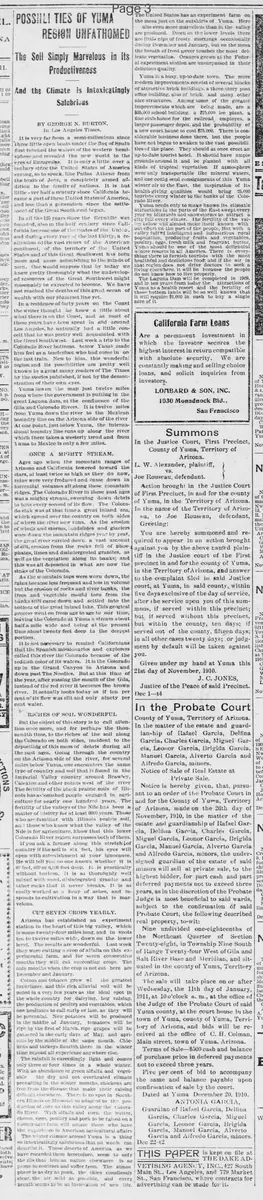
The Soil Simply Marvelous in its Productiveness
And the Climate is Intoxicatingly Salubrious
BY GEORGE N. BURTON.
In Los Angeles Times,
It is very far from a semi-millenium since three little open boats under the flag of Spain first touched the waters of the western hemisphere and revealed the new world to the eyes of Europeans. It is only a little over a century since the United States of America sprang, so to speak, like Pallas Athene from the brain of Jove, a completely armed addition to the family of nations. It is but little over half a century since California became a part of these United States of America, and less than a generation since the settlement of the Great Southwest began.
In all the 125 years since the Republic was founded, also in the half century since California became one of the States of the Union, and during every year of the last thirty, a realization of the vast riches of the American continent, of the territory of the United States and of this Great Southwest has been more and more astonishing to the minds of men. One would suppose that by today we knew pretty thoroughly what the undeveloped resources of the Great Southwest might reasonably be expected to become. We have not reached the depths of this great ocean of wealth with our plummet line yet.
In a residence of forty years on the Coast the writer thought he knew a little about what there is on the Coast, and as most of these years have been spent in and around Los Angeles, he naturally had a little conceit that he was pretty well acquainted with the Great Southwest. Last week a trip to the Colorado River bottoms below Yuma made him feel as a tenderfoot who had come in on the last train. New to him, this wonderful region and its possibilities are pretty well known to a great many readers of The Times by the stories published, if not by the demonstration of their own eyes.
Yuma lies on the map just twelve miles from where the government is putting in the great Laguna dam, at the confluence of the Gila and Colorado Rivers. It is twelve miles from Yuma down the river to the Mexican boundary line on the Arizona side of the river. At one point, just below Yuma, the international boundary line runs up along the river which there takes a westerly trend and from Yuma to Mexico is only a few miles.
ONCE A MIGHTY STREAM.
Ages ago when the mountain ranges of Arizona and California towered toward the stars, at least twice as high as they do now, rains were very frequent and came down in torrential volumes all along these mountain ridges. The Colorado River in these past ages was a mighty stream, sweeping down debris in tons every second of its flow. The Colorado sink was at that time a great inland sea, which spread over the country on both sides of where the river now runs. As the erosion of winds and storms, landslides and glaciers wore down the mountain ridges year by year, the great river carried down a vast amount of silt, erosion from the rocks full of phosphates, limes and disintegrated granites, as well as the vegetation along its banks; and this was all deposited in what are now the sinks of the Colorado.
As the mountain tops were worn down, the rains became less frequent and less in volume but the erosion of rocks and river banks, the trees and vegetable mould torn from the banks still came down and settled into the bottom of the great inland lake. This geological process went on from age to age to our time, leaving the Colorado at Yuma a stream about half a mile wide and being at the present time about twenty feet deep in the deepest portion.
It is not necessary to remind Californians that the Spanish missionaries and explorers called this river the Colorado because of the reddish color of its waters. It is the Colorado up in the Grand Canyon in Arizona and down past The Needles, But at this time of the year, after passing the mouth of the Gila, instead of the red river it becomes the brown river. It actually looks today as if ten per cent of its flow was silt and only ninety per cent water.
RICHES OF SOIL WONDERFUL
But the object of this story is to call attention once more, and for perhaps the thousandth time, to the riches of the soil along the Colorado on both sides, incident to the depositing of this mass of debris during all the past ages. Going through the country on the Arizona side of the river, for several miles below Yuma, one encounters the same type of country and soil that is found in the Imperial Valley country around Brawley, Calexico and other points west of the river.
The fertility of the black prairie soils of Illinois has astonished people engaged in agriculture for nearly one hundred years. The fertility of the valleys of the Nile has been a matter of history for at least 6000 years. Those who are familiar with Illinois prairie soil, and those who know what the valley of the Nile is for agriculture, know that this lower Colorado River region surpasses both of them.
If you ask a farmer along this stretch of country if the soil is six feet, his eyes will open with astonishment at your ignorance. He will tell you no one knows whether it is 60 feet, 600 or 6000 feet deep. It is practically without bottom. It is so thoroughly well mixed with sand, disintegrated granite and other rocks that it never bakes. It is as easily worked as a heap of ashes, and responds to cultivation in a way that is marvelous.
CUT SEVEN CROPS YEARLY.
Arizona has established an experiment station in the heart of this big valley, which is some twenty-four miles long, and in spots ten to twelve miles wide, down on the lower level. The results are wonderful. Last week they were cutting a crop of alfalfa on this experimental farm, and for seven consecutive months they will cut succeeding crops. The only months when the crop is not cut here are December and January.
Cotton and tobacco grow with the greatest luxuriance, and this rich alluvial soil will be noted in a very few years as the ideal spot in the whole country for dairying, hog raising, the production of poultry and vegetables, which one hesitates to call early or late, as they will be perennial. New potatoes will be produced in the middle of January, tomatoes will be ripe by the first of March, ripe grapes will be gathered in the early days of May, and apricots by the middle of the same month. Chickens and turkeys flourish there in the winter time beyond all experience anywhere else.
The rainfall is exceedingly light and comes only three or four times in a whole winter. With an abundance of green alfalfa and vegetables the dry and not overheated climate prevailing in the winter months, chickens are free from the disease that make their raising difficult elsewhere. There is no spot in Southern Illinois or Missouri so adapted to the production of corn as this valley along the Colorado River. With alfalfa and corn, the butter, cheese, eggs, poultry and pork to be raised on a twenty-acre farm, will amaze those who have the experience in American agricultural affairs.
The winter climate around Yuma is a thing so intoxicatingly salubrious that no words can describe it. Those deserts of America, as we have regarded them heretofore, seem to defy the ills that human nature elsewhere is so prone to contract and suffer from. The atmosphere is as dry as punk, the skies cloudlessly clear, the air mild as possible, and every breath seems to be an inspiration of new life.
The United States has an experiment farm on the mesa just on the outskirts of Yuma. Here fruits even more marvelous than in the valley are produced. Down on the lower levels there are little nips of frosty mornings occasionally during December and January, but on the mesa the breath of frost never touches the most delicate vegetation. Oranges grown at the Federal experiment station are unsurpassed in their delicious quality.
Yuma is a busy, up-to-date town. The more modern improvements consist of several blocks of attractive brick buildings, a three-story post office building, also of brick, and many other nice structures. Among some of the greater improvements which are being made, are a $35,000 school building, a $75,000 ice plant, a fine club-house for the railroad employees, a larger passenger depot, and the probability of a new court house to cost $75,000. There is considerable business done there, but the people have not begun to awaken to the vast possibilities of the place. They should at once erect an up-to-date tourist hotel. It should have ample grounds around it and be planted with all kinds of tropical vegetation. If atmosphere were only transportable like mineral waters, and one could send consignments of this Yuma winter air to the East, the inspiration of its health-giving qualities would bring 25,000 tourists every winter to the banks of the Colorado River.
Yuma needs only to make known its climatic attractions in the parts of the East swept every year by blizzards and snowstorms to attract a city full every winter. The fertility of the valley below will almost make itself known without effort on the part of the people. But with a valley full of intelligent and industrious rural population, producing fruits and vegetables, poultry, eggs, fresh milk and fragrant butter, Yuma should be one of the most delightful winter resorts in all America. There is everything there to furnish tourists with the most healthful and delicious food: and if the air in that region does not drive doctors to seek a living elsewhere, it will be because the people do not know how to live properly.
The Laguna Dam will be completed in 1909, and in ten years from today the attractions of Yuma as a health resort and the fertility of these bottom lands will be so well known that it will require $1,000 in cash to buy a single acre of it.
What sub-type of article is it?
What themes does it cover?
What keywords are associated?
What entities or persons were involved?
Where did it happen?
Story Details
Key Persons
Location
Yuma Region, Colorado River Bottoms Below Yuma, Arizona Side
Event Date
Circa 1908
Story Details
Writer recounts geological history of Colorado River deposits creating deep fertile soil surpassing Illinois prairies and Nile Valley; describes trip revealing potential for seven alfalfa crops yearly, luxuriant cotton, tobacco, early fruits, vegetables, livestock; praises salubrious winter climate ideal for health resort; urges tourist hotel development ahead of 1909 Laguna Dam completion.