Thank you for visiting SNEWPapers!
Sign up free
Letter to Editor
August 13, 1841
The Liberator
Boston, Suffolk County, Massachusetts
What is this article about?
H.C. Wright's letter to Amos A. Phelps, published in The Liberator, denounces the Methodist Episcopal Church as a 'brotherhood of man-stealers' for countenancing slavery, citing John Wesley's anti-slavery views, historical church disciplines, and recent conference resolutions supporting slaveholders while opposing abolitionists.
Clipping
OCR Quality
98%
Excellent
Full Text
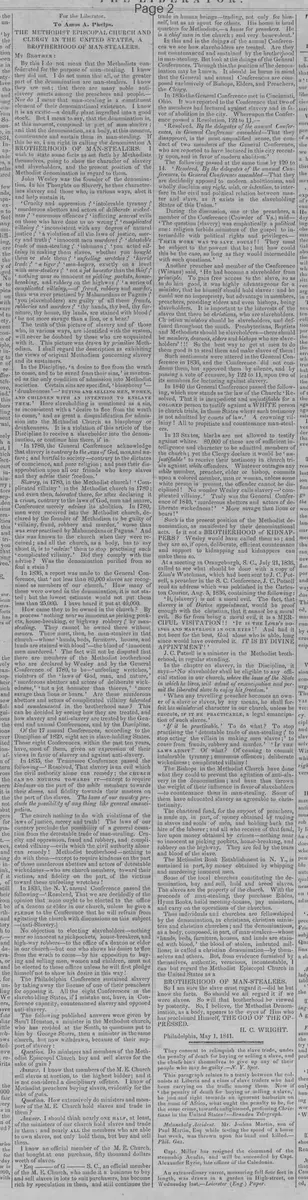
For the Liberator.
To Amos A. Phelps,
THE METHODIST EPISCOPAL CHURCH AND CLERGY IN THE UNITED STATES, A BROTHERHOOD OF MAN-STEALERS.
My Brother:
By this I do not mean that the Methodists confederated for the purpose of man-stealing. I know they did not. I do not mean that all, or the greater part of the denomination are man-stealers. I know they are not; that there are many noble anti-slavery hearts among the preachers and people.—Nor do I mean that man-stealing is a constituent element of their denominational existence. I know it is an exotic—a deadly plant ingrafted into a good stock. But I mean to say, that the denomination is, at this moment, composed in part of man-stealers; and that the denomination, as a body, at this moment countenance and sustain them in man-stealing. If this be so, I am right in calling the denomination A BROTHERHOOD OF MAN-STEALERS. I wish to state some facts as set forth by Methodists themselves, going to show the character of slavery and slaveholders, and the present position of the Methodist denomination in regard to them.
John Wesley was the founder of the denomination. In his Thoughts on Slavery, he thus characterizes slavery and those who, in various ways, abet it and help sustain it.
'Cruelty and oppression;' 'intolerable tyranny;' 'murderous abettors and actors of deliberate wickedness;' 'enormous offences;' 'inflicting severest evils on those who have done us no wrong;' 'complicated villainy;' 'inconsistent with any degree of natural justice;' 'a violation of all the laws of justice, mercy and truth; innocent men murdered; detestable trade of man-stealing;' 'inhuman;' 'you acted villainy in making them slaves, whether you bought them or stole them; unfeeling wretches;' horrid trade; 'a tiger;' 'men-buyers, exactly on a level with men-stealers;' not a jot honester than the thief; 'nothing near so innocent as picking pockets, house-breaking, and robbery on the highway;' 'a series of complicated villainy,—of fraud, robbery and murder, than was ever practised by Mahomedans or Pagans; you (slaveholders) are guilty of all these frauds, robberies and murders: thy hands, thy bed, thy furniture, thy house, thy lands, are stained with blood; be not more savage than a lion, or a bear.'
The truth of this picture of slavery and of those who, in various ways, are identified with the system, will never be doubted by those who are acquainted with it. This picture was drawn by primitive Methodism. I shall regard the description as exhibiting the views of original Methodism concerning slavery and its sustainers.
In the Discipline, 'a desire to flee from the wrath to come, and to be saved from their sins,' is mentioned as the only condition of admission into Methodist societies. Certain sins are specified, 'blasphemy,' 'drunkenness,' 'BUYING AND SELLING MEN, WOMEN, AND CHILDREN WITH AN INTENTION TO ENSLAVE THEM.' Here slaveholding is mentioned as a sin, as inconsistent with a 'desire to flee from the wrath to come,' and as great a disqualification for admission into the Methodist Church as blasphemy or drunkenness. It is a violation of this article of the Discipline to receive a slaveholder into the denomination, or continue him there, if in.
'In 1780, the General Conference acknowledge that slavery is contrary to the laws of God, man, and nature; and hurtful to society—contrary to the dictates of conscience, and pure religion; and pass their disapprobation upon all our friends who keep slaves and they advise their freedom.'
Slavery, in 1780, in the Methodist church! Complicated villainy in the Methodist church in 1780; and even then, tolerated there, for after declaring it a crime, contrary to the laws of God, man and nature, Conference merely advises its abolition. In 1780, men were received into the Methodist church, declared by the founder of Methodism to be guilty of 'villainy, fraud, robbery and murder,' worse than was ever practised by Mahomedans or Pagans.' And this was known to the church when they were received; and all the church, as a body, has to say about it, is to advise them to stop practising such 'complicated villainy.' Did they comply with the advice? Was the denomination purified from so foul a stain?
In 1836, a report was made to the General Conference, that 'not less than 80,000 slaves are recognised as members of our church.' How many of these were owned in the denomination, it is not stated; but the lowest estimate would not put them less than 25,000. I have heard it put at 40,000. How came they to be owned in the church? By a process 'nothing near so innocent as picking pockets, house-breaking, or highway robbery; by man-stealing.
They cannot be owned there without owners. There must, then, be man-stealers in that church—whose 'hands, beds, furniture, houses, and lands are stained with blood'—the blood of 'innocent men murdered.' The fact will not be disputed that there are members of the Methodist brotherhood who are declared by Wesley and by the General Conference of 1780, to be—'unfeeling wretches, violators of the 'laws of God, man, and nature,' 'murderous abettors and actors of deliberate wickedness,' not a jot honester than thieves,' more savage than lions or bears.' Are these murderous abettors and actors of complicated villainy tolerated and countenanced in the brotherhood now? This can be decided by seeing how they are treated, and how slavery and anti-slavery are treated by the General and annual Conferences, and by the Discipline.
Of the 17 annual Conferences, according to the Discipline of 1829, eight are in slave-holding States. These eight Conferences, within the past ten years, have, most of them, given an expression of their views in favor of slavery and against anti-slavery.
In 1835, the Tennessee Conference passed the following—'Resolved, That slavery is an evil which the civil authority alone can remedy; the CHURCH CAN DO NOTHING TOWARDS IT—EXCEPT TO REQUIRE kindness on the part of the white members towards their slaves, and fidelity towards their masters on the part of the slaves. The laws of our country preclude the possibility of any thing like general emancipation.'
The church nothing to do with violations of the laws of justice, mercy and truth! The laws of our country preclude the possibility of a general cessation from the detestable trade of man-stealing. Cruelty and oppression, fraud and robbery, and complicated villainy—evils which the civil authority alone can remedy! Methodist brotherhood—nothing to do with them—except to require kindness on the part of those murderous abettors and actors of detestable wickedness—who are church members, toward their victims, and fidelity on the part of the victims toward these unfeeling wretches!
In 1836, the N. Y. annual Conference passed the following—'Resolved, That we are decidedly of the opinion that none ought to be elected to the office of a deacon or elder in our church, unless he give a PLEDGE to the Conference that he will refrain from agitating the church with discussions on this subject (anti-Slavery.)'
No objection to electing slaveholders—nothing near so innocent as pickpockets, house-breakers, and high-way robbers—to the office of a deacon or elder in our church—but one who shows his desire to flee from the wrath to come—by his opposition to buying and selling men, women and children, must not be elected to these offices unless he will first pledge himself not to show his desire in this way!
The Philadelphia Conference sustained slavery by taking away the license of one of their preachers for opposing it. All the eight Conferences in the slaveholding States, if I mistake not, have, in Conference capacity, countenanced slavery and opposed anti-slavery.
The following published answers were given by Sam'l Houston, a minister in the Methodist church, who has resided at the South, to questions put to him by George Storrs, then a minister in the same church, but now withdrawn, because of their support of slavery:
Question. Do ministers and members of the Methodist Episcopal Church buy and sell slaves for the sake of gain?
Answer. I know that members of the M. E. Church sell slaves at auction, to the highest bidder; and it is not considered a disciplinary offence. I know of Methodist preachers buying slaves, evidently for the sake of gain.
Question. How extensively do ministers and members of the M. E. Church hold slaves and trade in them?
Answer. I should think nearly one HALF, at least, of the ministers of our church hold slaves and trade in them; and nearly ALL the members who are able to own slaves, not only hold them, but buy and sell them.
I know an official member of the M. E. Church that bought at one purchase, fifty thousand dollars worth of slaves.
Esq. of G. S. C., an official member of the M. E. Church, who made it a business to buy and sell slaves in lots to suit purchasers, has become rich by speculation in them, and still continues the trade in human beings—trading, not only for himself, but as an agent for others. His house is head quarters for Methodists,—a house for preachers. He is a chief man in the church; and very benevolent.'
In this and in the doings of the annual Conferences we see how slaveholders are treated. Are they not countenanced and sustained by the brotherhood in man-stealing. But look at the doings of the General Conferences. Through this, the position of the denomination may be known. It should be borne in mind that the General and annual Conferences are composed exclusively of Bishops, Elders, and Preachers, the Clergy.
In 1836 the General Conference met in Cincinnati, Ohio. It was reported to the Conference that two of the members had lectured against slavery and in favor of abolition in the city. Whereupon the Conference passed a Resolution, 122 to 11,—
'Resolved, By the delegates of the annual Conferences, in General Conference assembled—That they disapprove, in the most unqualified sense, the conduct of two members of the General Conference, who are reported to have lectured in this city recently upon, and in favor of modern abolition.'
The following passed at the same time by 120 to 14. 'Resolved, By the delegates of the annual Conferences, in General Conference assembled—That they are decidedly opposed to modern abolitionism, and wholly disclaim any right, wish, or intention, to interfere in the civil and political relation between master and slave, as it exists in the slaveholding States of this Union.'
During the discussion, one of the preachers, a member of the Conference (Crowder of Va.) said—
The question (slavery) was emphatically a political one: religion forbids ministers of the gospel to intermeddle with political rights and privileges.—THEIR WORK WAS TO SAVE SOULS!! They must be subject to the powers that be; but how could this be the case, so long as they would intermeddle with such questions.
Another preacher and member of the Conference (Winans) said, He had become a slaveholder from principle. To gain free access to the slave, so as to do him good, it was highly advantageous for a minister, that he himself should hold slaves: and he could see no impropriety, but advantage in members, preachers, presiding elders and even bishops, being slaveholders. It is important to the interests of the slaves that there be christians, who are slaveholders. Christian ministers should be slaveholders, and diffused throughout the south. Presbyterians, Baptists and Methodists should be slaveholders—there should be members, deacons, elders and bishops who are slaveholders!!! So the best way to get at men to do them good is to steal them and make slaves of them!
Such sentiments were uttered in the General Conference in 1836, and the Conference 'did not condemn them, but approved them by silence, and by passing a vote of censure, by 122 to 11, upon two of its members for lecturing against slavery.
In 1840 the General Conference passed the following, which now stands as the law of the Church: 'Resolved, That it is inexpedient and unjustifiable for a COLORED person to testify against a WHITE person in church trials, in those States where such testimony is not admitted by courts of law.' A crowning villainy! All to propitiate and countenance man-stealers.
In 13 States, blacks are not allowed to testify against whites. 80,000 of these are of sufficient intelligence and character to be admitted members of the church; yet the Clergy declare it would be 'unjustifiable' to receive their testimony in church trials against white offenders. Whatever outrages any white member, preacher, elder or bishop, commits upon a colored member, man or woman, unless some white person is present, the offender cannot be disciplined! No wonder Wesley calls slavery—'complicated villainy.' Truly was the General Conference of 1840, 'murderous abettors and actors of deliberate wickedness!' More savage than lions or bears!'
Such is the present position of the Methodist denomination, as manifested by their denominational acts. Is it not a BROTHERHOOD OF KIDNAPPERS? Wesley would have called them so; and they are so, if open, deliberate, efficient countenance and support to kidnapping and kidnappers can make them so.
At a meeting in Orangeburgh, S. C., July 21, 1836, called to see what should be done with a copy of Zion's Watchman, which had been sent to J. C. Pottsell, a preacher in the S. C. Conference, J. C. Pottsell read an address which was published in the Charleston Courier, Aug. 5, 1836, containing the following:
It, (slavery) is not a moral evil. The fact, that slavery is of Divine appointment, would be proof enough with the christian, that it cannot be a moral evil. So far from being a moral evil, it is a MERCIFUL VISITATION!! 'IT IS THE LORD'S DOING AND MARVELOUS IN OUR EYES!' And had it not been for the best, God alone who is able, long since would have overruled it. IT IS BY DIVINE APPOINTMENT!
J. C. Pottsell is a minister in the Methodist brotherhood, in regular standing.
In the chapter on slavery, in the Discipline, it says—'No slaveholder shall be eligible to any official station in our church, where the laws of the State in which he lives, will admit of emancipation and permit the liberated slave to enjoy his freedom.'
'When any travelling preacher becomes an owner of a slave or slaves, by any means, he shall forfeit his ministerial character in our church, unless he execute, IF IT BE PRACTICABLE, a legal emancipation of such slaves.'
'If it be practicable.' To do what? To stop practising the 'detestable trade of man-stealing;' to stop acting the villain in making men slaves;' to cease from frauds, robbery and murder.' If THE LAWS ADMIT!' Of what? Of ceasing to commit intolerable tyranny; enormous offences; deliberate wickedness; complicated villainy!
The Bishops in the Methodist Church have done what they could to prevent the agitation of anti-slavery in the denomination; and have thus thrown the weight of their influence in favor of slaveholders—to countenance them in man-stealing. Some of them have advocated slavery as agreeable to christianity.
The chartered fund, for the support of preachers, is made up, in part, of money obtained by trading in slaves and souls of men, and holding back the hire of the laborer; and all who receive of that fund, live upon money obtained by crimes—nothing near so innocent as picking pockets, house-breaking, and robbery on the highway. They are fed by the tears and blood of the slave.
The Methodist Book Establishment in N. Y., is sustained in part, by money obtained by whipping and murdering innocent men.
Some of the local churches constituting the denomination, buy and sell, hold and breed slaves. The slaves are the property of the church. With the proceeds of man-stealing, they purchase Bibles. Hymn Books, build meeting-houses, pay ministers, and carry on the operations of the churches.
Thus individuals and churches are fellowshiped by the denomination, as christians, christian ministers and christian churches; and the denomination, as a body, composed, in part, of man-stealers—whose 'hands, beds, furniture, houses, and lands are stained with blood,' the blood of stolen, imbruted millions; is called a christian denomination—by themselves and others. But, from evidence furnished by themselves, authentic, veracious, incontestable, I can but regard the Methodist Episcopal Church in the United States as a BROTHERHOOD OF MAN-STEALERS.
So I am sure the slave must regard it did he but know the facts. So should we all regard it if we were slaves. So will that brotherhood be viewed by posterity. So, I believe, the Methodist Denomination, as a body, appears to the eyes of Him who has proclaimed Himself, THE GOD OF THE OPPRESSED.
H. C. WRIGHT
Philadelphia, May 1, 1841.
To Amos A. Phelps,
THE METHODIST EPISCOPAL CHURCH AND CLERGY IN THE UNITED STATES, A BROTHERHOOD OF MAN-STEALERS.
My Brother:
By this I do not mean that the Methodists confederated for the purpose of man-stealing. I know they did not. I do not mean that all, or the greater part of the denomination are man-stealers. I know they are not; that there are many noble anti-slavery hearts among the preachers and people.—Nor do I mean that man-stealing is a constituent element of their denominational existence. I know it is an exotic—a deadly plant ingrafted into a good stock. But I mean to say, that the denomination is, at this moment, composed in part of man-stealers; and that the denomination, as a body, at this moment countenance and sustain them in man-stealing. If this be so, I am right in calling the denomination A BROTHERHOOD OF MAN-STEALERS. I wish to state some facts as set forth by Methodists themselves, going to show the character of slavery and slaveholders, and the present position of the Methodist denomination in regard to them.
John Wesley was the founder of the denomination. In his Thoughts on Slavery, he thus characterizes slavery and those who, in various ways, abet it and help sustain it.
'Cruelty and oppression;' 'intolerable tyranny;' 'murderous abettors and actors of deliberate wickedness;' 'enormous offences;' 'inflicting severest evils on those who have done us no wrong;' 'complicated villainy;' 'inconsistent with any degree of natural justice;' 'a violation of all the laws of justice, mercy and truth; innocent men murdered; detestable trade of man-stealing;' 'inhuman;' 'you acted villainy in making them slaves, whether you bought them or stole them; unfeeling wretches;' horrid trade; 'a tiger;' 'men-buyers, exactly on a level with men-stealers;' not a jot honester than the thief; 'nothing near so innocent as picking pockets, house-breaking, and robbery on the highway;' 'a series of complicated villainy,—of fraud, robbery and murder, than was ever practised by Mahomedans or Pagans; you (slaveholders) are guilty of all these frauds, robberies and murders: thy hands, thy bed, thy furniture, thy house, thy lands, are stained with blood; be not more savage than a lion, or a bear.'
The truth of this picture of slavery and of those who, in various ways, are identified with the system, will never be doubted by those who are acquainted with it. This picture was drawn by primitive Methodism. I shall regard the description as exhibiting the views of original Methodism concerning slavery and its sustainers.
In the Discipline, 'a desire to flee from the wrath to come, and to be saved from their sins,' is mentioned as the only condition of admission into Methodist societies. Certain sins are specified, 'blasphemy,' 'drunkenness,' 'BUYING AND SELLING MEN, WOMEN, AND CHILDREN WITH AN INTENTION TO ENSLAVE THEM.' Here slaveholding is mentioned as a sin, as inconsistent with a 'desire to flee from the wrath to come,' and as great a disqualification for admission into the Methodist Church as blasphemy or drunkenness. It is a violation of this article of the Discipline to receive a slaveholder into the denomination, or continue him there, if in.
'In 1780, the General Conference acknowledge that slavery is contrary to the laws of God, man, and nature; and hurtful to society—contrary to the dictates of conscience, and pure religion; and pass their disapprobation upon all our friends who keep slaves and they advise their freedom.'
Slavery, in 1780, in the Methodist church! Complicated villainy in the Methodist church in 1780; and even then, tolerated there, for after declaring it a crime, contrary to the laws of God, man and nature, Conference merely advises its abolition. In 1780, men were received into the Methodist church, declared by the founder of Methodism to be guilty of 'villainy, fraud, robbery and murder,' worse than was ever practised by Mahomedans or Pagans.' And this was known to the church when they were received; and all the church, as a body, has to say about it, is to advise them to stop practising such 'complicated villainy.' Did they comply with the advice? Was the denomination purified from so foul a stain?
In 1836, a report was made to the General Conference, that 'not less than 80,000 slaves are recognised as members of our church.' How many of these were owned in the denomination, it is not stated; but the lowest estimate would not put them less than 25,000. I have heard it put at 40,000. How came they to be owned in the church? By a process 'nothing near so innocent as picking pockets, house-breaking, or highway robbery; by man-stealing.
They cannot be owned there without owners. There must, then, be man-stealers in that church—whose 'hands, beds, furniture, houses, and lands are stained with blood'—the blood of 'innocent men murdered.' The fact will not be disputed that there are members of the Methodist brotherhood who are declared by Wesley and by the General Conference of 1780, to be—'unfeeling wretches, violators of the 'laws of God, man, and nature,' 'murderous abettors and actors of deliberate wickedness,' not a jot honester than thieves,' more savage than lions or bears.' Are these murderous abettors and actors of complicated villainy tolerated and countenanced in the brotherhood now? This can be decided by seeing how they are treated, and how slavery and anti-slavery are treated by the General and annual Conferences, and by the Discipline.
Of the 17 annual Conferences, according to the Discipline of 1829, eight are in slave-holding States. These eight Conferences, within the past ten years, have, most of them, given an expression of their views in favor of slavery and against anti-slavery.
In 1835, the Tennessee Conference passed the following—'Resolved, That slavery is an evil which the civil authority alone can remedy; the CHURCH CAN DO NOTHING TOWARDS IT—EXCEPT TO REQUIRE kindness on the part of the white members towards their slaves, and fidelity towards their masters on the part of the slaves. The laws of our country preclude the possibility of any thing like general emancipation.'
The church nothing to do with violations of the laws of justice, mercy and truth! The laws of our country preclude the possibility of a general cessation from the detestable trade of man-stealing. Cruelty and oppression, fraud and robbery, and complicated villainy—evils which the civil authority alone can remedy! Methodist brotherhood—nothing to do with them—except to require kindness on the part of those murderous abettors and actors of detestable wickedness—who are church members, toward their victims, and fidelity on the part of the victims toward these unfeeling wretches!
In 1836, the N. Y. annual Conference passed the following—'Resolved, That we are decidedly of the opinion that none ought to be elected to the office of a deacon or elder in our church, unless he give a PLEDGE to the Conference that he will refrain from agitating the church with discussions on this subject (anti-Slavery.)'
No objection to electing slaveholders—nothing near so innocent as pickpockets, house-breakers, and high-way robbers—to the office of a deacon or elder in our church—but one who shows his desire to flee from the wrath to come—by his opposition to buying and selling men, women and children, must not be elected to these offices unless he will first pledge himself not to show his desire in this way!
The Philadelphia Conference sustained slavery by taking away the license of one of their preachers for opposing it. All the eight Conferences in the slaveholding States, if I mistake not, have, in Conference capacity, countenanced slavery and opposed anti-slavery.
The following published answers were given by Sam'l Houston, a minister in the Methodist church, who has resided at the South, to questions put to him by George Storrs, then a minister in the same church, but now withdrawn, because of their support of slavery:
Question. Do ministers and members of the Methodist Episcopal Church buy and sell slaves for the sake of gain?
Answer. I know that members of the M. E. Church sell slaves at auction, to the highest bidder; and it is not considered a disciplinary offence. I know of Methodist preachers buying slaves, evidently for the sake of gain.
Question. How extensively do ministers and members of the M. E. Church hold slaves and trade in them?
Answer. I should think nearly one HALF, at least, of the ministers of our church hold slaves and trade in them; and nearly ALL the members who are able to own slaves, not only hold them, but buy and sell them.
I know an official member of the M. E. Church that bought at one purchase, fifty thousand dollars worth of slaves.
Esq. of G. S. C., an official member of the M. E. Church, who made it a business to buy and sell slaves in lots to suit purchasers, has become rich by speculation in them, and still continues the trade in human beings—trading, not only for himself, but as an agent for others. His house is head quarters for Methodists,—a house for preachers. He is a chief man in the church; and very benevolent.'
In this and in the doings of the annual Conferences we see how slaveholders are treated. Are they not countenanced and sustained by the brotherhood in man-stealing. But look at the doings of the General Conferences. Through this, the position of the denomination may be known. It should be borne in mind that the General and annual Conferences are composed exclusively of Bishops, Elders, and Preachers, the Clergy.
In 1836 the General Conference met in Cincinnati, Ohio. It was reported to the Conference that two of the members had lectured against slavery and in favor of abolition in the city. Whereupon the Conference passed a Resolution, 122 to 11,—
'Resolved, By the delegates of the annual Conferences, in General Conference assembled—That they disapprove, in the most unqualified sense, the conduct of two members of the General Conference, who are reported to have lectured in this city recently upon, and in favor of modern abolition.'
The following passed at the same time by 120 to 14. 'Resolved, By the delegates of the annual Conferences, in General Conference assembled—That they are decidedly opposed to modern abolitionism, and wholly disclaim any right, wish, or intention, to interfere in the civil and political relation between master and slave, as it exists in the slaveholding States of this Union.'
During the discussion, one of the preachers, a member of the Conference (Crowder of Va.) said—
The question (slavery) was emphatically a political one: religion forbids ministers of the gospel to intermeddle with political rights and privileges.—THEIR WORK WAS TO SAVE SOULS!! They must be subject to the powers that be; but how could this be the case, so long as they would intermeddle with such questions.
Another preacher and member of the Conference (Winans) said, He had become a slaveholder from principle. To gain free access to the slave, so as to do him good, it was highly advantageous for a minister, that he himself should hold slaves: and he could see no impropriety, but advantage in members, preachers, presiding elders and even bishops, being slaveholders. It is important to the interests of the slaves that there be christians, who are slaveholders. Christian ministers should be slaveholders, and diffused throughout the south. Presbyterians, Baptists and Methodists should be slaveholders—there should be members, deacons, elders and bishops who are slaveholders!!! So the best way to get at men to do them good is to steal them and make slaves of them!
Such sentiments were uttered in the General Conference in 1836, and the Conference 'did not condemn them, but approved them by silence, and by passing a vote of censure, by 122 to 11, upon two of its members for lecturing against slavery.
In 1840 the General Conference passed the following, which now stands as the law of the Church: 'Resolved, That it is inexpedient and unjustifiable for a COLORED person to testify against a WHITE person in church trials, in those States where such testimony is not admitted by courts of law.' A crowning villainy! All to propitiate and countenance man-stealers.
In 13 States, blacks are not allowed to testify against whites. 80,000 of these are of sufficient intelligence and character to be admitted members of the church; yet the Clergy declare it would be 'unjustifiable' to receive their testimony in church trials against white offenders. Whatever outrages any white member, preacher, elder or bishop, commits upon a colored member, man or woman, unless some white person is present, the offender cannot be disciplined! No wonder Wesley calls slavery—'complicated villainy.' Truly was the General Conference of 1840, 'murderous abettors and actors of deliberate wickedness!' More savage than lions or bears!'
Such is the present position of the Methodist denomination, as manifested by their denominational acts. Is it not a BROTHERHOOD OF KIDNAPPERS? Wesley would have called them so; and they are so, if open, deliberate, efficient countenance and support to kidnapping and kidnappers can make them so.
At a meeting in Orangeburgh, S. C., July 21, 1836, called to see what should be done with a copy of Zion's Watchman, which had been sent to J. C. Pottsell, a preacher in the S. C. Conference, J. C. Pottsell read an address which was published in the Charleston Courier, Aug. 5, 1836, containing the following:
It, (slavery) is not a moral evil. The fact, that slavery is of Divine appointment, would be proof enough with the christian, that it cannot be a moral evil. So far from being a moral evil, it is a MERCIFUL VISITATION!! 'IT IS THE LORD'S DOING AND MARVELOUS IN OUR EYES!' And had it not been for the best, God alone who is able, long since would have overruled it. IT IS BY DIVINE APPOINTMENT!
J. C. Pottsell is a minister in the Methodist brotherhood, in regular standing.
In the chapter on slavery, in the Discipline, it says—'No slaveholder shall be eligible to any official station in our church, where the laws of the State in which he lives, will admit of emancipation and permit the liberated slave to enjoy his freedom.'
'When any travelling preacher becomes an owner of a slave or slaves, by any means, he shall forfeit his ministerial character in our church, unless he execute, IF IT BE PRACTICABLE, a legal emancipation of such slaves.'
'If it be practicable.' To do what? To stop practising the 'detestable trade of man-stealing;' to stop acting the villain in making men slaves;' to cease from frauds, robbery and murder.' If THE LAWS ADMIT!' Of what? Of ceasing to commit intolerable tyranny; enormous offences; deliberate wickedness; complicated villainy!
The Bishops in the Methodist Church have done what they could to prevent the agitation of anti-slavery in the denomination; and have thus thrown the weight of their influence in favor of slaveholders—to countenance them in man-stealing. Some of them have advocated slavery as agreeable to christianity.
The chartered fund, for the support of preachers, is made up, in part, of money obtained by trading in slaves and souls of men, and holding back the hire of the laborer; and all who receive of that fund, live upon money obtained by crimes—nothing near so innocent as picking pockets, house-breaking, and robbery on the highway. They are fed by the tears and blood of the slave.
The Methodist Book Establishment in N. Y., is sustained in part, by money obtained by whipping and murdering innocent men.
Some of the local churches constituting the denomination, buy and sell, hold and breed slaves. The slaves are the property of the church. With the proceeds of man-stealing, they purchase Bibles. Hymn Books, build meeting-houses, pay ministers, and carry on the operations of the churches.
Thus individuals and churches are fellowshiped by the denomination, as christians, christian ministers and christian churches; and the denomination, as a body, composed, in part, of man-stealers—whose 'hands, beds, furniture, houses, and lands are stained with blood,' the blood of stolen, imbruted millions; is called a christian denomination—by themselves and others. But, from evidence furnished by themselves, authentic, veracious, incontestable, I can but regard the Methodist Episcopal Church in the United States as a BROTHERHOOD OF MAN-STEALERS.
So I am sure the slave must regard it did he but know the facts. So should we all regard it if we were slaves. So will that brotherhood be viewed by posterity. So, I believe, the Methodist Denomination, as a body, appears to the eyes of Him who has proclaimed Himself, THE GOD OF THE OPPRESSED.
H. C. WRIGHT
Philadelphia, May 1, 1841.
What sub-type of article is it?
Persuasive
Ethical Moral
Religious
What themes does it cover?
Slavery Abolition
Religion
Morality
What keywords are associated?
Methodist Church
Slavery
Man Stealing
John Wesley
General Conference
Abolition
Slaveholders
Church Discipline
What entities or persons were involved?
H. C. Wright
Amos A. Phelps
Letter to Editor Details
Author
H. C. Wright
Recipient
Amos A. Phelps
Main Argument
the methodist episcopal church, as a body, countenances and sustains slaveholders in man-stealing, despite john wesley's condemnation of slavery, making the denomination a brotherhood of man-stealers.
Notable Details
Quotes John Wesley's 'Thoughts On Slavery' Describing Slaveholders As 'Murderous Abettors' And Slavery As 'Complicated Villainy'
Cites 1780 General Conference Acknowledging Slavery As Contrary To Laws Of God But Only Advising Freedom
References 1836 Report Of 80,000 Slaves As Church Members
Details Resolutions From Tennessee, N.Y., Philadelphia Conferences Supporting Slavery Or Opposing Anti Slavery Agitation
Quotes Samuel Houston On Prevalence Of Slave Trading Among Methodist Ministers And Members
Describes 1836 General Conference Censure Of Abolition Lecturers And Opposition To Abolitionism
Notes 1840 Rule Barring Colored Testimony Against Whites In Church Trials
Mentions J.C. Pottsell's Defense Of Slavery As Divine Appointment