Thank you for visiting SNEWPapers!
Sign up free
The Kentucky Gazette
Lexington, Fayette County, Kentucky
What is this article about?
President John Adams' message to Congress on March 19, 1798, read in the House of Representatives in Philadelphia on March 21, reports failure of U.S. envoys' negotiations with France and urges defensive measures including arming vessels, replenishing arsenals, and efficient revenue for commerce protection.
Clipping
OCR Quality
Full Text
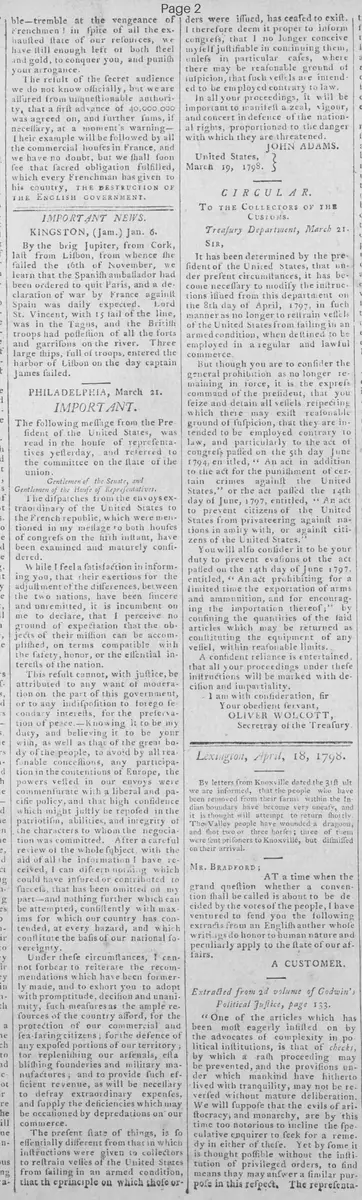
IMPORTANT.
The following message from the President of the United States, was read in the house of representatives yesterday, and referred to the committee on the state of the union.
Gentlemen of the Senate, and Gentlemen of the House of Representatives.
The dispatches from the envoys extraordinary of the United States to the French republic, which were mentioned in my message to both houses of congress on the fifth instant, have been examined and maturely considered.
While I feel a satisfaction in informing you, that their exertions for the adjustment of the differences, between the two nations, have been sincere and unremitted, it is incumbent on me to declare, that I perceive no ground of expectation that the objects of their mission can be accomplished, on terms compatible with the safety, honor, or the essential interests of the nation.
This result cannot, with justice, be attributed to any want of moderation on the part of this government, or to any indisposition to forego secondary interests, for the preservation of peace.—Knowing it to be my duty, and believing it to be your wish, as well as that of the great body of the people, to avoid by all reasonable concessions, any participation in the contentions of Europe, the powers vested in our envoys were commensurate with a liberal and pacific policy, and that high confidence which might justly be reposed in the patriotism, abilities, and integrity of the characters to whom the negotiation was committed. After a careful review of the whole subject with the aid of all the information I have received, I can discern nothing which could have insured or contributed to success, that has been omitted on my part—and nothing further which can be attempted, consistently with maxims for which our country has contended, at every hazard, and which constitute the basis of our national sovereignty.
Under these circumstances, I cannot forbear to reiterate the recommendations which have been formerly made, and to exhort you to adopt with promptitude, decision and unanimity, such measures as the ample resources of the country afford, for the protection of our commercial and sea-faring citizens; for the defence of any exposed portions of our territory; for replenishing our arsenals, establishing foundries and military manufactories; and to provide such efficient revenue, as will be necessary to defray extraordinary expenses, and supply the deficiencies which may be occasioned by depredations on our commerce.
The present state of things, is so essentially different from that in which instructions were given to collectors to restrain vessels of the United States from sailing in an armed condition, that the principle on which those orders were issued, has ceased to exist.
I therefore deem it proper to inform congress, that I no longer conceive myself justifiable in continuing them, unless in particular cases, where there may be reasonable ground of suspicion, that such vessels are intended to be employed contrary to law.
In all your proceedings, it will be important to manifest a zeal, vigour, and concert in defence of the national rights, proportioned to the danger with which they are threatened.
JOHN ADAMS.
United States,
March 19, 1798.
What sub-type of article is it?
What keywords are associated?
What entities or persons were involved?
Where did it happen?
Domestic News Details
Primary Location
Philadelphia
Event Date
March 21, 1798
Key Persons
Outcome
failure of negotiations with france; recommendations for national defense preparations.
Event Details
Message from President John Adams to Congress stating that U.S. envoys' efforts to adjust differences with France have failed on terms compatible with U.S. safety, honor, and interests. Recommends measures for protecting commerce, defending territory, replenishing arsenals, establishing military manufactories, providing revenue, and revoking orders restraining armed U.S. vessels.