Thank you for visiting SNEWPapers!
Sign up free
Alexandria Daily Advertiser
Alexandria, Virginia
What is this article about?
An editorial from the Boston Repertory reprints a letter from Thomas Turner accusing Thomas Jefferson of cowardice as Virginia governor during the Revolutionary War, financial support for scandalmonger James Callender, an attempted seduction of his friend Colonel John Walker's wife, and dishonest repayment of a debt to Gabriel Jones, aiming to tarnish Jefferson's reputation.
Merged-components note: Merged across columns as continuation of the same editorial article from the Boston Repertory detailing facts about Mr. Jefferson.
Clipping
OCR Quality
Full Text
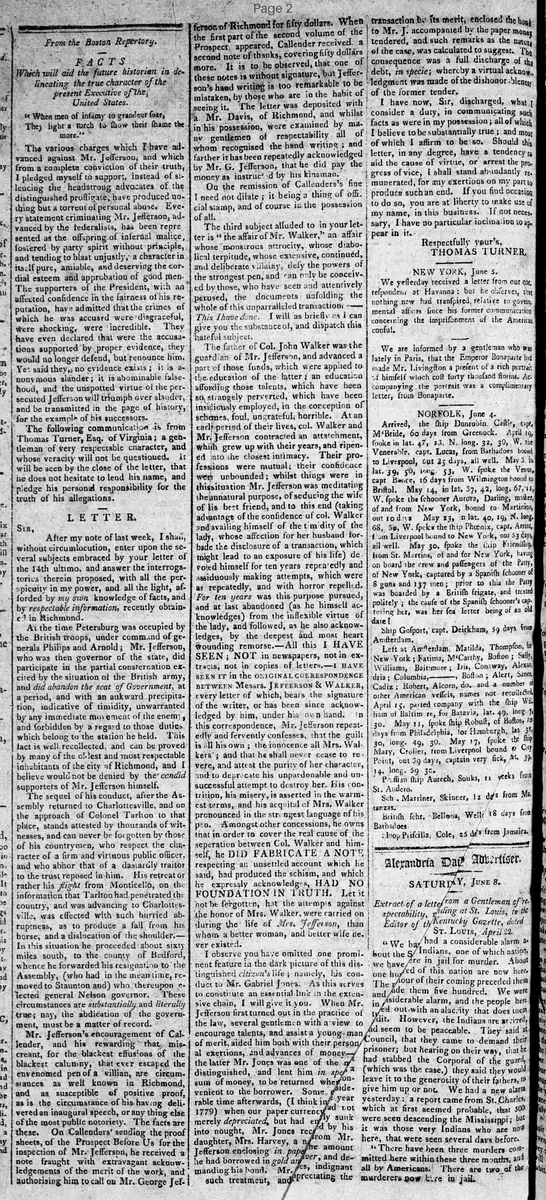
FACTS
Which will aid the future historian in delineating the true character of the present Executive of the United States.
"When men of infamy to grandeur soar,
They light a torch to show their shame the more."
The various charges which I have advanced against Mr. Jefferson; and which from a complete conviction of their truth, I pledged myself to support, instead of silencing the headstrong advocates of the distinguished profligate, have produced nothing but a torrent of personal abuse. Every statement criminating Mr. Jefferson, advanced by the federalists, has been represented as the offspring of infernal malice, fostered by party spirit without principle, and tending to blast unjustly, a character in itself pure, amiable, and deserving the cordial esteem and approbation of good men. The supporters of the President, with an affected confidence in the fairness of his reputation, have admitted that the crimes of which he was accused were disgraceful, were shocking, were incredible. They have even declared that were the accusations supported by proper evidence, they would no longer defend, but renounce him. Yet said they, no evidence exists; it is anonymous slander; it is abominable falsehood, and the unspotted virtue of the persecuted Jefferson will triumph over slander, and be transmitted in the page of history, for the example of his successors.
The following communication is from Thomas Turner, Esq. of Virginia; a gentleman of very respectable character, and whose veracity will not be questioned. It will be seen by the close of the letter, that he does not hesitate to lend his name, and pledge his personal responsibility for the truth of his allegations.
LETTER.
SIR.
After my note of last week, I shall, without circumlocution, enter upon the several subjects embraced by your letter of the 14th ultimo, and answer the interrogatories therein proposed, with all the perspicuity in my power, and all the light, afforded by my own knowledge of facts, and by respectable information, recently obtained in Richmond.
At the time Petersburg was occupied by the British troops, under command of generals Philips and Arnold; Mr. Jefferson, who was then governor of the state, did participate in the partial consternation excited by the situation of the British army, and did abandon the seat of Government, at a period, and with an awkward precipitation, indicative of timidity, unwarranted by any immediate movement of the enemy, and forbidden by a regard to those duties which belong to the station he held. This fact is well recollected, and can be proved by many of the oldest and most respectable inhabitants of the city of Richmond, and I believe would not be denied by the candid supporters of Mr. Jefferson himself.
The sequel of his conduct, after the Assembly returned to Charlottesville, and on the approach of Colonel Tarlton to that place, stands attested by thousands of witnesses, and can never be forgotten by those of his countrymen, who respect the character of a firm and virtuous public officer, and who abhor that of a dastardly traitor to the trust reposed in him. His retreat or rather his flight from Monticello, on the information that Tarlton had penetrated the country, and was advancing to Charlottesville, was effected with such hurried abruptness, as to produce a fall from his horse, and a dislocation of the shoulder. In this situation he proceeded about sixty miles south, to the county of Bedford, whence he forwarded his resignation to the Assembly, (who had in the mean time, removed to Staunton and) who thereupon elected general Nelson governor. These circumstances are substantially and literally true; nay, the abdication of the government, must be a matter of record.
Mr. Jefferson's encouragement of Callender, and his rewarding that miscreant, for the blackest effusions of the blackest calumny, that ever escaped the envenomed pen of a villain, are circumstances as well known in Richmond, and as susceptible of positive proof, as is the circumstance of his having delivered an inaugural speech, or any thing else of the most public notoriety. The facts are these. On Callender's sending the proof sheets, of the Prospect Before Us for the inspection of Mr. Jefferson, he received a note fraught with extravagant acknowledgements of the merit of the work, and authorising him to call on Mr. George Jefferson of Richmond for fifty dollars. When the first part of the second volume of the Prospect appeared, Callender received a second note of thanks, covering fifty dollars more. It is to be observed, that one of these notes is without signature, but Jefferson's hand writing is too remarkable to be mistaken, by those who are in the habit of seeing it. The letter was deposited with a Mr. Davis, of Richmond, and whilst in his possession, were examined by many gentlemen of respectability, all of whom recognised the hand writing; and farther it has been repeatedly acknowledged by Mr. G. Jefferson, that he did pay the money as instructed by his kinsman.
On the remission of Callender's fine I need not dilate; it being a thing of official stamp, and of course in the possession of all.
The third subject alluded to in your letter is "the affair of Mr. Walker," an affair whose monstrous attrocity, whose diabolical turpitude, whose extensive, continued, and deliberate villainy, defy the powers of the strongest pen, and can only be conceived by those, who have seen and attentively perused, the documents unfolding the whole of this unparalleled transaction. This I have done. I will as briefly as I can give you the substance of, and dispatch this hateful subject.
The father of Col. John Walker was the guardian of Mr. Jefferson, and advanced a part of those funds, which were applied to the education of the latter; an education affording those talents, which have been so strangely perverted, which have been insidiously employed, in the conception of schemes, foul, ungrateful, horrible. At an early period of their lives, col. Walker and Mr. Jefferson contracted an attachment, which grew up with their years, and ripened into the closest intimacy. Their professions were mutual; their confidence were unbounded; whilst things were in this situation Mr. Jefferson was meditating the unnatural purpose, of seducing the wife of his best friend, and to this end (taking advantage of the confidence of col. Walker and availing himself of the timidity of the lady, whose affection for her husband forbade the disclosure of a transaction; which might lead to an exposure of his life) devoted himself for ten years repeatedly and assiduously making attempts, which were as repeatedly, and with horror repelled. For ten years was this purpose pursued, and at last abandoned (as he himself acknowledges) from the inflexible virtue of the lady, and followed, as he also acknowledges, by the deepest and most heart wounding remorse. All this I HAVE SEEN; NOT in newspapers, not in extracts, not in copies of letters. I HAVE SEEN IT in the ORIGINAL CORRESPONDENCE Between Messrs. Jefferson & Walker, every letter of which, bears the signature of the writer, or has been since acknowledged by him, under his own hand. in this correspondence, Mr. Jefferson repeatedly and fervently confesses, that the guilt is all his own; the innocence all Mrs. Walker's; and that he shall never cease to revere, and attest the purity of her character, and to deprecate his unpardonable and unsuccessful attempt to destroy her. His contrition, his misery, is asserted in the warmest terms, and his acquittal of Mrs. Walker pronounced in the strongest language of his pen. Amongst other concessions, he owns that in order to cover the real cause of the seperation between Col. Walker and himself, he DID FABRICATE A NOTE respecting an unsettled account which he said, had produced the schism, and which he expressly acknowledges, HAD NO FOUNDATION IN TRUTH. Let it not be forgotten, that the attempts against the honor of Mrs. Walker, were carried on during the life of Mrs. Jefferson, than whom a better woman, and better wife never existed.
I observe you have omitted one prominent feature in the dark picture of this distinguished citizen's life; namely, his conduct to Mr. Gabriel Jones. As this serves to constitute an essential link in the extensive chain, I will give it you. When Mr. Jefferson first turned out in the practice of the law, several gentlemen with a view to encourage talents, and assist a young man of merit, aided him both with their personal exertions, and advances of money. The latter Mr. Jones was one of the ny sum of money, to be returned when convenient to the borrower. Some, rable time afterwards, (I think in) year ad not 1779) when our paper currency had merely depreciated, but had en into nought, Mr. Jones rec from Mr. daughter, Mrs. Harvey, a he. amount Jefferson enclosing in paper lver, and de he had borrowed in gold an manding his bond. Mr. es, indignant such treatment, ang preciating the transaction by its merit, enclosed the bond to Mr. J. accompanied by the paper money tendered, and such remarks as the nature of the case, was calculated to suggest. The consequence was a full discharge of the debt, in specie; whereby a virtual acknowledgment was made of the dishonorableness: of the former tender.
I have now, Sir, discharged, what I consider a duty, in communicating such facts as were in my possession; all of which I believe to be substantially true; and most of which I affirm to be so. Should this letter, in any degree, have a tendency to aid the cause of virtue, or arrest the progress of vice, I shall stand abundantly remunerated, for any exertions on my part to produce such an end. If you find occasion to do so, you are at liberty to make use of my name, in this business. If not necessary, I have no particular inclination to appear in it.
Respectfully your's,
THOMAS TURNER
What sub-type of article is it?
What keywords are associated?
What entities or persons were involved?
Editorial Details
Primary Topic
Accusations Against Thomas Jefferson's Character And Conduct As Governor And Private Citizen
Stance / Tone
Strongly Critical And Accusatory Against Jefferson
Key Figures
Key Arguments