Thank you for visiting SNEWPapers!
Sign up free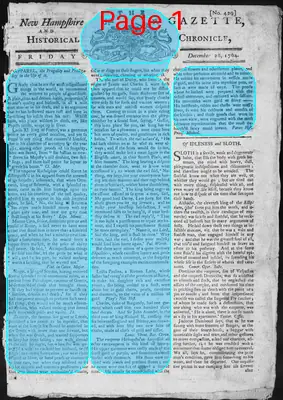
Literary
December 28, 1764
The New Hampshire Gazette And Historical Chronicle
Portsmouth, Greenland, Rockingham County, New Hampshire
What is this article about?
An essay on frugality and prodigality in apparel, praising modest dress through examples of historical figures like Louis XI, Emperor Rudolphus, Marcus Cato, and Zaleucus, while condemning extravagance in cases like Lollia Paulina, Charles Duke of Burgundy, and Emperor Heliogabalus.
Merged-components note: Merged the image with the literary component on apparel due to spatial overlap in bounding boxes, indicating the image is an illustration for this essay.
Clipping
OCR Quality
75%
Good
Full Text
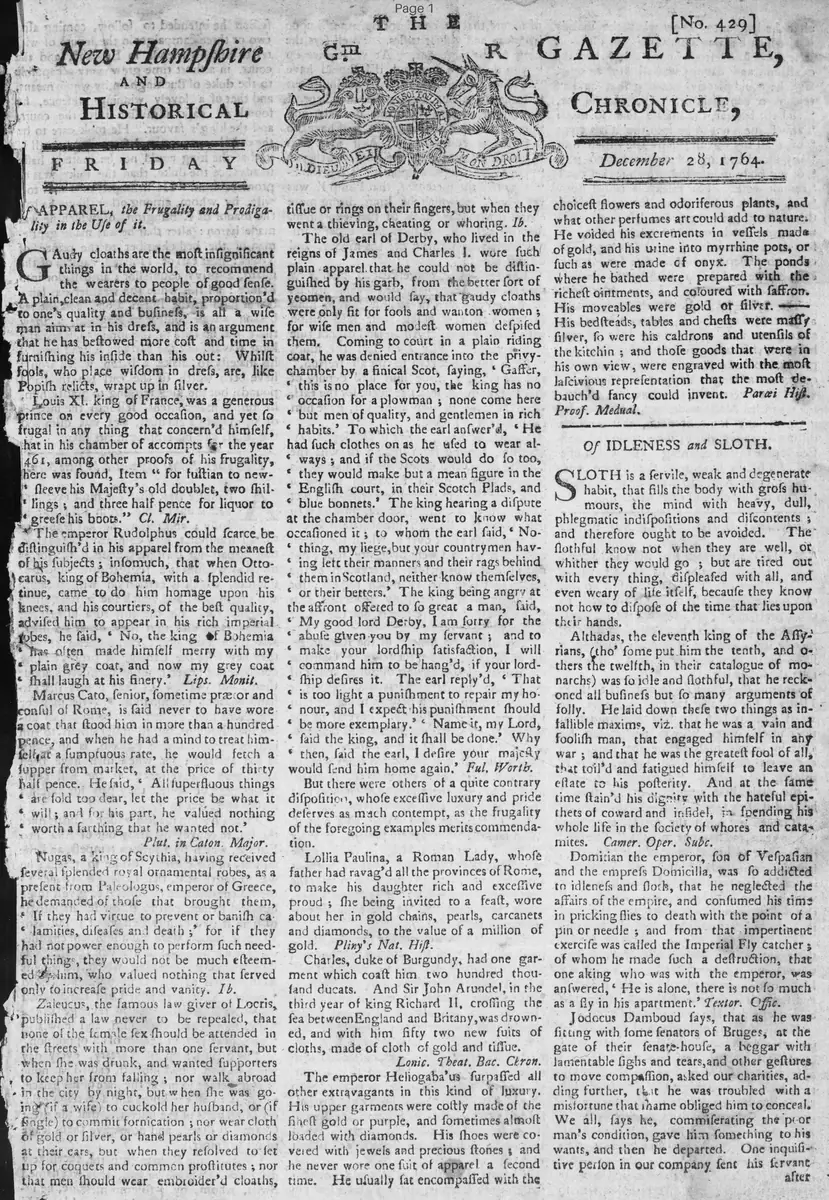
On Apparel, the Frugality and Prodigality in the Use of it.
Gaudy cloaths are the most insignificant things in the world, to recommend the wearers to people of good sense.
A plain, clean and decent habit, proportion'd to one's quality and business, is all a wise man aims at in his dress, and is an argument that he has bestowed more care and time in furnishing his inside than his outside: Whilst fools, who place wisdom in dress, are, like Phocion's relicts, wrapt up in silver.
Louis XI. king of France, was a generous prince on every good occasion, and yet so frugal in any thing that concern'd himself. That in his chamber of accounts for the year 1461, among other proofs of his frugality, there was found, Item "for fustian to new-sleeve his Majesty's old doublet, two shillings; and three half pence for liquor to grease his boots." Cl. Mir.
The emperor Rudolphus could scarce be distinguish'd in his apparel from the meanest of his subjects: Insomuch, that when Ottocarus, king of Bohemia, with a splendid retinue, came to do him homage upon his knees, and his courtiers, of the best quality, advis'd him to appear in his rich imperial robes, he said, No, the king of Bohemia has often made himself merry with my plain grey coat, and now my grey coat shall laugh at his finery. Lips. Monit.
Marcus Cato, senior, sometime prætor and consul of Rome, is said never to have wore a coat that stood him in more than a hundred pence, and when he had a mind to treat himself at a sumptuous rate, he would fetch a supper from market, at the price of thirty half pence. He said, All superfluous things are sold too dear, let the price be what it will; and for his part, he valued nothing worth a farthing that he wanted not. Plut. in Caton. Maior.
Nugas, a king of Scythia, having received several splendid royal ornamental robes, as a present from Paleologus, emperor of Greece, he demanded of those that brought them, If they had virtue to prevent or banish calamities, diseases and death; for if they had not power enough to perform such needful things, they would not be much esteem'd. Epaminondas, who valued nothing that serv'd only to increase pride and vanity. Ib.
Zaleucus, the famous law giver of Locri, published a law never to be repealed, that none of the female sex should be attended in the streets with more than one servant, but when she was drunk, and wanted supporters to keep her from falling; nor walk abroad in the city by night, but when she was going (if a wife) to cuckold her husband, or (if single) to commit fornication; nor wear cloth of gold or silver, or hang pearls or diamonds at their ears, but when they resolv'd to set up for coquets and common prostitutes; nor that men should wear embroider'd cloaths, tissue or rings on their fingers, but when they went a thieving, cheating or whoring. Ib.
The old earl of Derby, who lived in the reigns of James and Charles I. wore such plain apparel that he could not be distinguish'd by his garb, from the better sort of yeomen, and would say, that gaudy cloaths were only fit for fools and wanton women; for wise men and modest women despis'd them. Coming to court in a plain riding coat, he was denied entrance into the privy-chamber by a finical Scot, saying, Gaffer, this is no place for you, the king has no occasion for a plowman; none come here but men of quality, and gentlemen in rich habits. To which the earl answer'd, He had such clothes on as he us'd to wear always; and if the Scots would do so too, they would make but a mean figure in the English court, in their Scotch Plads, and blue bonnets. The king hearing a dispute at the chamber door, went to know what occasion'd it; to whom the earl said, Nothing, my liege, but your countrymen having left their manners and their rags behind them in Scotland, neither know themselves, nor their betters. The king being angry at the affront offer'd to so great a man, said, My good lord Derby, I am sorry for the abuse given you by my servant; and to make your lordship satisfaction, I will command him to be hang'd, if your lordship desires it. The earl reply'd, That 's is too light a punishment to repair my honour, and I expect his punishment should be more exemplary. Name it, my Lord, said the king, and it shall be done. Why then, said the earl, I desire your majesty would send him home again. Ful. Worth.
But there were others of a quite contrary disposition, whose excessive luxury and pride deserves as much contempt, as the frugality of the foregoing examples merits commendation.
Lollia Paulina, a Roman Lady, whose father had ravag'd all the provinces of Rome, to make his daughter rich and excessive proud; she being invited to a feast, wore about her in gold chains, pearls, carcanets and diamonds, to the value of a million of gold. Pliny's Nat. Hist.
Charles, duke of Burgundy, had one garment which cost him two hundred thousand ducats. And Sir John Arundel, in the third year of king Richard II. crossing the sea between England and Brittany, was drown'd, and with him fifty two new suits of cloths, made of cloth of gold and tissue. Lonic. Theat. Bac. Chron.
The emperor Heliogabalus surpass'd all other extravagants in this kind of luxury. His upper garments were costly made of the finest gold or purple, and sometimes almost loaded with diamonds. His shoes were cover'd with jewels and precious stones; and he never wore one suit of apparel a second time. He usually at encompassed with the choicest flowers and odoriferous plants, and what other perfumes art could add to nature. He voided his excrements in vessels made of gold, and his urine into myrrhine pots, or such as were made of onyx. The ponds where he bathed were prepared with the richest ointments, and coloured with saffron. His moveables were gold or silver. His bedsteads, tables and chests were massy silver, so were his caldrons and utensils of the kitchen; and those goods that were in his own view, were engraved with the most lascivious representations that the most debauch'd fancy could invent. Parci Hist. Proof. Medual.
Gaudy cloaths are the most insignificant things in the world, to recommend the wearers to people of good sense.
A plain, clean and decent habit, proportion'd to one's quality and business, is all a wise man aims at in his dress, and is an argument that he has bestowed more care and time in furnishing his inside than his outside: Whilst fools, who place wisdom in dress, are, like Phocion's relicts, wrapt up in silver.
Louis XI. king of France, was a generous prince on every good occasion, and yet so frugal in any thing that concern'd himself. That in his chamber of accounts for the year 1461, among other proofs of his frugality, there was found, Item "for fustian to new-sleeve his Majesty's old doublet, two shillings; and three half pence for liquor to grease his boots." Cl. Mir.
The emperor Rudolphus could scarce be distinguish'd in his apparel from the meanest of his subjects: Insomuch, that when Ottocarus, king of Bohemia, with a splendid retinue, came to do him homage upon his knees, and his courtiers, of the best quality, advis'd him to appear in his rich imperial robes, he said, No, the king of Bohemia has often made himself merry with my plain grey coat, and now my grey coat shall laugh at his finery. Lips. Monit.
Marcus Cato, senior, sometime prætor and consul of Rome, is said never to have wore a coat that stood him in more than a hundred pence, and when he had a mind to treat himself at a sumptuous rate, he would fetch a supper from market, at the price of thirty half pence. He said, All superfluous things are sold too dear, let the price be what it will; and for his part, he valued nothing worth a farthing that he wanted not. Plut. in Caton. Maior.
Nugas, a king of Scythia, having received several splendid royal ornamental robes, as a present from Paleologus, emperor of Greece, he demanded of those that brought them, If they had virtue to prevent or banish calamities, diseases and death; for if they had not power enough to perform such needful things, they would not be much esteem'd. Epaminondas, who valued nothing that serv'd only to increase pride and vanity. Ib.
Zaleucus, the famous law giver of Locri, published a law never to be repealed, that none of the female sex should be attended in the streets with more than one servant, but when she was drunk, and wanted supporters to keep her from falling; nor walk abroad in the city by night, but when she was going (if a wife) to cuckold her husband, or (if single) to commit fornication; nor wear cloth of gold or silver, or hang pearls or diamonds at their ears, but when they resolv'd to set up for coquets and common prostitutes; nor that men should wear embroider'd cloaths, tissue or rings on their fingers, but when they went a thieving, cheating or whoring. Ib.
The old earl of Derby, who lived in the reigns of James and Charles I. wore such plain apparel that he could not be distinguish'd by his garb, from the better sort of yeomen, and would say, that gaudy cloaths were only fit for fools and wanton women; for wise men and modest women despis'd them. Coming to court in a plain riding coat, he was denied entrance into the privy-chamber by a finical Scot, saying, Gaffer, this is no place for you, the king has no occasion for a plowman; none come here but men of quality, and gentlemen in rich habits. To which the earl answer'd, He had such clothes on as he us'd to wear always; and if the Scots would do so too, they would make but a mean figure in the English court, in their Scotch Plads, and blue bonnets. The king hearing a dispute at the chamber door, went to know what occasion'd it; to whom the earl said, Nothing, my liege, but your countrymen having left their manners and their rags behind them in Scotland, neither know themselves, nor their betters. The king being angry at the affront offer'd to so great a man, said, My good lord Derby, I am sorry for the abuse given you by my servant; and to make your lordship satisfaction, I will command him to be hang'd, if your lordship desires it. The earl reply'd, That 's is too light a punishment to repair my honour, and I expect his punishment should be more exemplary. Name it, my Lord, said the king, and it shall be done. Why then, said the earl, I desire your majesty would send him home again. Ful. Worth.
But there were others of a quite contrary disposition, whose excessive luxury and pride deserves as much contempt, as the frugality of the foregoing examples merits commendation.
Lollia Paulina, a Roman Lady, whose father had ravag'd all the provinces of Rome, to make his daughter rich and excessive proud; she being invited to a feast, wore about her in gold chains, pearls, carcanets and diamonds, to the value of a million of gold. Pliny's Nat. Hist.
Charles, duke of Burgundy, had one garment which cost him two hundred thousand ducats. And Sir John Arundel, in the third year of king Richard II. crossing the sea between England and Brittany, was drown'd, and with him fifty two new suits of cloths, made of cloth of gold and tissue. Lonic. Theat. Bac. Chron.
The emperor Heliogabalus surpass'd all other extravagants in this kind of luxury. His upper garments were costly made of the finest gold or purple, and sometimes almost loaded with diamonds. His shoes were cover'd with jewels and precious stones; and he never wore one suit of apparel a second time. He usually at encompassed with the choicest flowers and odoriferous plants, and what other perfumes art could add to nature. He voided his excrements in vessels made of gold, and his urine into myrrhine pots, or such as were made of onyx. The ponds where he bathed were prepared with the richest ointments, and coloured with saffron. His moveables were gold or silver. His bedsteads, tables and chests were massy silver, so were his caldrons and utensils of the kitchen; and those goods that were in his own view, were engraved with the most lascivious representations that the most debauch'd fancy could invent. Parci Hist. Proof. Medual.
What sub-type of article is it?
Essay
Satire
What themes does it cover?
Moral Virtue
Temperance
Social Manners
What keywords are associated?
Frugality
Prodigality
Apparel
Historical Examples
Modest Dress
Extravagance
Virtue
Luxury
Literary Details
Title
On Apparel, The Frugality And Prodigality In The Use Of It.
Form / Style
Prose Essay With Historical Anecdotes On Dress And Virtue.
Key Lines
Gaudy Cloaths Are The Most Insignificant Things In The World, To Recommend The Wearers To People Of Good Sense.
A Plain, Clean And Decent Habit, Proportion'd To One's Quality And Business, Is All A Wise Man Aims At In His Dress...
All Superfluous Things Are Sold Too Dear, Let The Price Be What It Will; And For His Part, He Valued Nothing Worth A Farthing That He Wanted Not.