Thank you for visiting SNEWPapers!
Sign up free
Berkeley And Jefferson Intelligencer
Martinsburg, Berkeley County, Virginia
What is this article about?
Proceedings in Colonel Aaron Burr's treason trial from August 18-21, detailing jury requests, witness examinations on Blennerhassett's island events, and debates on evidence admissibility regarding overt acts of treason.
Merged-components note: Continuation of narrative on Burr trial proceedings across sequential reading orders and pages.
Clippings
1 of 2
OCR Quality
Full Text
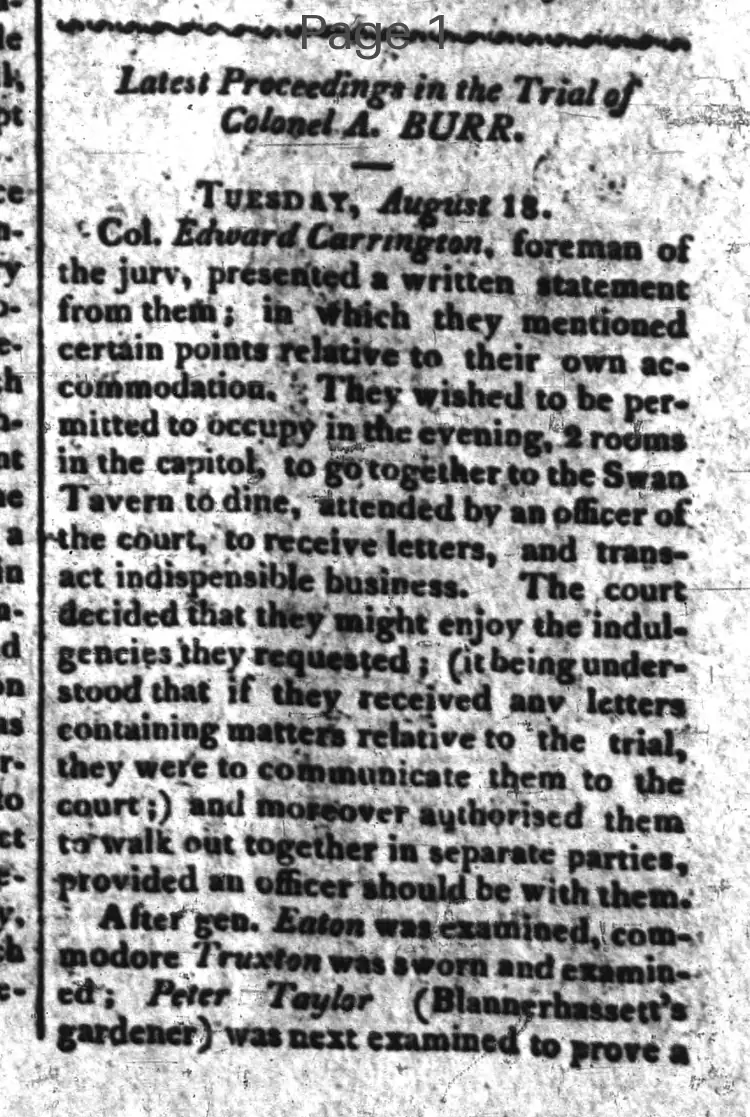
Colonel A. BURR.
TUESDAY August 18.
Col. Edward Carrington, foreman of the jury, presented a written statement from them; in Which they mentioned certain points relative to their own accommodation. They wished to be permitted to occupy in the evening, 2 rooms in the capitol, to go together to the Swan Tavern. to dine, attended by an officer of the court, to receive letters, and transact indispensible business. The court decided that they might enjoy the indulgencies they requested; (it being understood that if they received any letters containing matters relative to the trial. they were to communicate them to the court:) and moreover authorised them for walk out together in separate parties, provided an officer should be with them.
After Gen. Eaton was examined Commodore Truxton was Sworn and examined; Peter Taylor (Blannerhassett's gardener ) was next examined to prove a
Connection between Col. Burr and Blennerhassett, and explain and prove the designs of them both & the assemblage of men on Blennerhassett island.
WEDNESDAY, August 19.
General John Morgan of the county of Washington, in the state of Pennsylvania, his venerable father Col. George Morgan and Mr. Thomas Morgan his brother, were examined for the purpose of proving circumstances relative to the treasonable intentions of which Aaron Burr is accused.
The next witness introduced was Jacob Albright whose place of residence is in the state of Ohio, about one mile from Blennerhassett's. His evidence was long, and detailed a variety of circumstances concerning the assemblage of men on the island, and their departure down the river. On the same subject William Love (who had acted as a servant of Blennerhassett) was also examined. He was followed by Mr. Dudley Woodbridge, who had been Blennerhassett's partner in trade, and had kept a store on their joint account at Marietta. His testimony related partly to the same point; and was also intended to show the connexion between Burr and Blennerhassett the purchase of boats for the expedition, and some other circumstances.
The court adjourned at four o'clock in the evening.
THURSDAY, August 20.
Simeon Poole, Maurice B. Belknap, and Edmund B. Dana all of whom reside in the state of Ohio in the neighborhood of Blennerhassett's island, were examined as to the assemblage of men at that place.
From all the evidence hitherto introduced it having appeared that Col. Burr was not in the island at the time when the overt act of treason was charged to have been there committed and it being acknowledged on the part of the U. S. that he was not present Col. Burr and his counsel objected to the admissibility of any other evidence; on the ground that the proof of any connexion between him and the men assembled on the island or of his contriving or procuring them to assemble would not be sufficient (even on a supposition that they were guilty of treason) to convict him of an overt act of treason in levying war against the U. S.
This objection gave rise to most important debate, on the event of which the ultimate fate of the trial to a great degree depends.
It was opened by Mr. Wickham in a learned, ingenious and elaborate speech which lasted fully five hours, and consumed the rest of the time allowed to the session of the court.
FRIDAY, August 21.
Mr. Wickham continued his argument, which was not finished yesterday, and concluded about twelve o'clock; the session of the court having commenced at ten.
The points of law contended for by him, in the course of his long and interesting discourse were, generally, that treason in levying war against the United States cannot be committed without the employment of actual force; that, under the definition of treason in the constitution of the United States, accessories (who would be so denominated in cases of felony) are not to be considered as principals in cases of treason—that no person can be charged with treason in levying war against the United States, upon the ground of his counselling or procuring the overt act of treason, being accessory thereto, either before, or after the fact; and that a person accused of accessorial or derivative treason cannot be tried and convicted without producing a record of the conviction of the principal agent in the overt act.
He also entered into an examination of the evidence, so far as it had been introduced; and endeavored to show that no act of levying war against the United States was proved to have been committed at Blennerhassett's island.
The counsel for the United States objected to his arguing on this part of the enquiry, since the jury alone and not the court, were to judge of the weight of the evidence; but the court declared that whether the argument was correct or incorrect, they were compelled by their duty to hear it.
After Mr. Wickham had finished two witnesses were introduced on the part of the United States, (Israel Miller and Putley Howe) for the purpose of completing the evidence relative to the assemblage of men on Blennerhassett's island.
Mr. Randolph then continued the debate on the part of Col. Burr—until nearly 3 o'clock.
Mr. Hay then moved the court to allow the counsel for the United States
What sub-type of article is it?
What themes does it cover?
What keywords are associated?
What entities or persons were involved?
Where did it happen?
Story Details
Key Persons
Location
Blennerhassett's Island, Ohio; Capitol; Swan Tavern
Event Date
August 18 21
Story Details
Jury requests accommodations; witnesses testify on Burr-Blennerhassett connection and island assemblage; legal debate on evidence admissibility for treason charges, arguing accessories not principals without principal conviction.