Thank you for visiting SNEWPapers!
Sign up free
Daily National Intelligencer
Washington, District Of Columbia
What is this article about?
On February 17, 1818, in the U.S. House of Representatives, Mr. Tyler of Virginia opposed the Bankrupt Bill in a lengthy speech, criticizing its exclusivity to merchants and potential for fraud. Other members debated, and the House voted 82-70 to indefinitely postpone the bill, rejecting it.
Merged-components note: Merged as these components cover the continuation of the debate on the Bankrupt Bill, forming a single coherent news story.
Clippings
1 of 2
OCR Quality
Full Text
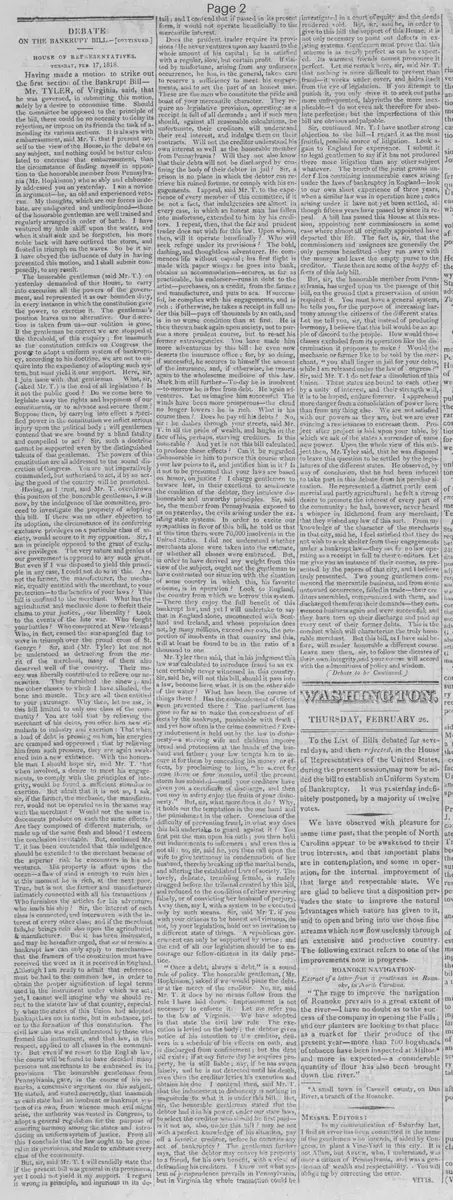
ON THE BANKRUPT BILL.—[CONTINUED.]
HOUSE OF REPRESENTATIVES.
TUESDAY, FEB. 17, 1818.
Having made a motion to strike out the first section of the Bankrupt Bill—
Mr. TYLER, of Virginia, said, that he was governed, in submitting this motion, solely by a desire to economise time. Should the committee be opposed to the principle of the bill, there could be no necessity to delay its rejection, or impose on its friends the task of amending its various sections. It is always with embarrassment, said Mr. T. that I present myself to the view of the House, in the debate on any subject, and nothing could be better calculated to increase that embarrassment, than the circumstance of finding myself in opposition to the honorable member from Pennsylvania (Mr. Hopkinson) who so ably and elaborately addressed you on yesterday. I am a novice in argument—he, an old and experienced veteran. My thoughts, which are our forces in debate, are undigested and undisciplined—those of the honorable gentleman are well trained and regularly arranged in order of battle. I have ventured my little skiff upon the water, and when it shall sink and be forgotten, his more noble bark will have outlived the storm, and floated in triumph on the waves. So be it sir. I have obeyed the influence of duty in having presented this motion, and I shall submit composedly, to any result.
The honorable gentleman (said Mr. T.) on yesterday demanded of this House, to carry into execution all the powers of the government, and represented it as our bounden duty, in every instance in which the constitution gave the power, to exercise it. The gentleman's position leaves us no alternative. Our discretion is taken from us—our volition is gone. If the gentleman be correct we are stopped at the threshold, of this enquiry; for inasmuch as the constitution confers on Congress the power to adopt a uniform system of bankruptcy, according to his doctrine, we are not to enquire into the expediency of adopting such system, but must yield it our support. Here, sir, I join issue with that gentleman. What, sir, (asked Mr. T.) is the end of all legislation? Is it not the public good? Do we come here to legislate away the rights and happiness of our constituents, or to advance and secure them? Suppose then, by carrying into effect a specified power in the constitution we inflict serious injury upon the political body; will gentlemen contend that we are bound by a blind fatality and compelled to act? Sir, such a doctrine cannot be supported even by the distinguished talents of that gentleman. The powers of this constitution are all addressed to the sound discretion of Congress. You are not imperatively commanded, but authorised to act, if by so acting the good of the country will be promoted.
Having, as I trust, said Mr. T. overthrown this position of the honorable gentleman, I will now, by the indulgence of the committee, proceed to investigate the propriety of adopting this bill. If there was no other objection to its adoption, the circumstance of its conferring exclusive privileges on a particular class of society, would secure to it my opposition. Sir, I am in principle opposed to the grant of exclusive privileges. The very nature and genius of our government is opposed to any such grant. But even if I was disposed to yield this principle in any case, I could not do so in this. Are not the farmer, the manufacturer, the mechanic, equally entitled with the merchant, to your protection—to the benefits of your laws? This bill is confined to the merchant. What has the agriculturist and mechanic done to forfeit their claims to your justice, your liberality? Look to the events of the late war. Who fought your battles? Who conquered at New Orleans? Who, in fact, caused the star-spangled flag to wave in triumph over the proud cross of St. George? Sir, said (Mr. Tyler) let me not be understood as detracting from the merit of the merchant, many of them also deserved well of the country. Their money was liberally contributed to relieve our necessities. They furnished the sinews; and the other classes to which I have alluded, the bone and muscle. They are all then entitled to your patronage. Why then, let me ask, is this bill limited to only one class of the community? You are told that by relieving the merchant of his debts, you offer him new stimulants to industry and exertion: That when a load of debt is pressing on him, his energies are cramped and oppressed; that by relieving him from such pressure, they are again awakened into a new existence. With the honorable man I should hope sir, said Mr. T. that when involved, a desire to meet his engagements, to comply with the principles of integrity, would be found a sufficient stimulus to exertion. But admit that it is not so, I ask, sir, if the farmer, the mechanic, the manufacturer, would not be operated on in the same way with the merchant? Would not the same inducements produce on each the same effects? Are they composed of different materials, or made up of the same flesh and blood? I esteem the conclusion inevitable. But, continued Mr. T. it has been contended that this indulgence should be extended to the merchant because of the superior risk he encounters in his adventures. His property is afloat upon the ocean—a flaw of wind is enough to ruin him; at this moment he is rich, at the next poor. True, but is not the farmer and manufacturer intimately connected with all his transactions? Who furnishes the articles for his adventure; who loads his ship? Sir, the interest of each class is connected, and interwoven with the interest of every other class; and if the merchant fails, he brings ruin also upon the agriculturist & manufacturer. But it has been insinuated, and may be hereafter urged, that ex vi termini a bankrupt law can only apply to merchants—that the framers of the constitution must have received the word as it is received in England. Although I am ready to admit that reference must be had to the common law, in order to obtain the proper signification of legal terms used in the instrument under which we act; yet, I cannot well imagine why we should resort to the statute law of that country, especially when the states of this Union had adopted bankrupt laws not in name, but in substance, prior to the formation of this constitution. The civil law also was well understood by those who framed this instrument, and that law, in this respect, applied to all classes in the community. But even if we resort to the English law, the courts will be found to have decided many persons not merchants to be embraced in its provisions The honorable gentleman from Pennsylvania, gave, in the course of his remarks, a conclusive argument on this subject. He stated, and stated correctly, that inasmuch as each state had an insolvent or bankrupt system of its own, from whence much evil might arise, the authority was vested in Congress, to adopt a general regulation for the purpose of ensuring harmony among the states and introducing an uniform system of justice. From all this I conclude that the law ought to be general in its provisions, and made to embrace every class of the community.
But, sir, said Mr. T. I will candidly state that if the present bill was general in its provisions, yet I could not yield it my support. I regard it wrong in principle, and injurious in its details; and I contend that if passed in its present form, it would not operate beneficially to the mercantile interest. Does the prudent trader require its provisions? He never ventures upon any hazard to the whole amount of his capital: he is satisfied with a regular, slow, but certain profit. If visited by misfortune, arising from any unforeseen occurrence, he has, in the general, taken care to reserve a sufficiency to meet his engagements, and to act the part of an honest man. These are the men who constitute the pride and boast of your mercantile character. They require no legislative provision, operating as a receipt in full of all demands; and if such men should, against all reasonable calculations, be unfortunate, their creditors will understand their real interest, and indulge them on their contracts. Will not the creditor understand his own interest as well as the honorable member from Pennsylvania? Will they not also know that their debts will not be discharged by confining the body of their debtor in jail? Sir, a prison is no place in which the debtor can retrieve his ruined fortune, or comply with his engagements. I appeal, said Mr. T. to the experience of every member of this committee, if it be not a fact, that indulgencies are almost in every case, in which an honest man has fallen into misfortune, extended to him by his creditors. I repeat, then, that the fair and prudent trader does not wish for this law. Upon whom, then, will it operate beneficially? Who will seek refuge under its provisions? The bold, dashing, and thoughtless adventurer. He commences life without capital; his first flight is made with paper wings: he goes into bank, obtains an accommodation—secures, as far as practicable, his endorser—runs in debt to the artist—purchases, on a credit, from the farmer and manufacturer, and puts to sea. If successful, he complies with his engagements, and is rich; if otherwise, he takes a receipt in full under this bill—pays off thousands by an oath, and is in no worse condition than at first. He is then thrown back again upon society, not to pursue a more prudent course, but to re-act his former extravagancies. You have made him more adventurous by this bill: he even now deserts the insurance office; for, by so doing if successful, he secures to himself the amount of the insurance, and, if otherwise, he resorts again to the wholesome medicine of this law. Mark him still further—To-day he is insolvent—to-morrow he is free from debt. He again adventures. Let us imagine him successful The winds have been more prosperous—the cloud no longer lowers: he is rich. What is his course then? Does he pay off his debts? No, sir: he dashes through your streets, said Mr. T. in all the pride of wealth, and laughs in the face of his, perhaps, starving creditors. Is this honorable? And yet is not this bill calculated to produce these effects? Can it be regarded dishonorable in him to pursue this course when your law points to it, and justifies him in it? Is it not to be presumed that your laws are based on honor, on justice? I charge gentlemen to beware lest, in their exertions to ameliorate the condition of the debtor, they inculcate dishonorable and unworthy principles. Sir, said he, the member from Pennsylvania exposed to us on yesterday, the evils arising under the existing state systems. In order to excite our sympathies in favor of this bill, he told us that at this time there were 70,000 insolvents in the United States. I did not understand whether merchants alone were taken into the estimate, or whether all classes were embraced. But, in order to have derived any weight from this view of the subject, ought not the gentleman to have contrasted our situation with the situation of some country in which this, his favorite scheme, is in operation? Look to England, the country from which we borrow this system.—There they enjoy the full benefit of this bankrupt law, and yet I will undertake to say that in England alone, unconnected with Scotland and Ireland, and whose population does not, by many millions, exceed our own, the proportion of insolvents in that country and this, will at least be found to be in the ratio of a thousand to one
Mr. Tyler then said, that in his judgment this law was calculated to introduce fraud to an extent certainly never witnessed in this country. Sir, said he, will not this bill, should it pass into a law, become here what it is on the other side of the water? What has been the course of things there? Has the embezzlement of effects been prevented there? The parliament has gone so far as to make the concealment of effects by the bankrupt, punishable with death; and yet how often is the crime committed? Every inducement is held out by the law to dishonesty—a starving wife and children implore bread and protection at the hands of the husband and father; your law tempts him to secure it for them by concealing his money or effects, by proclaiming to him, "be secret for some three or four months, until the present storm has subsided—until your creditors have given you a certificate of discharge, and then you may in safety enjoy the fruits of your dishonesty." But, sir, what more does it do? Why, it holds out the temptation in the one hand and the punishment in the other. Conscious of the difficulty of preventing fraud, in what way does this bill undertake to guard against it? You first put the man upon his oath; you then hold out inducements to informers; and even this is not all: no, sir, said he, you then call upon the wife to give testimony in condemnation of her husband, thereby breaking up the marital bonds, and altering the established laws of society. The lovely, delicate, trembling female, is rudely dragged before the tribunal created by this bill, and reduced to the condition of either swearing falsely, or of convicting her husband of perjury. Away then, say I, with a system to be executed only by such means. Sir, said Mr T. if you wish your citizens to be honest and virtuous, do not, by your legislation, hold out an invitation to a different state of things. A republican government can only be supported by virtue; and the end of all our legislation should be to encourage our fellow-citizens in its daily practice.
"Once a debt, always a debt." is a sound rule of policy. The honorable gentleman, (Mr. Hopkinson,) asked if we would place the debtor at the mercy of the creditor. No, sir, said Mr. T. it does by no means follow from the rule I have laid down. Imprisonment is not necessary to enforce it. Let me refer you to the law of Virginia. We have adopted in that state the civil law rule The execution is levied on the body; the debtor gives notice of his intention to the creditor, delivers in a schedule of his effects on oath, and is discharged from confinement; but the debt still exists; if at any future day he acquires property, he is still liable; nay, if he has sworn falsely, and he is not detected until his death, even then the creditor levies his execution and obtains his due I contend then, said Mr. T. that the inducement to dishonesty is nothing in magnitude to what it is under this bill. But, sir, the honorable gentleman stated that the debtor had it in his power, under our state laws, to select the creditor who should be first paid—is it not so, also, under this bill? may he not with a perfect knowledge of his situation, pay off a favorite creditor, before he commits any act of bankruptcy? The gentleman further says, that the debtor may convey his property to a friend, for his own benefit, with a view of defrauding his creditors. I know not what system of jurisprudence prevails in Pennsylvania, but in Virginia the whole transaction could be investigated in a court of equity and the deeds rendered void. But, sir, said he, in order to give to this bill the support of this House, it is not only necessary to point out defects in existing systems. Gentlemen must prove that this scheme is as nearly perfect as can be expected. Its warmest friends cannot pronounce it perfect. Let me remark here, sir, said Mr. T. that nothing is more difficult to prevent than fraud—it works under cover, and hides itself from the eye of legislation. If you attempt to punish it, you only drive it to seek out paths more unfrequented, labyrinths the more inexplicable—I do not even ask therefore for absolute perfection; but the imperfections of this bill are obvious and palpable.
Sir. continued Mr. T. I have another strong objection to the bill—I regard it as the most fruitful, possible source of litigation. Look again to England for experience. I submit it to legal gentlemen to say if it has not produced there more litigation than any other subject whatever. The bench of the jurist groans under folios containing innumerable cases arising under the laws of bankruptcy in England—look to our own short experience of three years, when a similar law was in operation here; cases arising under it have not yet been settled, although fifteen years have passed by since its repeal. A bill has passed this House at this session, appointing new commissioners in some case where almost all originally appointed have departed this life. The fact is, sir, that the commissioners and assignees are generally the only persons benefitted—they run away with the money and leave the empty purse to the creditor. These then are some of the happy effects of this holy bill.
But, sir, the honorable member from Pennsylvania, has urged upon us the passage of this bill, on the ground that a preservation of union required it. You must have a general system, he tells you, for the purpose of increasing harmony among the citizens of the different states Let me tell you, sir, that instead of producing harmony, I believe that this bill would be an apple of discord to the people. How would those classes excluded from its operation like the discrimination it proposes to make? Would the mechanic or farmer like to be told by the merchant, "you shall linger in jail for your debts, while I am released under the law of Congress?" Sir, said Mr. T. I do not fear a dissolution of this Union. These states are bound to each other by a unity of interest, and their strength will, it is to be hoped, endure forever. I apprehend more danger from a consolidation of power here than from any thing else. We are not satisfied with our powers as they are, but we are ever evincing a restlessness to increase them. Project after project is laid upon your table, by which we ask of the states a surrender of some new power. Upon the whole view of this subject then, Mr. Tyler said, that he was disposed to leave this question to be settled by the legislatures of the different states. He observed, by way of conclusion, that he had been induced to take part in this debate from his peculiar situation. He represented a district partly commercial and partly agricultural; he felt a strong desire to promote the interest of every part of the community: he had, however, never heard a whisper in Richmond from any merchant, that they wished any law of this sort. From my knowledge of the character of the merchants in that city, said he. I feel satisfied that they do not wish to seek shelter from their engagements under a bankrupt law—they ask for no law operating as a receipt in full to their creditors. Let me give you an instance of their course, as presented by the papers of that city, and I believe truly presented. Two young gentlemen commenced the mercantile business, and from some untoward occurrence, failed in trade—their creditors assembled, compromized with them, and discharged them from their demands—they commenced business again and were successful; and they have torn up their discharge and paid up every cent of their former debts. This is the conduct which will characterize the truly honorable merchant. But this bill, as I have said before, will render honorable a different course. Leave men then. sir, to follow the dictates of their own integrity, and your course will accord with the admonitions of policy and wisdom.
(Debate to be Continued.)
The House then again proceeded to the consideration of the BANKRUPT BILL.
The question being on Mr. Edwards motion, to discharge the committee of the whole House from the further consideration of the bill and to postpone it indefinitely.
Mr. Whitman of Mass. delivered a speech of about an hour in length against the motion, and in favor of the system.
Mr. Barbour next took the floor, in favor of the postponement, and decidedly against the bill.
Mr. Livermore, Mr. Baldwin, and Mr. Beecher then spoke in opposition to the motion to postpone the further consideration of the bill.
The House having refused to agree to a motion for adjournment,
The question on the motion to postpone the bill indefinitely was taken by Yeas and Nays, as follows:
YEAS—Messrs. Abbott, Anderson, Ken. Austin, Ball, Barbour, Va. Bassett, Bateman, Belllinger, Bennett, Blount, Boden, Bryan, Burwell, Butler, Campbell, Clagett, Claiborne Cobb, Comstock, Cook, Crafts, Crawford, Desha, Earle, Edwards, Floyd. Forney, Garnett, Hale, Hall, N. C. Hendricks, Herrick, Holmes, Mass. Johnson, Va Johnson, Ky. Jones, Kinsey, W. Macklay, Wm. P. Macklay, M'Coy, Marr, Merrill, Morton, Mumford, Murray, H. Nelson, Nesbitt, Newton, Owen, Patterson, Pindall, Pleasants, Quarles, Rhea, Richards, Ringgold, Robertson, Lou. Sampson, Savage, Scudder, Settle, Shaw, Simkins, Slocumb, Bal. Smith, Alex. Smyth, J. S Smith, Spencer, Stewart, N. C. Strother, Tarr, Terrill, Trimble. Tucker, Va. Tucker, S. C. Tyler, Upham, Walker, Ky. Wallace, Williams, N. Y. Williams, N. C. Wilson, Pen.—82.
NAYS—Messrs. Adams, Allen, Mass. Allen Vt Anderson, Pen Baldwin, Bayley, Beecher, Boss, Colston, Cruger, Cushman, Darlington, Ellicott, Ervin, S. C. Folger, Forsyth, Fuller, Hall, Del. Harrison, Hasbrouck, Herbert, Herkimer, Heister, Hitchcock, Holmes, Con. Hopkinson, Hubbard, Huntingdon, Kirtland, Lawyer, Little, Livermore, Lowndes, M'Lane, Mason, Mass. Mason, R. I. Mercer. Middleton, Mills, Moore, Mosely, Jer. Nelson, Ogden, Ogle, Orr, Palmer, Parrott, Peter, Poindexter, Porter, Reed, Rich, Robertson, Ky. Ruggles, Sawyer, Schuyler, Sergeant, Seybert, Sherwood, Tallmadge. Taylor, Terry, Tompkins, Wendover, Westerlo, Whiteside, Whitman, Williams, Con. Wilkin, Wilson, Mass.—70.
So the House determined that the bill be INDEFINITELY POSTPONED, that is, rejected.
And the house adjourned.
Our Reporter misunderstood Mr. Clay to have made a motion on Tuesday to strike out the first section of the Bankrupt Bill. That question recurred of course on the re consideration of the first vote, and Mr. Clay voted on the second, as he had on the first trial of the question, against striking out the first section.
What sub-type of article is it?
What keywords are associated?
What entities or persons were involved?
Where did it happen?
Domestic News Details
Primary Location
House Of Representatives
Event Date
February 17, 1818
Key Persons
Outcome
the house voted 82-70 to indefinitely postpone the bankrupt bill, effectively rejecting it.
Event Details
Mr. Tyler of Virginia moved to strike out the first section of the Bankrupt Bill to test its principle and delivered a speech opposing it, arguing against exclusive privileges for merchants, potential for fraud, and promotion of dishonesty, advocating for state-level handling or a general law. Other members spoke for and against postponement. The motion to postpone indefinitely passed.