Thank you for visiting SNEWPapers!
Sign up free
The Courier Index
Marianna, Lee County, Arkansas
What is this article about?
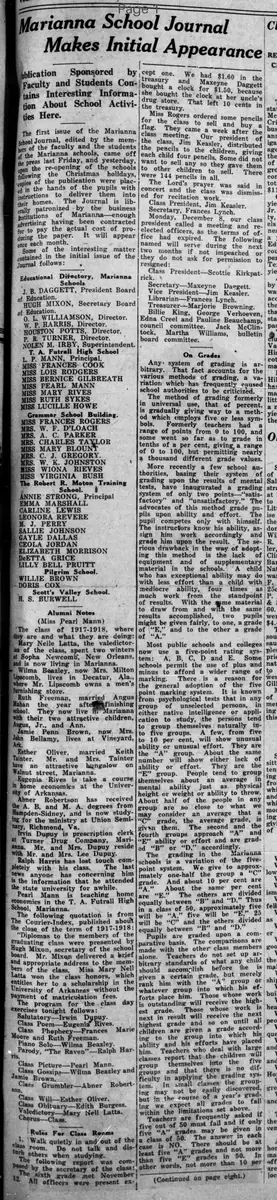
The inaugural issue of the Marianna School Journal, edited by faculty and students, was published last Friday in December 1923. Sponsored by local businesses, it features school directory, alumni updates, class activities, grading explanations, football awards, and grammar school reports in Marianna, Arkansas.
Merged-components note: Merging the Marianna School Journal story from page 1 (reading orders 2 and 3) with its continuation on page 8, as indicated by the 'Continued from page one' text.
Clippings
1 of 2
OCR Quality
Full Text
Makes Initial Appearance
Publication Sponsored by
Faculty and Students Con-
tains Interesting Informa-
tion About School Activi-
ties Here.
The first issue of the Marianna
School Journal, edited by the mem-
bers of the faculty and the students
of the Marianna schools, came off
the press last Friday, and yesterday,
upon the re-opening of the schools
the copies of the publication were plac-
ed in their homes. The Journal is lib-
erally patronized by the business
institutions of Marianna-enough
advertising having been contracted
for to pay the actual cost of pro-
ducing the paper.
It will appear once each month.
Some of the interesting matter
contained in the initial issue of the
Journal follows:
Educational
Directory,
Marianna
Schools
J. B. DAGGETT, President Board
of Education.
HUGH MIXON, Secretary Board
of Education.
O. L. WILLIAMSON, Director.
W. P. HARRIS, Director.
HOUSTON POTTS, Director.
P. R. TURNER, Director.
NOLEN M. IRBY, Superintendent.
T. A. Futrall High School
L. P. MANN, Principal.
MISS FRANCES COOK
MISS LOIS RODGERS
MISS BERNICE GILBREATH
MISS PEARL MANN
MISS MARY RIVES
MISS RUTH SYKES
MISS LUCILLE HOWE
Grammar School Building.
MISS FRANCES ROGERS
MRS. W. F. D'LOACH
MRS. A. C. PARKER
MRS. CHARLES TAYLOR
MISS MARY BLOUNT
MRS. C. J. GREGORY.
MRS. W. K. JOHNSTON
MISS WIONA RIEVES
MISS VIRGINIA BUSH
The Robert R. Moton Training
School.
ANNIE STRONG. Principal
EMMA MARSHALL
CARLINE LEWIS
LEONORA REVERE
M. J. PERRY
SALLIE JOHNSON
GAYLE DALLAS
CEOLA JORDAN
ELIZABETH MORRISON
DEETTA GRICE
LILLY BELL PRUITT
Pilgrim School.
WILLIE BROWN
DORIS COX
Scott's Valley School.
H. S. BURWELL
Alumni Notes
(Miss Pearl Mann)
The class of 1917-1918, where
they are and what they are doing:
Mary Nelle Latta, the valedictor-
ian of the class, spent two winters
at Sophie Newcomb, New Orleans,
and is now living in Marianna.
Wilma Beazley, now Mrs. Milton
Lipscomb, lives in Decatur, Ala.,
where Mr. Lipscomb owns a men's
furnishing store.
Ruth Freeman,
married Angus
Mahan the year
after finishing
school. They now live in Marianna
with their two attractive children,
Angus, Jr., and Ann.
Jamie Penn Brown, now Mrs.
John Bellamy,
lives at Vineyard,
Ark.
Esther
Oliver,
married
Keith
Tainter.
Mr. and
Mrs.
Tainter
have an attractive bungalow on
Walnut street, Marianna.
Eugenia Rives is taking a course
in home economics at the Univer-
sity of Arkansas.
Abner Robertson has received
the A. B. and M. A. degrees from
Hampden-Sidney. and is now study-
ing for the ministry at Union Semi-
nary, Richmond, Va.
Irvin Dupuy is prescription clerk
at Turner Drug Company, Mari-
anna. Mr. and Mrs. Dupuy reside
with Mr. and Mrs. Lee Dupuy.
Ralph Harris has lost touch com-
pletely with his class. The last
news anyone has concerning him
is the information that he attended
the state university for awhile.
Pearl Mann is teaching home
economics in the T. A. Futrall High
School, Marianna.
The following quotation is from
The Courier-Index, published about
the close of the term of 1917-1918:
"Diplomas to the members of the
graduating class were presented by
Hugh Mixon, secretary of the school
board. Mr. Mixon delivered a brief
and appropriate address to the mem-
bers of the class. Miss Mary Nell
Latta won the class honors, which
entitles her to a scholarship in the
University of Arkansas without the
payment of matriculation fees.
The program for the class day
exercises tonight follows:
Salutatory-Irvin Dupuy.
Class Poem-Eugenia Rives.
Class Prophecy—Frances
Marie
Moore and Ruth Freeman.
Piano Solo-Wilma Beazley.
Parody, "The Raven" —Ralph Har-
ris.
Class Picture-—Pearl Mann.
Class Gossips-Wilma Beazley and
Jamie Brown.
Class
Grumbler-Abner Robert-
son.
Class Will—Esther Oliver.
Class Obituary—Edith Burgess.
Valedictory-Mary Nell Latta.
Chorus-Class.
Rules For Class Rooms
1. Walk quietly in and out of the
class room
Do not talk and dis-
turb others
The following report was com-
posed by the secretary of the class:
The
12. All officers were present ex-
cept one.
We had $1.60 in the
treasury and Maxeyne Daggett
bought a clock for $1.50, because
she bought the clock at her uncle's
drug store. That left 10 cents in
the treasury.
Miss Rogers ordered some pencils
for the class to sell and buy a
flag. They came a week after the
class meeting. Our president of
the class, Jim Keasler. distributed
the pencils to the children, giving
each child four pencils. Some did not
want to sell any so they gave them
to other children to sell. There
were 144 pencils in all.
The Lord's prayer was said in
concert and the class was dismiss-
ed for recitation work.
Class President, Jim Keasler.
Secretary, Frances Lynch.
Monday, December 8, our class
president called a meeting and re-
elected officers, as the terms of of-
fice had expired. The following
named will serve during the next
two months if not impeached or
they do not ask for permission to
resign:
Class President-Scottie Kirkpat-
riek.
Secretary-Maxeyne Daggett.
Vice President-Jim Keasler.
Librarian-Frances Lynch.
Treasurer-Marjorie Browning.
Billie King, George Verhoeven,
Edna Creel and Pauline Beauchamp,
council committee. Jack MeClin-
tock, Martha Williams, bulletin
board committee:
On Grades
Any system of grading is ar-
bitrary. That fact accounts for the
various methods of grading, a va-
riation which has frequently caused
school authorities to be criticized.
The method of grading formerly
in universal use, that of percent,
is gradually giving way to a meth-
od which employs five or less sym-
bols. Formerly teachers had a
range of points from 0 to 100, and
some went so far as to grade in
tenths of a per cent, giving a range
of 0 to 100, but permitting nearly
a thousand different grade values.
More recently a few school au-
thorities, basing their system of
grading upon the results of mental
tests, have inaugurated a grading
system of only two points "satis-
factory" and "unsatisfactory." The
advocates of this method grade pu-
pils upon ability and effort. The
pupil competes only with himself.
The instructors know his ability, as-
sign him work accordingly and
grade him upon the result. The se-
rious drawback in the way of adopt-
ing this method is the lack of
equipment and of supplementary
material in the schools. A child
who has exceptional ability may do
with less effort than a child with
mediocre ability, four times as
much work from the standpoint
of results. With the same material
to draw from and with the same
results accomplished, two pupils
might be given fairly, to one, a grade
of "E,"
and to the other a grade
of
"A."
Most public schools and colleges
now use a five-point rating sys-
tem: A, B. C, D and E. Some
schools permit the use of plus and
minus to afford a wider range of
marking. There is a reason for
the general adoption of the five
point marking system. It is known
from psychological tests that in any
group of unselected persons, in
either native intelligence or appli-
cation to study, the persons tend
to group themselves naturally in-
to five groups. A few, from five
to 10 per cent, will show unusual
ability or unusual effort. They are
the "A" group. About the same
number will show either lack of
ability or effort. They are the
"E" group. People tend to group
themselves about an average in
mental ability just as physical
height or weight or ability to throw.
About half of the people in any
group are so close to what we
may consider an average that a
"C"
grade, the average grade, is
given them. The second and the
fourth groups approach "A" and
"E" ability or effort and are grad-
ed "B" or "D," accordingly.
The grading in the Marianna
schools is a variation of the five-
point system. We give to approx-
imately one-half the group a "C"
grade. And about 10 per cent are
"A."
About the same per cent
are "E." The others are divided
in a class of 50, approximately five
equally between "B" and "D." Thus
will be "A." five will be "E." 25
will be "C" and the others divided
equally between "B" and "D."
Pupils are graded upon a com-
parative basis. The comparisons are
made with the other class members
alone. Teachers do not set up ar-
bitrary standards of what any child
should accomplish before he is
given a certain grade. but merely
rank him with the "A" group or
whatever group into which his ef-
forts place him. Those whose work
is outstanding will receive the high-
est grade. Those whose work is
next in result will receive the next
highest grade and so on until all
children are given a grade accord-
ing to the group into which his
ability and his efforts have placed
him. Teachers who deal with large
classes report that the children will
group themselves into the five
groups and that there is no dif-
ficulty in applying the grading sys-
tem. In small classes the group-
ing may not be easily discovered,
but in the course of a year's grad-
ing we expect all grades to fall
within the limitations set above.
Teachers are frequently asked if
five "A" grades may be given in
a class of 50. The answer in each
case is NO. There should be at
least five "A" grades and not more
than five "E" grades in 50. In
other words, not more than 10 per
(Continued on page eight.)
Marianna School Journal
(Continued from page one.)
cent of the children may fail. In other years, in other schools, at least, it is not uncommon to find that as many as 25 per cent have failed. The failing pupil has another protection. Grades are merely comparisons, but promotions are made when it is thought the child will do better in the succeeding grade. In extreme cases a child may have made an "E" grade for the year and still be promoted at the end of the year. Such cases are treated individually and parents, teachers and the superintendent pass on each case.
We believe the method outlined above is the best to use. It seems the only fair method. It gives all children an equal chance at the best marks. We are following the practice of the better high schools and colleges in the country. Parents who have discussed the plan with teachers have usually pronounced it good.
Letter Men to Get Sweaters
As an expression of their appreciation for the splendid work done by the Marianna High School football team, the business men will give all letter men a large black coat sweater with a gold "M" on it. Chas. Harp and Addison Wall did not make their letters this year. But in view of the fact that they are both Seniors and that sweaters have never been given before, and that they have both played regularly on the team for the past three years, it was decided to award them sweaters on their past services. Those who will receive sweaters are: K. Jones, H. Irby, R. Dupuy, H. Strain, H. Jackson, S. Gilberg, E. Goodwinn, A. Nelson, H. Shumacker, W. Woodall, F. Jones, J. Maynard, C. Harp and A. Wall.
STATE DEPARTMENT OF EDUCATION
Little Rock, Arkansas
December 12, 1923.
Supt. Nolen M. Irby,
Marianna, Ark.
Dear Sir:
It gives pleasure to announce to you that your school was again placed on the Southern Accredited List. I am enclosing some new regulations of the Commission and suggestions for the work of the coming year.
With best wishes. I am,
yours truly,
J. R. ALLEN.
State High School Inspector.
JRA-EF
Class Constitution and Preamble
We, the pupils of the sixth grade, in order to keep up with the standard of our school and grade, to form a more united class, establish habits of industry, insure courtesy, provide for co-operation promote class spirit and harmony and to get and use a good education, do ordain and establish this constitution for our class:
Article 1.
Officers and their duties.
Section 1.
Officers: The officers of this class will be president, vice president, secretary, treasurer sergeant-at-arms and the council
Qualifications: All officers must be firm, dignified, and should always be orderly.
The terms of office for all officers and standing committees shall be two months.
Section 2. The class may, upon vote of two-thirds of those present, impeach any officer or committee member.
Section 3. Upon the resignation of the president the vice president shall become president and the class shall at the next class meeting elect a new vice president. In case of vacancies in other offices the successor shall be elected at the next class meeting.
Article 4. Oath of Office: I do solemnly swear that I will faithfully carry out the duties of my office and to the best of my ability will protect and preserve this constitution of the sixth grade.
Article 5. Amendments upon a vote of two-thirds of the class an amendment becomes legal. Upon a vote of two-thirds of the class constitution shall become legal.
Section 2. Duties of Officers:
The president shall preside at meetings, keep order and enforce laws. He shall appoint the chairman of all standing committees except the council and the magazine committees.
He shall regularly call formal meetings of the class. The vice president shall acquaint himself with the duties of the president's place. He shall also act as chairman of the council. The secretary shall keep a neat and careful record of all money paid out or handed in. The sergeant-at-arms shall provide seats for visitors and books with an explanation of the work on hand.
Section 1. It shall be the duty of the council to advise and assist the president in all matters of class government.
Section 2. The Librarian shall account for all books and give them out for reference work. Shall see that books are properly catalogued and shall keep books in good order.
Section 3. The magazine committee shall arrange, edit and publish the class report.
Section 4. The house committee shall take charge of the room, water, plants, take out glasses and keep the room neat each day.
Section 5. The bulletin board committee shall arrange material for the bulletin board.
Article 3. Section 1. The resignation of officers is lawful but do not become effective unless accepted by the majority of class.
Report of Grammar School
The Grammar School opened this year with an unusual amount of interest shown by both pupils, and teachers.
We have some very conscientious teachers in their work, and everyone seems to be anxious to help her co-workers.
Our convocation periods are very good this year. Mrs. Gregory, the second grade teacher, gave an interesting Thanksgiving program. These programs are rendered on Tuesdays and Fridays of each week, from 1 o'clock to 1:30 o'clock.
During the week of November 18-24 which was designated by our president of the United States and Gov. T. C. McRae, throughout the state American Education Week,
we were honored very much by some very interesting addresses, by one member of our school board P. R. Turner, Mr. Samuel and Mr. Norment.
Mrs. W. F. DeLoach, teacher of the fifth grade, deserves credit and our thanks for helping to continue our public school music this year in most of the grades. Heretofore the school board has hired a teacher for this work. She gives us her services and does not receive extra pay.
John Harp, aged 10 years, surprised his class several weeks ago by being promoted from fourth to fifth grade. He is doing excellent work.
Third Grade
Faber Sellers, who recently had her tonsils removed, is improving. We hope she will be in school soon.
Margaret Jones has so far been the only all "A" pupil of this grade.
Twelve girls and 12 boys in the third grade were neither absent nor tardy last month.
Gaines Augustus, who has visited this grade for the past month, has returned to his home in Mississippi.
This grade recently gave the play, "Hansel and Gretel," at convocation.
Miss Blount and her pupils deserve credit for this interesting work.
The teacher and children of the third grade, in Mrs. Taylor's room were shocked by the sad accident which resulted in the death of Archie King, one of their fellow students. Hearts have gone out in tenderest sympathy to his little sister with the vacant desk behind her. This they tried to express by sending flowers to this little fellow's last resting place.
Mrs. L. M. Osborne has donated the grade school a nice couch which is much appreciated by both pupils and teachers.
We have about 240 books in our library of which about 40 of them have been donated by the sixth grade.
The sixth grade teacher, on account of having an extra amount of work to manage, has formulated a "Class Constitution" for their grade in the form of student government which has been very helpful in this grade.
What sub-type of article is it?
What themes does it cover?
What keywords are associated?
What entities or persons were involved?
Where did it happen?
Story Details
Key Persons
Location
Marianna, Arkansas
Event Date
December 1923
Story Details
The first issue of the Marianna School Journal details school staff directory, alumni updates from 1917-1918 class including marriages, education, and careers; class activities and constitution; explanation of comparative grading system; awards for football team; accreditation letter; and grammar school reports on programs, promotions, and student events.