Thank you for visiting SNEWPapers!
Sign up free
The National Intelligencer And Washington Advertiser
Washington, District Of Columbia
What is this article about?
Analysis of New York state's population growth from 1756 (96,775 inhabitants) to 1790 (340,120), with projections to 980,240 by 1810 and 1,960,480 by 1834, factoring natural increase and emigration, suggesting capacity for up to three million.
Clipping
OCR Quality
Full Text
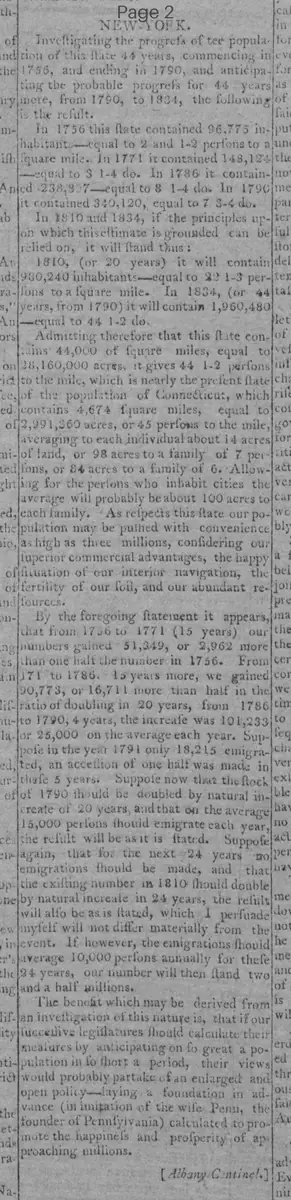
Investigating the progress of the population of this state 44 years, Commencing in 1756, and ending in 1790, and anticipating the probable progress for 44 years more, from 1790, to 1834, the following is the result.
In 1756 this state contained 96,775 inhabitants-equal to 2 and 1-2 persons to a square mile. In 1771 it contained 148,124 equal to 3 1-4 do. In 1786 it contained 238,377-equal to 8 1-4 do. In 1790 it contained 340,120, equal to 7 3-4 do.
In 1810 and 1834, if the principles upon which this estimate is grounded can be relied on, it will stand thus:
1810, (or 20 years) it will contain 980,240 inhabitants-equal to 22 1-3 persons to a square mile. In 1834, (or 44 years, from 1790) it will contain 1,960,480 -equal to 44 1-2 do.
Admitting therefore that this state contains 44,000 of square miles, equal to 28,160,000 acres, it gives 44 1-2 persons to the mile, which is nearly the present state of the population of Connecticut, which contains 4,674 square miles, equal to 2,991,360 acres, or 45 persons to the mile, averaging to each individual about 14 acres of land, or 98 acres to a family of 7 persons, or 84 acres to a family of 6. Allowing for the persons who inhabit cities the average will probably be about 100 acres to each family. As respects this state our population may be pushed with convenience as high as three millions, considering our superior commercial advantages, the happy situation of our interior navigation, the fertility of our soil, and our abundant resources.
By the foregoing statement it appears, that from 1756 to 1771 (15 years) our numbers gained 51,349, or 2,962 more than one half the number in 1756. From 1771 to 1786, 15 years more, we gained 90,773, or 16,711 more than half in the ratio of doubling in 20 years, from 1786 to 1790, 4 years, the increase was 101,233 or 25,000 on the average each year. Suppose in the year 1791 only 18,215 emigrated, an accretion of one half was made in those 5 years. Suppose now that the stock of 1790 should be doubled by natural increase of 20 years, and that on the average 15,000 persons should emigrate each year, the result will be as it is stated. Suppose again, that for the next 24 years more emigrations should be made, and that the existing number in 1810 should double by natural increase in 24 years, the result will also be as is stated, which I persuade myself will not differ materially from the event. If however, the emigrations should average 10,000 persons annually for these 24 years, our number will then stand two and a half millions.
The benefit which may be derived from an investigation of this nature is, that if our successive legislatures should calculate their measures by anticipating on so great a population in so short a period, their views would probably partake of an enlarged and open policy-laying a foundation in advance (in imitation of the wise Penn, the founder of Pennsylvania) calculated to promote the happiness and prosperity of approaching millions.
[Albany Centinel.]
What sub-type of article is it?
What keywords are associated?
What entities or persons were involved?
Where did it happen?
Domestic News Details
Primary Location
New York
Key Persons
Event Details
Investigating the progress of the population of this state 44 years, Commencing in 1756, and ending in 1790, and anticipating the probable progress for 44 years more, from 1790, to 1834, the following is the result. In 1756 this state contained 96,775 inhabitants-equal to 2 and 1-2 persons to a square mile. In 1771 it contained 148,124 equal to 3 1-4 do. In 1786 it contained 238,377-equal to 8 1-4 do. In 1790 it contained 340,120, equal to 7 3-4 do. In 1810 and 1834, if the principles upon which this estimate is grounded can be relied on, it will stand thus: 1810, (or 20 years) it will contain 980,240 inhabitants-equal to 22 1-3 persons to a square mile. In 1834, (or 44 years, from 1790) it will contain 1,960,480 -equal to 44 1-2 do. Admitting therefore that this state contains 44,000 of square miles, equal to 28,160,000 acres, it gives 44 1-2 persons to the mile, which is nearly the present state of the population of Connecticut, which contains 4,674 square miles, equal to 2,991,360 acres, or 45 persons to the mile, averaging to each individual about 14 acres of land, or 98 acres to a family of 7 persons, or 84 acres to a family of 6. Allowing for the persons who inhabit cities the average will probably be about 100 acres to each family. As respects this state our population may be pushed with convenience as high as three millions, considering our superior commercial advantages, the happy situation of our interior navigation, the fertility of our soil, and our abundant resources. By the foregoing statement it appears, that from 1756 to 1771 (15 years) our numbers gained 51,349, or 2,962 more than one half the number in 1756. From 1771 to 1786, 15 years more, we gained 90,773, or 16,711 more than half in the ratio of doubling in 20 years, from 1786 to 1790, 4 years, the increase was 101,233 or 25,000 on the average each year. Suppose in the year 1791 only 18,215 emigrated, an accretion of one half was made in those 5 years. Suppose now that the stock of 1790 should be doubled by natural increase of 20 years, and that on the average 15,000 persons should emigrate each year, the result will be as it is stated. Suppose again, that for the next 24 years more emigrations should be made, and that the existing number in 1810 should double by natural increase in 24 years, the result will also be as is stated, which I persuade myself will not differ materially from the event. If however, the emigrations should average 10,000 persons annually for these 24 years, our number will then stand two and a half millions. The benefit which may be derived from an investigation of this nature is, that if our successive legislatures should calculate their measures by anticipating on so great a population in so short a period, their views would probably partake of an enlarged and open policy-laying a foundation in advance (in imitation of the wise Penn, the founder of Pennsylvania) calculated to promote the happiness and prosperity of approaching millions.