Thank you for visiting SNEWPapers!
Sign up free
Litchfield Enquirer
Litchfield, Litchfield County, Connecticut
What is this article about?
Professor Silliman's sixth lecture on geology in March discusses the Earth's place in the solar system, recent volcanic eruptions, coral's animal origins, transition rocks, and extensively the coal formation as evidence of divine providence, including its origins, fossils, global locations, and implications for ancient climate.
Clipping
OCR Quality
Full Text
By Professor Silliman.
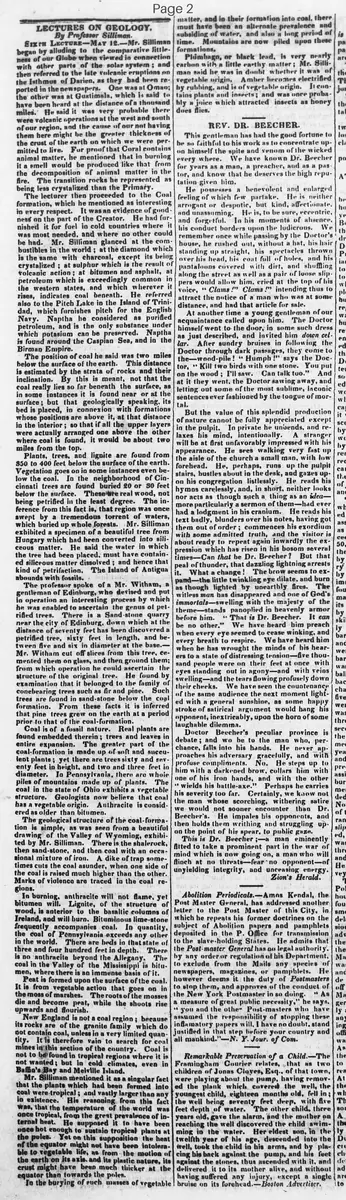
Sixth Lecture—March.—Mr. Silliman began by alluding to the comparative littleness of our Globe when viewed in connection with other parts of the solar system; and then referred to the late volcanic eruptions on the Isthmus of Darien, as they had been reported in the newspapers. One was at Omai; the other was at Guatemala, which is said to have been heard at the distance of a thousand miles. He said it was very probable there were volcanic operations at the west and south of our region, and the cause of our not having them here might be the greater thickness of the crust of the earth on which we were permitted to live. For proof that Coral contains animal matter, he mentioned that in burning it a smell would be produced like that from the decomposition of animal matter in the fire. The transition rocks he represented as being less crystallized than the Primary.
The lecturer then proceeded to the Coal formation, which he mentioned as interesting in every respect. It was an evidence of goodness on the part of the Creator. He had furnished it for fuel in cold countries where it was most needed, and where no other could be had. Mr. Silliman glanced at the combustibles in the world; at the diamond which is the same with charcoal, except its being crystallized; at sulphur which is the result of volcanic action; at bitumen and asphalt, at petroleum which is exceedingly common in the western states, and which wherever it rises, indicates coal beneath. He referred also to the Pitch Lake in the Island of Trinidad, which furnishes pitch for the English Navy. Naphtha he considered as purified petroleum, and is the only substance under which potassium can be preserved. Naphtha is found around the Caspian Sea, and in the Birman Empire.
The position of coal he said was two miles below the surface of the earth. This distance is estimated by the strata of rocks and their inclination. By this is meant, not that the coal really lies so far beneath the surface, as in some instances it is found near or at the surface; but that geologically speaking, its bed is placed, in connection with formations whose positions are above it, at that distance in the interior; so that if all the upper layers were actually arranged one above the other where coal is found, it would be about two miles from the top.
Plants, trees, and lignite are found from 350 to 400 feet below the surface of the earth. Vegetation goes on in some instances even below the coal. In the neighborhood of Cincinnati trees are found buried 20 or 30 feet below the surface. These are real wood, not being petrified in the least degree. The inference from this fact is, that region was once swept by a tremendous torrent of waters, which buried up whole forests. Mr. Silliman exhibited a specimen of a beautiful tree from Hungary which had been converted into siliceous matter. He said the water in which the tree had been placed, must have contained siliceous matter dissolved; and hence that kind of petrifaction. The Island of Antigua abounds with fossils.
The professor spoke of a Mr. Witham, a gentleman of Edinburgh, who devised and put in operation an interesting process by which he was enabled to ascertain the genus of petrified trees. There is a Sand-stone quarry near the city of Edinburgh, down which at the distance of seventy feet has been discovered a petrified tree, sixty feet in length, and between five and six in diameter at the base. Mr. Witham cut off slices from this tree, cemented them on glass, and then ground them; from which operation he could ascertain the structure of the original tree. He found by examination that it belonged to the family of cone-bearing trees such as fir and pine. Such trees are found in sand-stone below the coal formation. From these facts it is inferred that pine trees grew on the earth at a period prior to that of the coal-formation.
Coal is of a fossil nature. Real plants are found embedded therein: trees and leaves in entire expansion. The greater part of the coal-formation is made up of soft and succulent plants; yet there are trees sixty and seventy feet in height, and two and three feet in diameter. In Pennsylvania, there are whole piles of mountains made up of plants. The coal in the state of Ohio exhibits a vegetable structure. Geologists now believe that coal has a vegetable origin. Anthracite is considered as older than bitumen.
The geological structure of the coal-formation is simple, as was seen from a beautiful drawing of the Valley of Wyoming, exhibited by Mr. Silliman. There is the shale rock, then sand-stone, and then coal with an occasional mixture of iron. A dike of trap sometimes cuts the coal asunder, when one side of the coal is raised much higher than the other. Marks of violence are traced in the coal regions.
In burning, anthracite will not flame, yet bitumen will. Lignite, of the structure of wood, is anterior to the basaltic columns of Ireland, and will burn. Bituminous lime-stone frequently accompanies coal. In quantity, the coal of Pennsylvania exceeds any other in the world. There are beds in that state of three and four hundred feet in depth. There is no anthracite beyond the Alleghany. The coal in the Valley of the Mississippi is bituminous, where there is an immense basin of it. Peat is formed upon the surface of the coal. It is from vegetable action that goes on in the moss of marshes. The roots of the mosses die and become peat, while the shoots rise upwards and flourish.
New England is not a coal region: because its rocks are of the granite family which do not contain coal, unless in a very limited quantity. It is therefore vain to search for coal mines in this section of the country. Coal is not to be found in tropical regions where it is not wanted; but in cold climates, even in Baffin's Bay and Melville Island.
Mr. Silliman mentioned it as a singular fact that the plants which had been formed into coal were tropical; and vastly larger than any in existence. His reasoning from this fact was, that the temperature of the world was once tropical, from the great prevalence of internal heat. He supposed it to have been once hot enough to sustain tropical plants at the poles. Yet on this supposition the heat of the equator might not have been intolerable to vegetable life, as from the motion of the earth on its axis, and its plastic nature, its crust might have been much thicker at the equator than towards the poles.
In the burying of such masses of vegetable matter, and in their formation into coal, there must have been an alternate prevalence and subsiding of water, and also a long period of time. Mountains are now piled upon these formations.
What sub-type of article is it?
What themes does it cover?
What keywords are associated?
What entities or persons were involved?
Where did it happen?
Story Details
Key Persons
Location
Various Locations Including Isthmus Of Darien, Guatemala, Cincinnati, Pennsylvania, Ohio, New England
Event Date
March
Story Details
Professor Silliman lectures on geology, covering volcanic eruptions, coral composition, transition rocks, and the coal formation as divine provision for fuel, detailing its vegetable origins, fossils, global distribution, geological structure, and implications for ancient tropical climate worldwide.