Thank you for visiting SNEWPapers!
Sign up free
Literary
December 5, 1872
Yorkville Enquirer
York, York County, South Carolina
What is this article about?
A former diver narrates his life: surviving a shipwreck near the Bolt, falling in love with farmer's daughter Polly, promising to return in a year with prospects, joining a treasure recovery expedition on Galleon Reef's Spanish wrecks, surviving betrayal and attempted murder by partner Bleggs, recovering gold, and marrying Polly on Christmas Eve with the reward money.
Clipping
OCR Quality
95%
Excellent
Full Text
The Story Teller.
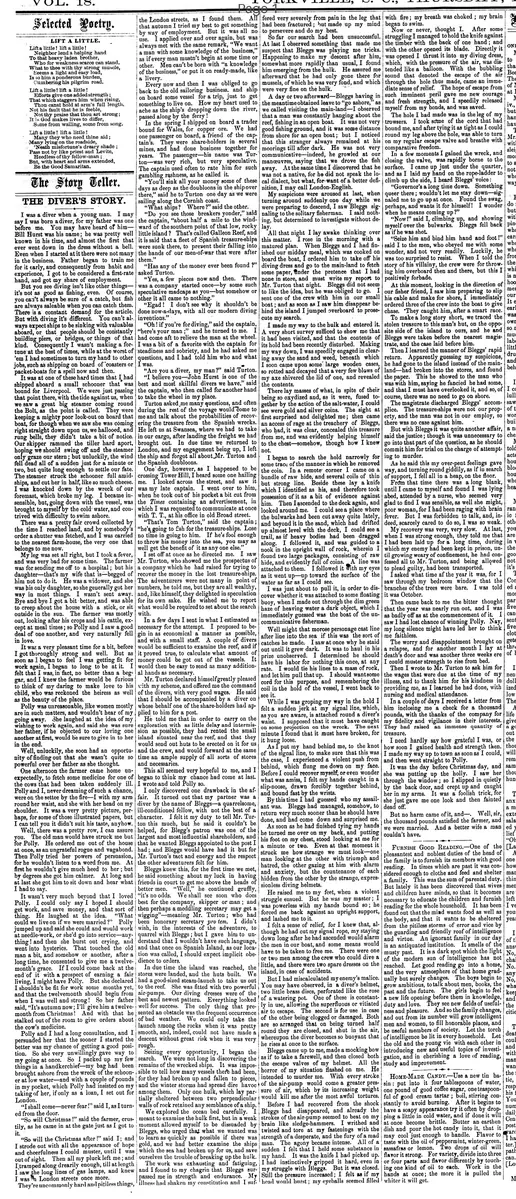
THE DIVER'S STORY.
I was a diver when a young man. I may say I was born a diver, for my father was one before me. You may have heard of him— Bill Hurst was his name; he was pretty well known in his time, and almost the first that ever went down in the dress without a bell. Even when I started at it there were not many in the business. Father began to train me for it early, and consequently from habit and experience, I got to be considered a first-rate hand, and got my share of employment. But you see diving isn't like other things— it's not as good as fishing, even. Of course, you can't always be sure of a catch, but fish are always saleable when you can catch them. There is a constant demand for the article. But with diving it's different. You can't always expect ships to be sinking with valuables aboard, or that people should be constantly building piers, or bridges, or things of that kind. Consequently I wasn't making a fortune at the best of times, while at the worst of 'em I had sometimes to turn my hand to other jobs, such as shipping on board of coasters or packet-boats for a spell now and then.
It was at one of these hard times that I had shipped aboard a small schooner that was bound for Liverpool. We were just passing that point there, with the tide against us, when we saw a great big steamer coming round the Bolt, as the point is called. They were keeping a mighty poor look-out on board that boat, for though when we saw she was coming right straight down upon us, we hallooed, and rung bells, they didn't take a bit of notice. Our skipper rammed the tiller hard aport, hoping we should swing off and the steamer only graze our stern; but unluckily, the wind fell dead all of a sudden just for a minute or two, but quite long enough to settle our fate. The steamer struck the schooner full amidships, and cut her in half, like so much cheese. I was knocked down by the wreck of our foremast, which broke my leg. I became insensible, but, going down with the vessel, was brought to myself by the cold water, and contrived with difficulty to swim ashore. There was a pretty fair crowd collected by the time I reached land, and by somebody's order a shutter was fetched, and I was carried to the nearest farm-house, the very one that belongs to me now.
My leg was set all right, but I took a fever, and was very bad for some time. The farmer was for sending me off to a hospital; but his daughter—that's my wife that is—begged of him not to do it. He was a widower, and she was his only daughter, so she generally got her way in most things. I wasn't sent away. By and by I got a bit better, and was able to creep about the house with a stick, or sit outside in the sun. The farmer was mostly out, looking after his crops and his cattle, except at meal times; so Polly and I saw a good deal of one another, and very naturally fell in love.
It was a very pleasant time for a bit, before I got thoroughly strong and well. But as soon as I began to feel I was getting fit for work again, I began to long to be at it. I felt that I was, in fact, no better than a beggar, and I knew the farmer would be furious to think of my daring to make love to his child, who was reckoned the heiress as well as the beauty of the place. Polly was unreasonable, like women mostly are in such matters, and wouldn't hear of my going away. She laughed at the idea of my wishing to work again, and said she was sure her father, if he objected to our loving one another at first, would be sure to give in to her in the end.
Well, unluckily, she soon had an opportunity of finding out that she wasn't quite so powerful over her father as she thought. One afternoon the farmer came home unexpectedly, to fetch some medicine for one of the cows that had been taken suddenly ill. Polly and I, never dreaming of such a chance, were on the settee by the fire—I with my arm round her waist, and she with her head on my shoulder. It was a very pretty picture, perhaps, for some of those illustrated papers, but I can tell you it didn't suit his taste, anyhow. Well, there was a pretty row, I can assure you. The old man would have struck me but for Polly. He ordered me out of the house at once, as an ungrateful rogue and vagabond. Then Polly tried her powers of persuasion, for he wouldn't listen to a word from me. At first he wouldn't give much heed to her; but by degrees she got him calmer. At long and at last she got him to sit down and hear what I had to say.
It wasn't very much beyond that I loved Polly. I could only say I hoped I should get work, and save money, and that sort of thing. He laughed at the idea. "What could we live on if we were married?" Polly jumped up and said she could and would work at needle-work, or she'd go into service—anything! and then she burst out crying, and went into hysterics. That touched the old man a bit, and somehow or another, after a long time, he consented to give me a twelve month's grace. If I could come back at the end of it with a prospect of earning a fair living, I might have Polly. But she declared I shouldn't be fit for work some months yet and that the twelvemonth should begin from when I was well and strong! So her father said, "It's autumn now; I'll give him a twelve month from Christmas!" And with that he stalked out of the room to give orders about the cow's medicine.
Polly and I had a long consultation, and I persuaded her that the sooner I started the better was my chance of getting a good position. So she very unwillingly gave way to my going at once. So I packed up my few things in a handkerchief—my bag had been brought ashore from the wreck of the schooner at low water—and with a couple of pounds in my pocket, which Polly had insisted on my taking of her, if only as a loan, I set out for London.
"I shall come—never fear!" said I, as I turned from the door.
"So will Christmas!" said the farmer, crustily, as he came in at the gate just as I got to it.
"So will the Christmas after!" said I; and I strode out with all the appearance of hope and cheerfulness I could muster, until I was out of sight. Then all my pluck left me; and I tramped along drearily enough, till at length I saw the long lines of gas lamps, and knew I was in London streets once more.
Men are hard and pitiless things the London streets, as I found them. All that autumn I tried my best to get something by way of employment. But it was all no use. I applied over and over again, but was always met with the same remark, "We want a man with some knowledge of the business," as if every man mustn't begin at some time or other. Men can't be born with "a knowledge of the business," or put it on ready-made, like a livery.
Every now and then I was obliged to go back to the old sailoring business, and ship on board some vessel for a trip, just to get something to live on. How my heart used to ache as the ship, dropping down the river, passed along by the ferry!
In the spring I shipped on board a trader bound for Wales, for copper ore. We had one passenger on board, a friend of the captain's. They were share-holders in several mines, and had done business together for years. The passenger—his name was Turton—was very rich, but very speculative. The captain used often to rate him for such gambling, rashness, as he called it.
"You'll sink all your money some of these days as deep as the doubloons in the ship over there," said he to Turton one day as we were sailing along the Cornish coast.
"What ships? Where?" said the other.
"Do you see those breakers yonder," said the captain, "about half a mile to the windward of the southern point of that low, rocky little island? That's called Galleon Reef, and it is said that a fleet of Spanish treasure-ships were sunk there, to prevent their falling into the hands of our men-of-war that were after them."
"Has any of the money ever been found?" asked Turton.
"Yes, a few pieces now and then. There was a company started once—by some such speculative madcaps as you—but somehow or other it all came to nothing."
"Egad! I don't see why it shouldn't be done now-a-days, with all our modern diving inventions."
"Oh! if you're for diving," said the captain "here's your man;" and he turned to me. I had come aft to relieve the man at the wheel. I was a bit of a favorite with the captain for steadiness and sobriety, and he had asked me questions, and I had told him who and what I was.
"Are you a diver, my man?" said Turton.
"I believe you—John Hurst is one of the best and most skillful divers we have," said the captain, who then called for another hand to take the wheel in my place.
Turton asked me many questions, and often during the rest of the voyage would come to me and talk about the probabilities of recovering the treasure from the Spanish wrecks. He left us at Swansea, where we had to take in our cargo, after landing the freight we had brought out. In due time we returned to London, and my engagement being up, I left the ship and forgot all about Mr. Turton and the Spanish doubloons.
One day, however, as I happened to be crossing Tower Hill, I heard some one hailing me. I looked across the street, and saw it was my late captain. I went over to him, when he took out of his pocket a bit cut from the Times containing an advertisement, in which I was requested to communicate at once with T. T., at his office in Old Broad street.
"That's Tom Turton," said the captain; "he's going to fish for the treasure-ships. Lose no time in going to him. If he's fool enough to throw his money into the sea, you may as well get the benefit of it as any one else."
I set off at once as he directed me. I saw Mr. Turton, who showed me the prospectus of a company which he had raised for trying to recover the money in the lost treasure-ships. The adventurers were not many in point of numbers, he told me, but they are all wealthy, and, like himself, they delighted in speculation for its own sake. He wished me to report what would be required to set about the search with. In a few days I sent in what I estimated as necessary for the attempt. I proposed to begin in as economical a manner as possible and with a small staff. A couple of divers would be sufficient to examine the reef, and if it proved true, to calculate what amount of money could be got out of the vessels. It would then be easy to send as many additional hands as necessary.
Mr. Turton declared himself greatly pleased with my scheme, and offered me the command of the divers, with very good wages. He said that I should be accompanied by a diver on whose behalf one of the share-holders had applied to him for a post. He told me that in order to carry on the exploration with as little delay and intermission as possible, they had rented the small island situated near the reef, and that they would send out huts to be erected on it for us and the crew, and would forward at the same time an ample supply of all sorts of stores and necessaries.
This all seemed very hopeful to me, and I began to think my chance had come at last. I wrote and told Polly so. I only discovered one drawback in the affair. It turned out that my partner was a diver by the name of Bleggs—a quarrelsome, ill-conditioned fellow, with not the best of a character. I felt it my duty to tell Mr. Turton this much, but he said it couldn't be helped, for Bleggs' patron was one of the largest and most influential shareholders, and that he wanted Bleggs appointed to the post I had; and Bleggs would have had it but for Mr. Turton's tact and energy and the respect the other adventurers felt for him.
Bleggs knew this, for the first time we met, he said something about my luck in having friends in court to get me above the heads of better men. "Well," he continued gruffly, "it's no odds. We shall see soon who does best for the company, skipper or man; and then perhaps a meddling secretary may get a wigging"—meaning Mr. Turton, who had been honorary secretary pro tem. I didn't wish, in the interests of the adventure, to quarrel with Bleggs; but I gave him to understand that I wouldn't have such language and that once on Spanish Island, as our location was called, I should expect implicit obedience to orders.
In due time the island was reached, the stores were landed, and the huts built. We had a good-sized steam-launch to take us out to the reef. She was fitted with two powerful air-pumps. Our diving dresses were of the best and newest pattern. Everything looked well for success. The only thing that presented an obstacle was the frequent occurrence of bad weather. We could only take the launch among the rocks when it was pretty smooth, and, indeed, could not have made a descent without great risk when it was very rough.
Seizing every opportunity, I began the search. We were not long in discovering the remains of the wrecked ships. It was impossible to tell how many vessels there had been, for they had broken up and fallen to pieces and the winter storms had spread dire havoc among them. Only one hulk, which lay partially sheltered between two perpendicular walls of rock retained any semblance of a ship.
We explored the ocean bed carefully. I meant to examine the hulk first, but in a weak moment allowed myself to be dissuaded by Bleggs, who urged that what we wanted was to learn as quickly as possible if there was gold, and we had better examine the ships which the sea had broken up for us, and save ourselves the trouble of breaking up the hulk. The work was exhausting and fatiguing and I found to my chagrin that Bleggs surpassed me in strength and endurance. My illness had shaken my constitution and I suffered very severely from pain in the leg that had been fractured; but made up my mind to persevere and do my best.
So far our search had been unsuccessful. At last I observed something that made me suspect that Bleggs was playing me tricks. Happening to make my descent after him, somewhat more rapidly than usual, I found him emerging from the hulk. He assured me afterward that he had only gone there for mussels, of which he was very fond, and which were very fine on the hulk.
A day or two afterward—Bleggs having in the meantime obtained leave to "go ashore," as we called visiting the main-land—I observed that a man was constantly hanging about the reef, fishing in an open boat. It was not very good fishing ground, and it was some distance from shore for an open boat: but I noticed that this stranger always remained at his moorings till after dark. He was not very communicative—indeed, he growled at our manoeuvres, saying that we drove the fish away. At the same time I discovered that he was not a native, for he did not speak the local dialect, but what, for want of a better definition, I may call London-English.
My suspicions were aroused at last, when turning around suddenly one day while we were preparing to descend, I saw Bleggs signaling to the solitary fisherman. I said nothing, but determined to investigate without delay.
All that night I lay awake thinking over this matter. I rose in the morning with a matured plan. When Bleggs and I had finished our midday meal, which was cooked on board the boat, I ordered him to take off his diving dress and go to the main-land to fetch some paper, under the pretence that I had none in store, and must write my report to Mr. Turton that night. Bleggs did not seem to like the idea, but he was obliged to go. I sent one of the crew with him in our small boat; and as soon as I saw him disappear behind the island I jumped overboard to prosecute my search.
I made my way to the hulk and entered it. A very short survey sufficed to show me that it had been visited, and that the contents of its hold had been recently disturbed. Making my way down, I was speedily engaged in clearing away the sand and weed, beneath which I soon came upon some large wooden cases so rotted and decayed that a very few blows of my axe shivered the lid of one, and revealed the contents.
There lay masses of what, in spite of their being so oxidized and, as it were, fused together by the action of the salt-water, I could see were gold and silver coins. The sight at first surprised and delighted me; then came an access of rage at the treachery of Bleggs, who had, it was clear, concealed this treasure from me, and was evidently helping himself to the chests somehow, though how I knew not.
I began to search the hold narrowly for some trace of the manner in which he removed the coin. In a remote corner I came on a bundle of raw hide, and several coils of thin but strong line. Beside these lay a knife which I identified as his, and therefore took possession of it as a bit of evidence against him. Then I ascended to the deck again, and looked around me. I could see a place where the bulwarks had been cut away quite lately, and beyond it in the sand, which had drifted up almost level with the deck, I could see a trail, as if heavy bodies had been dragged along. I followed it, and was guided to a nook in the upright wall of rock, wherein I found two large packages, consisting of raw hide, and evidently full of coins. A line was attached to them. I followed it with my eyes as it went up—up toward the surface of the water as far as I could see.
I was just about to pull it, in order to discover whether it was attached to some floating buoy, when I made out through the dim green haze of heaving water a dark object, which I immediately guessed was the boat of the uncommunicative fisherman.
Well might that morose personage cast line after line into the sea if this was the sort of catches he made. I saw at once why he staid out until it grew dark. It was to haul in his prize unobserved. I determined he should have his labor for nothing this once, at any rate. I would tie his lines to a mass of rock, and let him pull that up. I should want some cord for this purpose, and remembering the coil in the hold of the vessel, I went back to see it.
While I was groping my way in the hold I felt a sudden jerk at my signal line, which, as you are aware, is attached round a diver's waist. I supposed that it must have caught on some projection on the wreck. The next minute I found that it must have broken, for it hung loose.
As I put my hand behind me, to the knot of the signal line, to make sure that this was the case, I experienced a violent push from behind, which flung me down on my face. Before I could recover myself; or even wonder what was amiss, I felt my hands caught in a slip-noose, drawn forcibly together behind, and bound fast by the wrists.
By this time I had guessed who my assailant was. Bleggs had managed, somehow, to return very much sooner than he should have done, and had come down and surprised me. As soon as he had finished tying my hands he turned me over on my back, and putting his foot on my chest, stood looking at me for a minute or two. Even at that moment it struck me how strange we must look—one man looking at the other with triumph and hatred, the other gazing at him with alarm and anxiety, but the countenance of each hidden from the other by the strange, expressionless diving helmets.
He raised me to my feet, when a violent struggle ensued. But he was my master; I was powerless with my hands bound so; he forced me back against an upright support, and lashed me to it.
I felt a sense of relief, for I knew that, although he had cut my signal rope, my staying down long after he had ascended would alarm the men in our boat, and some means would have to be taken to free me. There were one or two men among the crew who could dive a little, and there were two spare dresses on the island, in case of accidents.
But I had miscalculated my enemy's malice. You may have observed, in a diver's helmet, two little brass discs, perforated like the rose of a watering pot. One of these is constantly in use, allowing the superfluous or vitiated air to escape. The second is for use in case of the other being clogged or damaged. Both are so arranged that on being turned half round they are closed, and shut in the air, whereupon the diver becomes so buoyant that he rises at once to the surface.
Bleggs came up to me, made a mocking bow as if to take a farewell, and then closed both the escape valves of my helmet. All the horror of my situation flashed on me. He intended to murder me. With every stroke of the air-pump would come a greater pressure of air, which by its increasing weight would kill me after the most awful tortures.
Before I had recovered from the shock Bleggs had disappeared, and already the strokes of the air-pump seemed to beat on my brain like sledge-hammers. I writhed and twisted and tore at my fastenings with the strength of a desperate, and the fury of a mad man. The agony became intense. All of a sudden I felt that I held some substance in my hand. It was the knife I had picked up. I had instinctively gripped it hard, even in my struggle with Bleggs. But it was closed.
Still the pressure increased; I felt as if my head would burst; my eyeballs seemed filled with fire; my breath was choked; my brain began to swim.
Now or never, thought I. After some struggling I managed to hold the knife against the timber with the back of one hand; and with the other opened its blade. Directly it was opened I thrust it into my diving dress, which, with the pressure of the air, was distended like a balloon. With the bubbling sound that denoted the escape of the air through the hole thus made, came an immediate sense of relief. The hope of escape from such imminent peril gave me new courage and fresh strength, and I speedily released myself from my bonds, and was saved.
The hole I had made was in the leg of my trowsers. I took some of the cord that had bound me, and after tying it as tight as I could round my leg above the hole, was able to turn on my regular escape valve and breathe with comparative freedom.
In a few moments I gained the wreck, and closing the valve, was rapidly borne to the surface. I came up just under the quarter, and as I laid my hand on the rope-ladder to climb up the side, I heard Bleggs' voice:
"Governor's a long time down. Something queer there; wouldn't let me stay down—signaled me to go up at once. Found the swag, perhaps, and wants it for himself! I wonder when he means coming up?"
"Now!" said I, climbing up, and showing myself over the bulwarks. Bleggs fell back as if he was shot.
"Seize him and bind him hand and foot!" said I to the men, who obeyed me with some wonder, and not very readily. Luckily, he was too surprised to resist. When I told the story of his villainy, the crew were for throwing him overboard then and there, but this I positively forbade.
At this moment, looking in the direction of our fisher friend, I saw him preparing to slip his cable and make for shore. I immediately ordered three of the crew into the boat to give chase. They caught him, after a smart race.
To make a long story short, we traced the stolen treasure to this man's hut, on the opposite side of the island to ours, and he and Bleggs were taken before the nearest magistrate, and the case laid before him.
Then I learned the manner of Bleggs' rapid return. Apparently guessing my suspicions, he had gone to the island instead of the main land—had broken into the stores, and found the paper. This he showed to the man who was with him, saying he fancied he had some and that I must have overlooked it, and so, of course, there was no need to go on shore.
The magistrate discharged Bleggs' accomplice. The treasure-ships were not our property, and the man was not in our employ, so there was no case against him.
But with Bleggs it was quite another affair, said the justice; though it was unnecessary to go into that part of the question, as he should commit him for trial on the charge of attempting to murder.
As he said this my over-pent feelings gave way, and turning round giddily, as if in search of support, I fell all in a heap, on the floor. From that time there was a long blank, until I came to myself and found I was lying abed, attended by a nurse, who seemed very glad to find I was sensible, as well she might poor woman, for I had been raging with brain fever. But I was forbidden to talk, and, indeed, scarcely cared to do so, I was so weak.
My recovery was very, very slow. At last when I was strong enough, they told me that I had been laid up for a long time, during which my enemy had been kept in prison, until growing weary of confinement, he had confessed all to Mr. Turton, and being allowed to plead guilty, had been transported.
I asked what time of the year it was, for I saw through my bedroom window that the branches of the trees were bare. I was told it was October.
Then came back to me the bitter thought that the year was nearly run out, and I was as badly off as at the commencement of it. I saw I had lost chance of winning Polly. Nay, my long silence might have led her to think me faithless.
The worry and disappointment brought on a relapse, and for another month I lay at death's door and was another three weeks ere I could muster strength to rise from bed.
Then I wrote to Mr. Turton to ask him for the wages that were due at the time of my illness, and to thank him for his kindness in providing me, as I learned he had done, with nursing and medical attendance.
In a couple of days I received a letter from him enclosing me a check for a thousand pounds, with the thanks of the company for my fidelity and vigilance in their interests. They had raised an immense quantity of treasure.
I need hardly say how grateful I was, or how soon I gained health and strength then. I made my way up to town as soon as I could, and then went straight to Polly.
It was the day before Christmas day, and she was putting up the holly. I saw her through the window; so I slipped in quietly by the back door, and crept up and caught her in my arms. It was a foolish trick, for she just gave me one look and then fainted dead off.
But no harm came of it, and— Well, sir, the thousand pounds satisfied the farmer, and we were married. And a better wife a man couldn't have.
THE DIVER'S STORY.
I was a diver when a young man. I may say I was born a diver, for my father was one before me. You may have heard of him— Bill Hurst was his name; he was pretty well known in his time, and almost the first that ever went down in the dress without a bell. Even when I started at it there were not many in the business. Father began to train me for it early, and consequently from habit and experience, I got to be considered a first-rate hand, and got my share of employment. But you see diving isn't like other things— it's not as good as fishing, even. Of course, you can't always be sure of a catch, but fish are always saleable when you can catch them. There is a constant demand for the article. But with diving it's different. You can't always expect ships to be sinking with valuables aboard, or that people should be constantly building piers, or bridges, or things of that kind. Consequently I wasn't making a fortune at the best of times, while at the worst of 'em I had sometimes to turn my hand to other jobs, such as shipping on board of coasters or packet-boats for a spell now and then.
It was at one of these hard times that I had shipped aboard a small schooner that was bound for Liverpool. We were just passing that point there, with the tide against us, when we saw a great big steamer coming round the Bolt, as the point is called. They were keeping a mighty poor look-out on board that boat, for though when we saw she was coming right straight down upon us, we hallooed, and rung bells, they didn't take a bit of notice. Our skipper rammed the tiller hard aport, hoping we should swing off and the steamer only graze our stern; but unluckily, the wind fell dead all of a sudden just for a minute or two, but quite long enough to settle our fate. The steamer struck the schooner full amidships, and cut her in half, like so much cheese. I was knocked down by the wreck of our foremast, which broke my leg. I became insensible, but, going down with the vessel, was brought to myself by the cold water, and contrived with difficulty to swim ashore. There was a pretty fair crowd collected by the time I reached land, and by somebody's order a shutter was fetched, and I was carried to the nearest farm-house, the very one that belongs to me now.
My leg was set all right, but I took a fever, and was very bad for some time. The farmer was for sending me off to a hospital; but his daughter—that's my wife that is—begged of him not to do it. He was a widower, and she was his only daughter, so she generally got her way in most things. I wasn't sent away. By and by I got a bit better, and was able to creep about the house with a stick, or sit outside in the sun. The farmer was mostly out, looking after his crops and his cattle, except at meal times; so Polly and I saw a good deal of one another, and very naturally fell in love.
It was a very pleasant time for a bit, before I got thoroughly strong and well. But as soon as I began to feel I was getting fit for work again, I began to long to be at it. I felt that I was, in fact, no better than a beggar, and I knew the farmer would be furious to think of my daring to make love to his child, who was reckoned the heiress as well as the beauty of the place. Polly was unreasonable, like women mostly are in such matters, and wouldn't hear of my going away. She laughed at the idea of my wishing to work again, and said she was sure her father, if he objected to our loving one another at first, would be sure to give in to her in the end.
Well, unluckily, she soon had an opportunity of finding out that she wasn't quite so powerful over her father as she thought. One afternoon the farmer came home unexpectedly, to fetch some medicine for one of the cows that had been taken suddenly ill. Polly and I, never dreaming of such a chance, were on the settee by the fire—I with my arm round her waist, and she with her head on my shoulder. It was a very pretty picture, perhaps, for some of those illustrated papers, but I can tell you it didn't suit his taste, anyhow. Well, there was a pretty row, I can assure you. The old man would have struck me but for Polly. He ordered me out of the house at once, as an ungrateful rogue and vagabond. Then Polly tried her powers of persuasion, for he wouldn't listen to a word from me. At first he wouldn't give much heed to her; but by degrees she got him calmer. At long and at last she got him to sit down and hear what I had to say.
It wasn't very much beyond that I loved Polly. I could only say I hoped I should get work, and save money, and that sort of thing. He laughed at the idea. "What could we live on if we were married?" Polly jumped up and said she could and would work at needle-work, or she'd go into service—anything! and then she burst out crying, and went into hysterics. That touched the old man a bit, and somehow or another, after a long time, he consented to give me a twelve month's grace. If I could come back at the end of it with a prospect of earning a fair living, I might have Polly. But she declared I shouldn't be fit for work some months yet and that the twelvemonth should begin from when I was well and strong! So her father said, "It's autumn now; I'll give him a twelve month from Christmas!" And with that he stalked out of the room to give orders about the cow's medicine.
Polly and I had a long consultation, and I persuaded her that the sooner I started the better was my chance of getting a good position. So she very unwillingly gave way to my going at once. So I packed up my few things in a handkerchief—my bag had been brought ashore from the wreck of the schooner at low water—and with a couple of pounds in my pocket, which Polly had insisted on my taking of her, if only as a loan, I set out for London.
"I shall come—never fear!" said I, as I turned from the door.
"So will Christmas!" said the farmer, crustily, as he came in at the gate just as I got to it.
"So will the Christmas after!" said I; and I strode out with all the appearance of hope and cheerfulness I could muster, until I was out of sight. Then all my pluck left me; and I tramped along drearily enough, till at length I saw the long lines of gas lamps, and knew I was in London streets once more.
Men are hard and pitiless things the London streets, as I found them. All that autumn I tried my best to get something by way of employment. But it was all no use. I applied over and over again, but was always met with the same remark, "We want a man with some knowledge of the business," as if every man mustn't begin at some time or other. Men can't be born with "a knowledge of the business," or put it on ready-made, like a livery.
Every now and then I was obliged to go back to the old sailoring business, and ship on board some vessel for a trip, just to get something to live on. How my heart used to ache as the ship, dropping down the river, passed along by the ferry!
In the spring I shipped on board a trader bound for Wales, for copper ore. We had one passenger on board, a friend of the captain's. They were share-holders in several mines, and had done business together for years. The passenger—his name was Turton—was very rich, but very speculative. The captain used often to rate him for such gambling, rashness, as he called it.
"You'll sink all your money some of these days as deep as the doubloons in the ship over there," said he to Turton one day as we were sailing along the Cornish coast.
"What ships? Where?" said the other.
"Do you see those breakers yonder," said the captain, "about half a mile to the windward of the southern point of that low, rocky little island? That's called Galleon Reef, and it is said that a fleet of Spanish treasure-ships were sunk there, to prevent their falling into the hands of our men-of-war that were after them."
"Has any of the money ever been found?" asked Turton.
"Yes, a few pieces now and then. There was a company started once—by some such speculative madcaps as you—but somehow or other it all came to nothing."
"Egad! I don't see why it shouldn't be done now-a-days, with all our modern diving inventions."
"Oh! if you're for diving," said the captain "here's your man;" and he turned to me. I had come aft to relieve the man at the wheel. I was a bit of a favorite with the captain for steadiness and sobriety, and he had asked me questions, and I had told him who and what I was.
"Are you a diver, my man?" said Turton.
"I believe you—John Hurst is one of the best and most skillful divers we have," said the captain, who then called for another hand to take the wheel in my place.
Turton asked me many questions, and often during the rest of the voyage would come to me and talk about the probabilities of recovering the treasure from the Spanish wrecks. He left us at Swansea, where we had to take in our cargo, after landing the freight we had brought out. In due time we returned to London, and my engagement being up, I left the ship and forgot all about Mr. Turton and the Spanish doubloons.
One day, however, as I happened to be crossing Tower Hill, I heard some one hailing me. I looked across the street, and saw it was my late captain. I went over to him, when he took out of his pocket a bit cut from the Times containing an advertisement, in which I was requested to communicate at once with T. T., at his office in Old Broad street.
"That's Tom Turton," said the captain; "he's going to fish for the treasure-ships. Lose no time in going to him. If he's fool enough to throw his money into the sea, you may as well get the benefit of it as any one else."
I set off at once as he directed me. I saw Mr. Turton, who showed me the prospectus of a company which he had raised for trying to recover the money in the lost treasure-ships. The adventurers were not many in point of numbers, he told me, but they are all wealthy, and, like himself, they delighted in speculation for its own sake. He wished me to report what would be required to set about the search with. In a few days I sent in what I estimated as necessary for the attempt. I proposed to begin in as economical a manner as possible and with a small staff. A couple of divers would be sufficient to examine the reef, and if it proved true, to calculate what amount of money could be got out of the vessels. It would then be easy to send as many additional hands as necessary.
Mr. Turton declared himself greatly pleased with my scheme, and offered me the command of the divers, with very good wages. He said that I should be accompanied by a diver on whose behalf one of the share-holders had applied to him for a post. He told me that in order to carry on the exploration with as little delay and intermission as possible, they had rented the small island situated near the reef, and that they would send out huts to be erected on it for us and the crew, and would forward at the same time an ample supply of all sorts of stores and necessaries.
This all seemed very hopeful to me, and I began to think my chance had come at last. I wrote and told Polly so. I only discovered one drawback in the affair. It turned out that my partner was a diver by the name of Bleggs—a quarrelsome, ill-conditioned fellow, with not the best of a character. I felt it my duty to tell Mr. Turton this much, but he said it couldn't be helped, for Bleggs' patron was one of the largest and most influential shareholders, and that he wanted Bleggs appointed to the post I had; and Bleggs would have had it but for Mr. Turton's tact and energy and the respect the other adventurers felt for him.
Bleggs knew this, for the first time we met, he said something about my luck in having friends in court to get me above the heads of better men. "Well," he continued gruffly, "it's no odds. We shall see soon who does best for the company, skipper or man; and then perhaps a meddling secretary may get a wigging"—meaning Mr. Turton, who had been honorary secretary pro tem. I didn't wish, in the interests of the adventure, to quarrel with Bleggs; but I gave him to understand that I wouldn't have such language and that once on Spanish Island, as our location was called, I should expect implicit obedience to orders.
In due time the island was reached, the stores were landed, and the huts built. We had a good-sized steam-launch to take us out to the reef. She was fitted with two powerful air-pumps. Our diving dresses were of the best and newest pattern. Everything looked well for success. The only thing that presented an obstacle was the frequent occurrence of bad weather. We could only take the launch among the rocks when it was pretty smooth, and, indeed, could not have made a descent without great risk when it was very rough.
Seizing every opportunity, I began the search. We were not long in discovering the remains of the wrecked ships. It was impossible to tell how many vessels there had been, for they had broken up and fallen to pieces and the winter storms had spread dire havoc among them. Only one hulk, which lay partially sheltered between two perpendicular walls of rock retained any semblance of a ship.
We explored the ocean bed carefully. I meant to examine the hulk first, but in a weak moment allowed myself to be dissuaded by Bleggs, who urged that what we wanted was to learn as quickly as possible if there was gold, and we had better examine the ships which the sea had broken up for us, and save ourselves the trouble of breaking up the hulk. The work was exhausting and fatiguing and I found to my chagrin that Bleggs surpassed me in strength and endurance. My illness had shaken my constitution and I suffered very severely from pain in the leg that had been fractured; but made up my mind to persevere and do my best.
So far our search had been unsuccessful. At last I observed something that made me suspect that Bleggs was playing me tricks. Happening to make my descent after him, somewhat more rapidly than usual, I found him emerging from the hulk. He assured me afterward that he had only gone there for mussels, of which he was very fond, and which were very fine on the hulk.
A day or two afterward—Bleggs having in the meantime obtained leave to "go ashore," as we called visiting the main-land—I observed that a man was constantly hanging about the reef, fishing in an open boat. It was not very good fishing ground, and it was some distance from shore for an open boat: but I noticed that this stranger always remained at his moorings till after dark. He was not very communicative—indeed, he growled at our manoeuvres, saying that we drove the fish away. At the same time I discovered that he was not a native, for he did not speak the local dialect, but what, for want of a better definition, I may call London-English.
My suspicions were aroused at last, when turning around suddenly one day while we were preparing to descend, I saw Bleggs signaling to the solitary fisherman. I said nothing, but determined to investigate without delay.
All that night I lay awake thinking over this matter. I rose in the morning with a matured plan. When Bleggs and I had finished our midday meal, which was cooked on board the boat, I ordered him to take off his diving dress and go to the main-land to fetch some paper, under the pretence that I had none in store, and must write my report to Mr. Turton that night. Bleggs did not seem to like the idea, but he was obliged to go. I sent one of the crew with him in our small boat; and as soon as I saw him disappear behind the island I jumped overboard to prosecute my search.
I made my way to the hulk and entered it. A very short survey sufficed to show me that it had been visited, and that the contents of its hold had been recently disturbed. Making my way down, I was speedily engaged in clearing away the sand and weed, beneath which I soon came upon some large wooden cases so rotted and decayed that a very few blows of my axe shivered the lid of one, and revealed the contents.
There lay masses of what, in spite of their being so oxidized and, as it were, fused together by the action of the salt-water, I could see were gold and silver coins. The sight at first surprised and delighted me; then came an access of rage at the treachery of Bleggs, who had, it was clear, concealed this treasure from me, and was evidently helping himself to the chests somehow, though how I knew not.
I began to search the hold narrowly for some trace of the manner in which he removed the coin. In a remote corner I came on a bundle of raw hide, and several coils of thin but strong line. Beside these lay a knife which I identified as his, and therefore took possession of it as a bit of evidence against him. Then I ascended to the deck again, and looked around me. I could see a place where the bulwarks had been cut away quite lately, and beyond it in the sand, which had drifted up almost level with the deck, I could see a trail, as if heavy bodies had been dragged along. I followed it, and was guided to a nook in the upright wall of rock, wherein I found two large packages, consisting of raw hide, and evidently full of coins. A line was attached to them. I followed it with my eyes as it went up—up toward the surface of the water as far as I could see.
I was just about to pull it, in order to discover whether it was attached to some floating buoy, when I made out through the dim green haze of heaving water a dark object, which I immediately guessed was the boat of the uncommunicative fisherman.
Well might that morose personage cast line after line into the sea if this was the sort of catches he made. I saw at once why he staid out until it grew dark. It was to haul in his prize unobserved. I determined he should have his labor for nothing this once, at any rate. I would tie his lines to a mass of rock, and let him pull that up. I should want some cord for this purpose, and remembering the coil in the hold of the vessel, I went back to see it.
While I was groping my way in the hold I felt a sudden jerk at my signal line, which, as you are aware, is attached round a diver's waist. I supposed that it must have caught on some projection on the wreck. The next minute I found that it must have broken, for it hung loose.
As I put my hand behind me, to the knot of the signal line, to make sure that this was the case, I experienced a violent push from behind, which flung me down on my face. Before I could recover myself; or even wonder what was amiss, I felt my hands caught in a slip-noose, drawn forcibly together behind, and bound fast by the wrists.
By this time I had guessed who my assailant was. Bleggs had managed, somehow, to return very much sooner than he should have done, and had come down and surprised me. As soon as he had finished tying my hands he turned me over on my back, and putting his foot on my chest, stood looking at me for a minute or two. Even at that moment it struck me how strange we must look—one man looking at the other with triumph and hatred, the other gazing at him with alarm and anxiety, but the countenance of each hidden from the other by the strange, expressionless diving helmets.
He raised me to my feet, when a violent struggle ensued. But he was my master; I was powerless with my hands bound so; he forced me back against an upright support, and lashed me to it.
I felt a sense of relief, for I knew that, although he had cut my signal rope, my staying down long after he had ascended would alarm the men in our boat, and some means would have to be taken to free me. There were one or two men among the crew who could dive a little, and there were two spare dresses on the island, in case of accidents.
But I had miscalculated my enemy's malice. You may have observed, in a diver's helmet, two little brass discs, perforated like the rose of a watering pot. One of these is constantly in use, allowing the superfluous or vitiated air to escape. The second is for use in case of the other being clogged or damaged. Both are so arranged that on being turned half round they are closed, and shut in the air, whereupon the diver becomes so buoyant that he rises at once to the surface.
Bleggs came up to me, made a mocking bow as if to take a farewell, and then closed both the escape valves of my helmet. All the horror of my situation flashed on me. He intended to murder me. With every stroke of the air-pump would come a greater pressure of air, which by its increasing weight would kill me after the most awful tortures.
Before I had recovered from the shock Bleggs had disappeared, and already the strokes of the air-pump seemed to beat on my brain like sledge-hammers. I writhed and twisted and tore at my fastenings with the strength of a desperate, and the fury of a mad man. The agony became intense. All of a sudden I felt that I held some substance in my hand. It was the knife I had picked up. I had instinctively gripped it hard, even in my struggle with Bleggs. But it was closed.
Still the pressure increased; I felt as if my head would burst; my eyeballs seemed filled with fire; my breath was choked; my brain began to swim.
Now or never, thought I. After some struggling I managed to hold the knife against the timber with the back of one hand; and with the other opened its blade. Directly it was opened I thrust it into my diving dress, which, with the pressure of the air, was distended like a balloon. With the bubbling sound that denoted the escape of the air through the hole thus made, came an immediate sense of relief. The hope of escape from such imminent peril gave me new courage and fresh strength, and I speedily released myself from my bonds, and was saved.
The hole I had made was in the leg of my trowsers. I took some of the cord that had bound me, and after tying it as tight as I could round my leg above the hole, was able to turn on my regular escape valve and breathe with comparative freedom.
In a few moments I gained the wreck, and closing the valve, was rapidly borne to the surface. I came up just under the quarter, and as I laid my hand on the rope-ladder to climb up the side, I heard Bleggs' voice:
"Governor's a long time down. Something queer there; wouldn't let me stay down—signaled me to go up at once. Found the swag, perhaps, and wants it for himself! I wonder when he means coming up?"
"Now!" said I, climbing up, and showing myself over the bulwarks. Bleggs fell back as if he was shot.
"Seize him and bind him hand and foot!" said I to the men, who obeyed me with some wonder, and not very readily. Luckily, he was too surprised to resist. When I told the story of his villainy, the crew were for throwing him overboard then and there, but this I positively forbade.
At this moment, looking in the direction of our fisher friend, I saw him preparing to slip his cable and make for shore. I immediately ordered three of the crew into the boat to give chase. They caught him, after a smart race.
To make a long story short, we traced the stolen treasure to this man's hut, on the opposite side of the island to ours, and he and Bleggs were taken before the nearest magistrate, and the case laid before him.
Then I learned the manner of Bleggs' rapid return. Apparently guessing my suspicions, he had gone to the island instead of the main land—had broken into the stores, and found the paper. This he showed to the man who was with him, saying he fancied he had some and that I must have overlooked it, and so, of course, there was no need to go on shore.
The magistrate discharged Bleggs' accomplice. The treasure-ships were not our property, and the man was not in our employ, so there was no case against him.
But with Bleggs it was quite another affair, said the justice; though it was unnecessary to go into that part of the question, as he should commit him for trial on the charge of attempting to murder.
As he said this my over-pent feelings gave way, and turning round giddily, as if in search of support, I fell all in a heap, on the floor. From that time there was a long blank, until I came to myself and found I was lying abed, attended by a nurse, who seemed very glad to find I was sensible, as well she might poor woman, for I had been raging with brain fever. But I was forbidden to talk, and, indeed, scarcely cared to do so, I was so weak.
My recovery was very, very slow. At last when I was strong enough, they told me that I had been laid up for a long time, during which my enemy had been kept in prison, until growing weary of confinement, he had confessed all to Mr. Turton, and being allowed to plead guilty, had been transported.
I asked what time of the year it was, for I saw through my bedroom window that the branches of the trees were bare. I was told it was October.
Then came back to me the bitter thought that the year was nearly run out, and I was as badly off as at the commencement of it. I saw I had lost chance of winning Polly. Nay, my long silence might have led her to think me faithless.
The worry and disappointment brought on a relapse, and for another month I lay at death's door and was another three weeks ere I could muster strength to rise from bed.
Then I wrote to Mr. Turton to ask him for the wages that were due at the time of my illness, and to thank him for his kindness in providing me, as I learned he had done, with nursing and medical attendance.
In a couple of days I received a letter from him enclosing me a check for a thousand pounds, with the thanks of the company for my fidelity and vigilance in their interests. They had raised an immense quantity of treasure.
I need hardly say how grateful I was, or how soon I gained health and strength then. I made my way up to town as soon as I could, and then went straight to Polly.
It was the day before Christmas day, and she was putting up the holly. I saw her through the window; so I slipped in quietly by the back door, and crept up and caught her in my arms. It was a foolish trick, for she just gave me one look and then fainted dead off.
But no harm came of it, and— Well, sir, the thousand pounds satisfied the farmer, and we were married. And a better wife a man couldn't have.
What sub-type of article is it?
Prose Fiction
What themes does it cover?
Love Romance
Moral Virtue
Commerce Trade
What keywords are associated?
Diver
Treasure Hunt
Spanish Wrecks
Betrayal
Romance
Shipwreck
Galleon Reef
Polly
Bleggs
Literary Details
Title
The Diver's Story.
Key Lines
"I Shall Come—Never Fear!" Said I, As I Turned From The Door.
"So Will Christmas!" Said The Farmer, Crustily, As He Came In At The Gate Just As I Got To It.
"So Will The Christmas After!" Said I;
There Lay Masses Of What, In Spite Of Their Being So Oxidized And, As It Were, Fused Together By The Action Of The Salt Water, I Could See Were Gold And Silver Coins.
It Was The Day Before Christmas Day, And She Was Putting Up The Holly. I Saw Her Through The Window; So I Slipped In Quietly By The Back Door, And Crept Up And Caught Her In My Arms.