Thank you for visiting SNEWPapers!
Sign up free
Portland Gazette, And Maine Advertiser
Portland, Cumberland County, Maine
What is this article about?
August 13, 1810 editorial reports London news to June 22, Erving's arrival with Pinkney despatches, sequestration of US property in Stralsund and elsewhere, contrasts Danish fairness with French seizures. Responds to Argus queries defending Federalist lawyers and denying political bias in courts. Analyzes Erskine's letters to highlight Jefferson's pro-French bias and Gallatin's pro-British views.
Merged-components note: Continuation of the editorial piece dated Portland, Monday, August 13, 1810, discussing political topics, taxes, and British vs. French influence, with sequential reading order on page 2 and 3.
Clippings
1 of 2
OCR Quality
Full Text
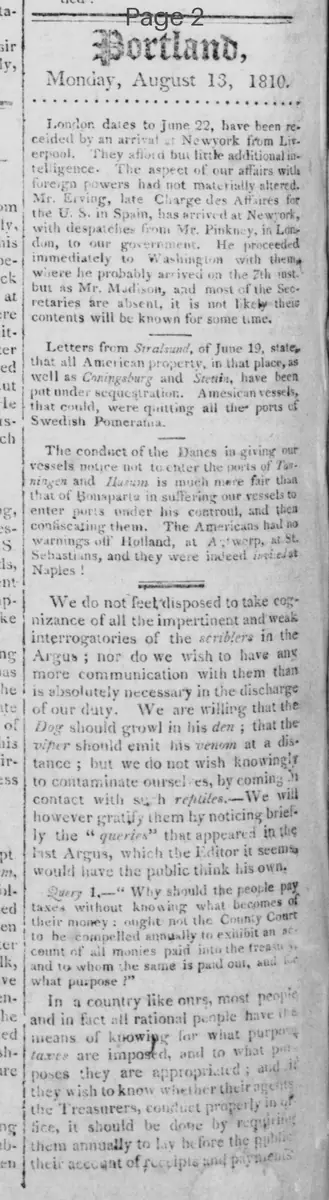
Monday, August 13, 1810.
London dates to June 22, have been received by an arrival at New York from Liverpool. They afford but little additional intelligence. The aspect of our affairs with foreign powers had not materially altered.
Mr. Erving, late Chargé des Affaires for the U. S. in Spain, has arrived at New York, with despatches from Mr. Pinkney, in London, to our government. He proceeded immediately to Washington with them where he probably arrived on the 7th inst. but as Mr. Madison, and most of the Secretaries are absent. it is not likely their contents will be known for some time.
Letters from Stralsund, of June 19. state, that all American property, in that place, as well as Königsberg and Stettin, have been put under sequestration. American vessels, that could, were quitting all the ports of Swedish Pomerania.
The conduct of the Danes in giving our vessels notice not to enter the ports of Tonningen and Husum is much more fair than that of Bonaparte in suffering our vessels to enter ports under his controul, and then confiscating them. The Americans had no warnings off Holland, at Antwerp, at St. Sebastian's, and they were indeed trapped at Naples!
We do not feel disposed to take cognizance of all the impertinent and weak interrogatories of the scribblers in the Argus; nor do we wish to have any more communication with them than is absolutely necessary in the discharge of our duty. We are willing that the Dog should growl in his den; that the viper should emit his venom at a distance; but we do not wish knowingly to contaminate ourselves, by coming in contact with such reptiles.—We will however gratify them by noticing briefly the "queries" that appeared in the last Argus, which the Editor it seems would have the public think his own.
Query 1.—"Why should the people pay their money: ought not the County Court taxes without knowing what becomes of it to be compelled annually to exhibit an account of all monies paid into the treasury and to whom the same is paid out, and what purpose?"
In a country like ours, most people and in fact all rational people have the means of knowing for what purposes taxes are imposed, and to what purposes they are appropriated; and if the people wish to know whether their agents conduct properly in office, it should be done by requiring them annually to lay before the public their account of receipts and payments.
It is no more the duty of County Courts to lay before the public a Treasurer's accounts, than it is the duty of the Governor and Council.
Query 2—'If we must have Lawyers, why do not the majority of the people unite and support none but such as will not abuse them, nor the government of their choice?'
When a man is about to employ a Lawyer, he makes enquiry for an honest and capable one; such men are always found in the federal ranks—and this is the reason why they are the most employed;—even the democrats themselves, if they find a Lawyer of their party set a mark upon him at once as being either a fool or a rogue.
Query 3—'Why should the people suffer the Courts to set their faces against Republican Lawyers, if they permit politics to enter the Sanctum sanctorum of Justice? Why should they not be turned out?'
That party politics are suffered to enter our Courts of Justice, is an insinuation as false as it is malicious. Nothing short of malignant, uneasy, morose, restless democracy would have expressed it.
British vs. French Influence.
The Editors of the Argus and other Jacobin papers, presuming on the ignorance and stupidity of their patrons, after publishing Erskine's late letters, draw this sage conclusion: that they 'afford additional proof of the existence of a party in this country devoted to the interest of Great Britain!'
Had they have withheld these letters from the public and came forward with the assertion without furnishing them with the power to judge for themselves, it could not have excited our surprise, because it is perfectly in character with them; but that they should have the effrontery thus to insult the understanding of their readers, in the face and eyes of common sense, is what we did not apprehend even from them. Had a magician, had Mr. Rannie played such deceptions on his audience, it might pass for harmless amusement, because it is what they would naturally calculate upon; but that the readers of those papers should suffer such libels to be imposed on their understandings, is somewhat remarkable. How far they were authorized by Mr. Erskine's letters to infer that 'the federalists are governed by British influence,' may be seen by the following extracts from his letter of December, 1808.—It will likewise be seen whether it goes farthest to establish the existence of British or French Influence.
'It is well known that Mr. Gallatin has long thought that the restrictive and jealous system of non-intercourse laws, embargoes, and other modes of checking a free trade with Great Britain, have been erroneous and highly injurious to the best interests of America. He informed me, distinctly, that he had always entertained that opinion, and that he had uniformly endeavored to persuade the President to place the conduct of Great Britain and France towards the United States in a fair light before the public. He seemed to check himself at the moment he was speaking upon this subject, and I could not get him to express himself more distinctly, but I could clearly collect from his manner, and from some slight insinuations, that he thought the President had acted with partiality towards France, for he turned the conversation immediately on Mr. Madison, and said that he could not be accused of having any such bias towards France; and remarked that Mr. Madison was known to be an admirer of the British Constitution, to be generally well disposed towards the nation, and to be entirely free from any enmity to its general prosperity.'
'These observations he made at that time for the purpose of contrasting the sentiments of Mr. Madison with these of the President, as he knew that I must have observed that Mr. Jefferson never spoke with approbation of any thing that was British, and always took up the French topics in his conversation, and always praised the people and country of France, and never lost an opportunity of shewing his dislike to Great Britain.'
We cannot have stronger proofs of the corrupt motives of our administration, says the editor of the Waterford Gazette, than is detailed in these paragraphs, and we are not at all surprised that the publication of such sentiments should have produced a schism in the cabinet, and the denunciation of Gallatin by the file leaders of democracy.
It is well known that schism commenced in the early part of the last session of congress. This is an additional proof that this correspondence was then in the possession of our administration, of what similar sentiments had been not
What sub-type of article is it?
What keywords are associated?
What entities or persons were involved?
Editorial Details
Primary Topic
Us Relations With Europe And Critique Of Democratic Administration
Stance / Tone
Federalist Defense And Anti Jeffersonian
Key Figures
Key Arguments