Thank you for visiting SNEWPapers!
Sign up free
The Alexandria Herald
Alexandria, Virginia
What is this article about?
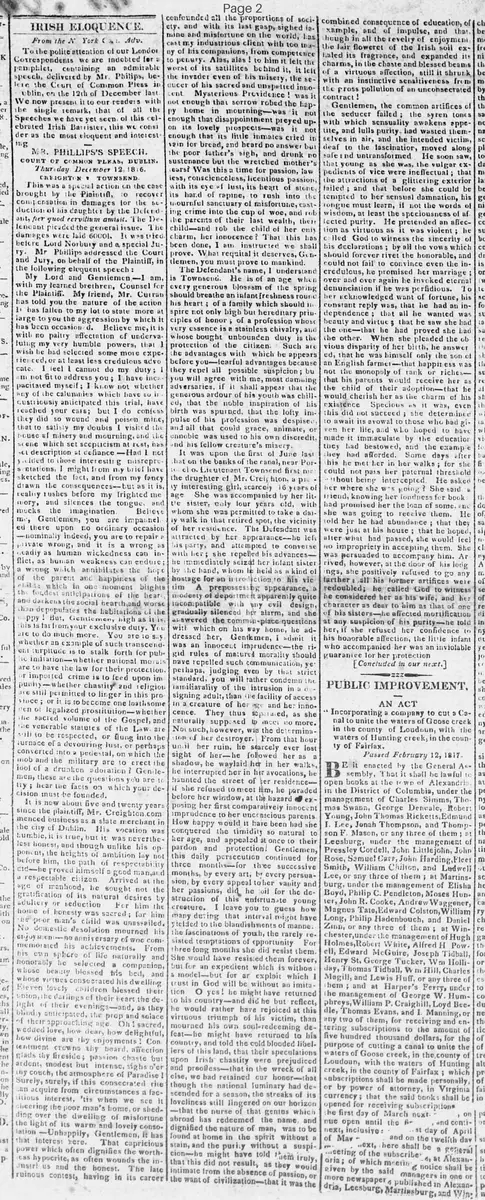
New York newspaper reprints an eloquent speech by Irish barrister Charles Phillips in the Dublin Court of Common Pleas on December 12, 1816, in the seduction trial Creighton v. Townsend. Phillips argues for the plaintiff, a slate merchant, whose 16-year-old daughter was seduced by Lt. Townsend after months of pursuit and deception.
Merged-components note: Single continuous story 'Irish Eloquence' split across multiple components due to parsing; merging based on sequential reading order and narrative flow.
Clipping
OCR Quality
Full Text
From the N. York Gaz.
To the polite attention of our London
Correspondents we are indebted for a
pamphlet, containing an admirable
speech, delivered by Mr. Philips, before
the Court of Common Pleas in
Dublin, on the 12th of December last.
We now present it to our readers with
the single remark, that of all the
Speeches we have yet seen. of this celebrated
Irish Barrister, this we consider as the most eloquent and interesting
MR. PHILLIPS'S SPEECH.
COURT OF COMMON PLEAS, DUBLIN.
Thursday December 12, 1816.
CREIGHTON V TOWNSEND.
This was a special action on the case
brought by the Plaintiff, to recover
compensation in damages for the seduction
of his daughter by the Defendant, per quod servitium amisit. The Defendant
pleaded the general issue. The
damages were laid 6000l. It was tried
before Lord Norbury and a special Jury.
Mr Phillips addressed the Court
and Jury, on behalf of the Plaintiff, in
the following eloquent speech :
My Lord and Gentlemen—I am,
with my learned brethren, Counsel for
the Plaintiff. My friend, Mr. Curran
has told you the nature of the action
It has fallen to my lot to state more at
large to you the aggression by which it
has been occasioned. Believe me, it is
with no paltry affectation of undervaluing
my very humble powers, that I
wish he had selected some more experienced,
or at least less credulous advocate.
I feel I cannot do my duty; I
am not fit to address you; I have incapacitated
myself: I know not whether
any of the calumnies which have so industriously
anticipated this trial, have
reached your ears; but I do confess
they did so wound and poison mine,
that to satisfy my doubts I visited the
house of misery and mourning, and the
scene which set scepticism at rest, has
put description at defiance—Had I not
yielded to those interesting misrepresentations,
I might from my brief have
sketched the fact, and from my fancy
drawn the consequences—but as it is,
reality rushes before my frightened memory,
and silences the tongue. and
mocks the imagination.
Believe
me, Gentlemen, you are impanelled
there upon no ordinary occasion—nominally
indeed, you are to repair a
private wrong, and it is a wrong as
acutely as human wickedness can inflict,
as human weakness can endure;
a wrong which annihilates the hope
of the parent and happiness of the
child: which in one moment blights
the fondest anticipations of the heart.
and darkens the social hearth, and worse
than depopulates the habitations of the
family! But, Gentlemen high as it is,
this is far from your exclusive duty. You
are to do much more. You are to say.
whether an example of such transcendent
turpitude is to stalk forth for public
imitation—whether national morals
are to have the law for their protection,
or imported crime is to feed upon impunity—whether
chastity and religion
are still permitted to linger in this province;
or it is to become one loathsome
renet of legalized prostitution—whether
the sacred volume of the Gospel, and
the venerable statutes of the Law. are
still to be respected, or flung into the
furnace of a devouring lust, or perhaps
converted into a pedestal, on which the
mob and the military are to erect the
idol of a drunken adoration ? Gentlemen,
these are the questions you are to
try; hear the facts on which your decision
must be founded.
It is now about five and twenty years
since the plaintiff, Mr. Creighton, commenced
business as a slate merchant in
the city of Dublin. His vocation was
tumble, it is true, but it was nevertheless
honest, and though unlike his opponent,
the heights of ambition lay not
before him, the path of respectability
did—he proved himself a good man, and
a respectable citizen. Arrived at the
age of manhood, he sought not the
gratification of its natural desires by
adultery or seduction For him the
home of honesty was sacred; for him
the poor man's child was unassailed.
No domestic desolation mourned his
enjoyment—no anniversary of woe commemorated
his achievements. From
his own sphere of life naturally and
honorably he selected a companion,
whose beauty blessed his bed, and
whose virtues consecrated his dwelling
Seven lovely children blessed their
union, the darlings of their heart the delight
of their evenings—and, as they
blindly anticipated, the prop and solace
of their approaching age. Oh! sacred,
wedded love, how clear, how delightful,
how divine are thy enjoyments! Contentment
crowns thy board, affection
glads thy fireside; passion chaste but
ardent, modest but intense, sighs o'er
thy couch, the atmosphere of Paradise!
Surely, surely, if this consecrated rite
can acquire from circumstances a factitious
interest, 'tis when we see it
cheering the poor man's home, or shedding
over the dwelling of misfortune
the light of its warm and lovely consolation —Unhappily,
Gentlemen, it has
that interest here.
That capricious
power which often dignifies the worthless
hypocrite, as often wounds the industrious
and the honest. The late
ruinous contest, having in its career
confounded all the proportions of society,
and with its last gasp, sighed its
ruin and misfortune on the world, has
cast my industrious client with too many
of his companions, from competence
to penury. Alas, alas ! to him it left the
worst of its satellites behind it, it left
the invader even of his misery, the seducer
of his sacred and unspotted innocent.
Mysterious Providence! was it
not enough that sorrow robed the happy
home in mourning was it not
enough that disappointment preyed upon
its lovely prospects—was it not
enough that its little inmates cried in
vain for bread. and heard no answer but
the poor father's sigh, and drunk no
sustenance but the wretched mother's
tears? Was this a time for passion, lawless,
conscienceless, licentious passion,
with its eye of lust, its heart of stone,
its hand of rapine, to rush into the
mournful sanctuary of misfortune, casting
crime into the cup of woe, and rob
the parents of their last wealth, their
child—and rob the child of her only
charm, her innocence? That this has
been done, I am instructed we shall
prove. What requital it deserves, Gentlemen,
you must prove to mankind.
The Defendant's name, I understand
is Townsend. He is of an age when
every generous blossom of the spring
should breathe an infant freshness round
his heart ; of a family which should inspire
not only high but hereditary principles
of honor; of a profession whose
very essence is a stainless chivalry, and
whose bounden duty is the
protection of the citizen. Such are
the advantages with which he appears
before you—fearful advantages because
they repel all possible suspicion; but
you will agree with me, most damning
adversaries, if it shall appear that the
generous ardour of his youth was chilled,
that the noble inspiration of his
birth was spurned, that the lofty impulse
of his profession was despised,
and all that could grace, animate, or
ennoble was used to his own discredit.
and his fellow creature's misery.
It was upon the first of June last
that on the banks of the canal, near Portobello.
Lieutenant Townsend first met
the daughter of Mr. Creighton, a pretty interesting
girl, scarcely 16 years of
age. She was accompanied by her little
sister. only four years old, with
whom she was permitted to take a daily
walk in that retired spot, the vicinity
of her residence. The Defendant was
attracted by her appearance—he left
his party, and attempted to converse
with her; she repelled his advances—he
immediately seized her infant sister
by the hand, whom he held as a kind of
hostage for an introduction to his victim
A prepossessing appearance, a
modesty of deportment apparently quite
incompatible with any evil design,
gradually silenced her alarm, and she
answered the common-place questions
with which on his way home, he addressed
her, Gentlemen, I admit it
was an innocent imprudence—the rigid
rules of matured morality should
have repelled such communication, yet
perhaps, judging even by that strict
standard, you will rather condemn the
familiarity of the intrusion in a designing
adult, than the facility of access
in a creature of her age and her innocence.
They thus separated, as she
naturally supposed to meet no more.
Not such, however, was the determination
of her destroyer. From that hour
until her ruin, he scarcely ever lost
sight of her—he followed her as a
shadow, he waylaid her in her walks,
he interrupted her in her avocations, he
haunted the street of her residence—if
she refused to meet him, he paraded
before her window, at the hazard of exposing
her first comparatively innocent
imprudence to her unconscious parents.
How happy would it have been had she
conquered the timidity so natural to
her age, and appealed at once to their
pardon and protection! Gentlemen,
this daily persecution continued for
three months—for three successive
months, by every art, by every persuasion,
by every appeal to her vanity and
her passions, did he toil for the destruction
of this unfortunate young
creature. I leave you to guess how
many during that interval might have
yielded to the blandishments of manner.
the fascinations of youth, the rarely resisted
temptations of opportunity For
three long months she did resist them.
She would have resisted them forever,
but for an expedient which is without
a model but for an exploit which I
trust in God will be without imitation O yes! he might have returned
to his country—and did he but reflect,
he would rather have rejoiced at this
virtuous triumph of his victim, than
mourned his own soul-redeeming defeat—he
might have returned to his
country, and told the cold blooded libellers
of this land, that their speculations
upon Irish chastity were prejudiced
and profless—that in the wreck of all
else, we had retained our honor—that
though the national luminary had descended
for a season, the streaks of its
loveliness still lingered on our horizon -that
the nurse of that genius which
abroad has redeemed the name, and
dignified the nature of man, was to be
found at home in the spirit without a
stain, and the purity without a suspicion—he
might have told them truly,
that this did not result, as they would
intimate from the absence of passion, or
the want of civilization—that it was the
combined consequence of education, of
example, and of impulse, and that.
though in all the revelry of enjoyment.
the fair floweret of the Irish soil exhaled
its fragrance, and expanded its
charms, in the chaste and blessed beams
of a virtuous affection, still it shrunk
with an instinctive sensitiveness from
the gross pollution of an unconsecrated
contract!
Gentlemen, the common artifices of
the seducer failed; the syren tones
with which sensuality awakens appetite,
and lulls purity. had wasted themselves
in air, and the intended victim,
deaf to the fascination, moved along
safe and untransformed He soon saw,
that young as she was, the vulgar expedients
of vice were ineffectual; that
the attractions of a glittering exterior
failed: and that before she could be
tempted to her sensual damnation, his
tongue must learn, if not the words of
wisdom, at least the speciousness of affected
purity. He pretended an affection
as virtuous as it was violent ; he
called God to witness the sincerity of
his declarations; by all the vows which
should forever rivet the honorable, and
could not fail to convince even the incredulous,
he promised her marriage;
over and over again he invoked eternal
denunciation if he was perfidious. To
her acknowledged want of fortune, his
constant reply was, that he had an independence;
that all he wanted was
beauty and virtue that he saw she had
the one—that he had proved she had
the other. When she pleaded the obvious
disparity of her birth, he answered,
that he was himself only the son of
an English farmer—that happiness was
not the monopoly of rank or riches—that
his parents would receive her as
the child of their adoption—that he
would cherish her as the charm of his
existence Specious as it was, even
this did not succeed; she determined
to await its avowal to those who had given
her life, and who hoped to have
made it immaculate by the education
they had bestowed, and the example
they had afforded. Some days after
his he met her in her walks; for she
could not pass her paternal threshold
without being intercepted. He asked
her where she was going ? She said a
friend, knowing her fondness for books
had promised her the loan of some. and
she was going to receive them. He
told her he had abundance ; that they
were just at his house; that he hoped,
after what had passed, she would feel
no impropriety in accepting them. She
was persuaded to accompany him. Arrived,
however, at the door of his lodgings,
she positively refused to go any
farther: all his former artifices were
redoubled; he called God to witness
he considered her as his wife, and her
character as dear to him as that of one
of his sisters—he affected mortification
at any suspicion of his purity—he told
her, if she refused her confidence to
his honorable affection, the little infant
who accompanied her was an inviolable
guarantee for her protection
[Concluded in our next.]
What sub-type of article is it?
What themes does it cover?
What keywords are associated?
What entities or persons were involved?
Where did it happen?
Story Details
Key Persons
Location
Court Of Common Pleas, Dublin; Banks Of The Canal Near Portobello
Event Date
Thursday December 12, 1816
Story Details
In a seduction trial, Phillips delivers an eloquent speech for plaintiff Creighton, a poor slate merchant, against Lt. Townsend, who pursued and deceived Creighton's 16-year-old daughter over three months with false marriage promises, leading to her ruin amid family hardship post-war.