Thank you for visiting SNEWPapers!
Sign up free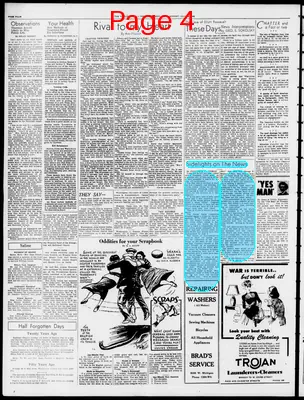
Story
July 16, 1945
The Ypsilanti Daily Press
Ypsilanti, Washtenaw County, Michigan
What is this article about?
Journalist Frederick C. Othman satirically recounts a chaotic congressional debate on funding war agencies and the Fair Employment Practices Committee (FEPC). After delays, the House passes a compromise amendment allocating $250,000 to FEPC, approved by the Senate, averting clerks' financial hardship.
Clipping
OCR Quality
98%
Excellent
Full Text
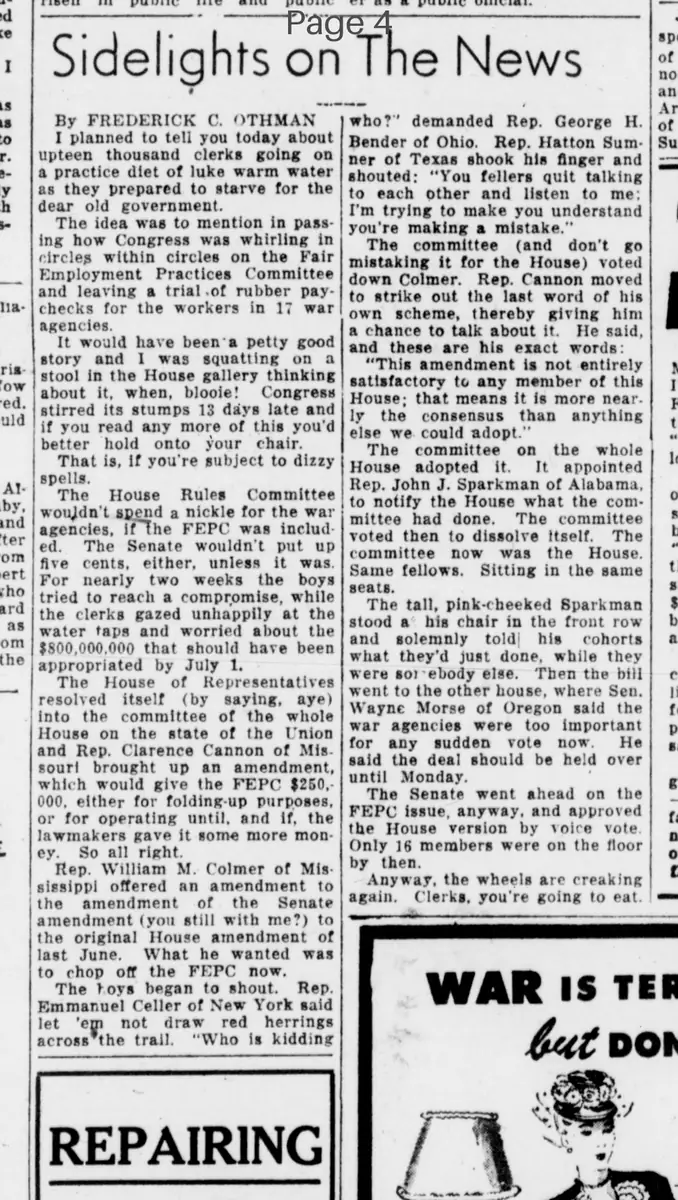
Sidelights on The News
By FREDERICK C. OTHMAN
I planned to tell you today about upteen thousand clerks going on a practice diet of luke warm water as they prepared to starve for the dear old government.
The idea was to mention in passing how Congress was whirling in circles within circles on the Fair Employment Practices Committee and leaving a trail of rubber pay-checks for the workers in 17 war agencies.
It would have been a pretty good story and I was squatting on a stool in the House gallery thinking about it, when, blooie! Congress stirred its stumps 13 days late and if you read any more of this you'd better hold onto your chair.
That is, if you're subject to dizzy spells.
The House Rules Committee wouldn't spend a nickle for the war agencies, if the FEPC was included.
The Senate wouldn't put up five cents, either, unless it was.
For nearly two weeks the boys tried to reach a compromise, while the clerks gazed unhappily at the water taps and worried about the $800,000,000 that should have been appropriated by July 1.
The House of Representatives resolved itself (by saying, aye) into the committee of the whole House on the state of the Union and Rep. Clarence Cannon of Missouri brought up an amendment, which would give the FEPC $250,000, either for folding-up purposes, or for operating until, and if, the lawmakers gave it some more money. So all right.
Rep. William M. Colmer of Mississippi offered an amendment to the amendment of the Senate amendment (you still with me?) to the original House amendment of last June. What he wanted was to chop off the FEPC now.
The boys began to shout. Rep. Emmanuel Celler of New York said let 'em not draw red herrings across the trail. "Who is kidding who?" demanded Rep. George H. Bender of Ohio. Rep. Hatton Sumners of Texas shook his finger and shouted; "You fellers quit talking to each other and listen to me: I'm trying to make you understand you're making a mistake."
The committee (and don't mistaking it for the House) voted down Colmer. Rep. Cannon moved to strike out the last word of his own scheme, thereby giving him a chance to talk about it. He said, and these are his exact words:
"This amendment is not entirely satisfactory to any member of this House: that means it is more nearly the consensus than anything else we could adopt."
The committee on the whole House adopted it. It appointed Rep. John J. Sparkman of Alabama, to notify the House what the committee had done. The committee voted then to dissolve itself. The committee now was the House. Same fellows. Sitting in the same seats.
The tall, pink-cheeked Sparkman stood at his chair in the front row and solemnly told his cohorts what they'd just done, while they were somebody else. Then the bill went to the other house, where Sen. Wayne Morse of Oregon said the war agencies were too important for any sudden vote now.
He said the deal should be held over until Monday.
The Senate went ahead on the FEPC issue, anyway, and approved the House version by voice vote. Only 16 members were on the floor by then.
Anyway, the wheels are creaking again. Clerks, you're going to eat.
By FREDERICK C. OTHMAN
I planned to tell you today about upteen thousand clerks going on a practice diet of luke warm water as they prepared to starve for the dear old government.
The idea was to mention in passing how Congress was whirling in circles within circles on the Fair Employment Practices Committee and leaving a trail of rubber pay-checks for the workers in 17 war agencies.
It would have been a pretty good story and I was squatting on a stool in the House gallery thinking about it, when, blooie! Congress stirred its stumps 13 days late and if you read any more of this you'd better hold onto your chair.
That is, if you're subject to dizzy spells.
The House Rules Committee wouldn't spend a nickle for the war agencies, if the FEPC was included.
The Senate wouldn't put up five cents, either, unless it was.
For nearly two weeks the boys tried to reach a compromise, while the clerks gazed unhappily at the water taps and worried about the $800,000,000 that should have been appropriated by July 1.
The House of Representatives resolved itself (by saying, aye) into the committee of the whole House on the state of the Union and Rep. Clarence Cannon of Missouri brought up an amendment, which would give the FEPC $250,000, either for folding-up purposes, or for operating until, and if, the lawmakers gave it some more money. So all right.
Rep. William M. Colmer of Mississippi offered an amendment to the amendment of the Senate amendment (you still with me?) to the original House amendment of last June. What he wanted was to chop off the FEPC now.
The boys began to shout. Rep. Emmanuel Celler of New York said let 'em not draw red herrings across the trail. "Who is kidding who?" demanded Rep. George H. Bender of Ohio. Rep. Hatton Sumners of Texas shook his finger and shouted; "You fellers quit talking to each other and listen to me: I'm trying to make you understand you're making a mistake."
The committee (and don't mistaking it for the House) voted down Colmer. Rep. Cannon moved to strike out the last word of his own scheme, thereby giving him a chance to talk about it. He said, and these are his exact words:
"This amendment is not entirely satisfactory to any member of this House: that means it is more nearly the consensus than anything else we could adopt."
The committee on the whole House adopted it. It appointed Rep. John J. Sparkman of Alabama, to notify the House what the committee had done. The committee voted then to dissolve itself. The committee now was the House. Same fellows. Sitting in the same seats.
The tall, pink-cheeked Sparkman stood at his chair in the front row and solemnly told his cohorts what they'd just done, while they were somebody else. Then the bill went to the other house, where Sen. Wayne Morse of Oregon said the war agencies were too important for any sudden vote now.
He said the deal should be held over until Monday.
The Senate went ahead on the FEPC issue, anyway, and approved the House version by voice vote. Only 16 members were on the floor by then.
Anyway, the wheels are creaking again. Clerks, you're going to eat.
What sub-type of article is it?
Historical Event
What themes does it cover?
Justice
Social Manners
Misfortune
What keywords are associated?
Congressional Debate
Fepc Funding
War Agencies
Appropriations Bill
Political Compromise
What entities or persons were involved?
Frederick C. Othman
Clarence Cannon
William M. Colmer
Emmanuel Celler
George H. Bender
Hatton Sumners
John J. Sparkman
Wayne Morse
Where did it happen?
House Of Representatives, Senate, Washington D.C.
Story Details
Key Persons
Frederick C. Othman
Clarence Cannon
William M. Colmer
Emmanuel Celler
George H. Bender
Hatton Sumners
John J. Sparkman
Wayne Morse
Location
House Of Representatives, Senate, Washington D.C.
Event Date
13 Days After July 1
Story Details
Congress debates and passes compromise funding for war agencies including $250,000 for FEPC after amendments and votes, resolving delay in $800,000,000 appropriation.