Thank you for visiting SNEWPapers!
Sign up free
Freeman's Chronicle
Columbus, Franklin County, Ohio
What is this article about?
Captain David Porter's letter details the USS Essex's 1812-1814 Pacific cruise, capturing British whalers, disrupting commerce, and honorable defense against superior British forces Phoebe and Cherub at Valparaiso, Chile, on March 28, 1814, resulting in Essex's capture after heavy losses.
Merged-components note: Merging the detailed narrative story about the cruise and capture of the U.S. Frigate Essex, including the table listing captured ships, across pages 1, 2, and 4. The text includes explicit continuation notes ('Continued to Last Page' on page 1 and 'Continued on Second Page' on page 4), indicating these components form a single coherent story despite non-sequential reading orders due to newspaper layout.
Clippings
1 of 3
OCR Quality
Full Text
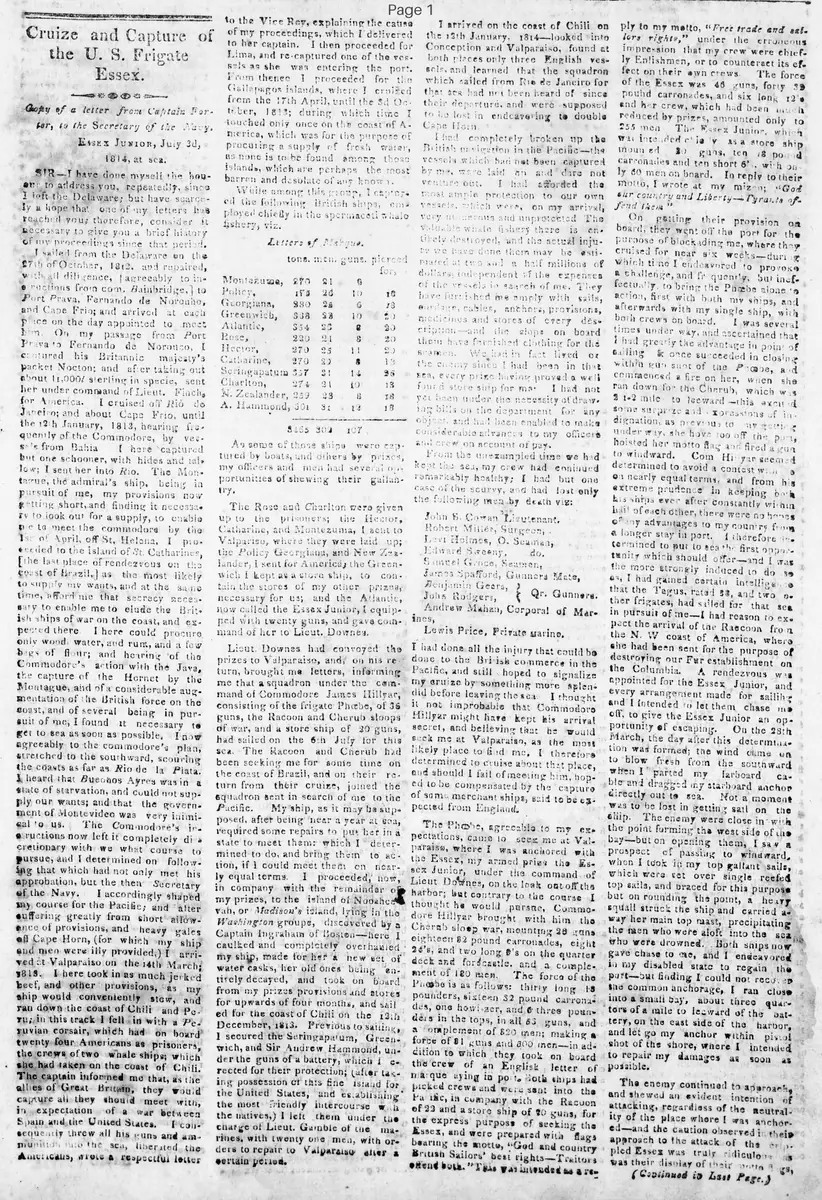
the U. S. Frigate
Essex.
Copy of a letter from Captain Porter,
to the Secretary of the Navy.
Essex Junior, July 3d,
1814, at sea.
SIR—I have done myself the honour
to address you repeatedly, since
I left the Delaware: but have scarcely
a hope that one of my letters has
reached you; therefore, consider it
necessary to give you a brief history
of my proceedings since that period.
I sailed from the Delaware on the
27th of October, 1812, and repaired,
with all diligence, (agreeably to in-
structions from Com. Bainbridge) to
Port Praya, Fernando de Noronha,
and Cape Frio; and arrived at each
place on the day appointed to meet
him. On my passage from Port
Praya to Fernando de Noronha, I
captured his Britannic majesty's
packet Nocton: and after taking out
about £10,000 sterling in specie, sent
her under command of Lieut. Finch
for America. I cruised off Rio de
Janeiro; and about Cape Frio, until
the 13th January, 1813, hearing fre-
quently of the Commodore, by ves-
sels from Bahia. I here captured
but one schooner, with hides and tal-
low: I sent her into Rio. The Mon-
tague, the admiral's ship, being in
pursuit of me, my provisions now
getting short, and finding it necessary
to look out for a supply, to enable
me to meet the commodore by the
1st of April, off St. Helena, I pro-
ceeded to the island of St. Catharines,
(the last place of rendezvous on the
coast of Brazil,) as the most likely
to supply my wants, and at the same
time, afford me that secrecy neces-
sary to enable me to elude the Brit-
ish ships of war on the coast, and ex-
pected there. I here could procure
only wood, water, and rum, and a few
bags of flour; and hearing of the
Commodore's action with the Java,
the capture of the Hornet by the
Montague, and of a considerable aug-
mentation of the British force on the
coast, and of several being in pur-
suit of me, I found it necessary to
get to sea as soon as possible. I now,
agreeably to the commodore's plan,
stretched to the southward, scouring
the coasts as far as Rio de la Plata.
I heard that Buenos Ayres was in a
state of starvation, and could not sup-
ply our wants; and that the govern-
ment of Montevideo was very inimical
to us. The Commodore's in-
structions now left it completely dis-
cretionary with me what course to
pursue, and I determined on follow-
ing that which had not only met his
approbation, but the then Secretary
of the Navy. I accordingly shaped
my course for the Pacific; and after
suffering greatly from short allow-
ances of provisions, and heavy gales
off Cape Horn, (for which my ship
and men were illy provided,) I arri-
ved at Valparaiso on the 14th March,
1813. I here took in as much jerked
beef, and other provisions, as my
ship would conveniently stow, and
ran down the coast of Chili and Pe-
ru; in this track I fell in with a Pe-
ruvian corsair, which had on board
twenty four Americans as prisoners,
the crews of two whale ships; which
she had taken on the coast of Chili.
The captain informed me that, as the
allies of Great Britain, they would
capture all they should meet with,
in expectation of a war between
Spain and the United States. I con-
sequently threw all his guns and am-
munition into the sea, liberated the
Americans, wrote a respectful letter
to the Viceroy, explaining the cause
of my proceedings, which I delivered
to her captain. I then proceeded for
Lima, and re-captured one of the ves-
sels as she was entering the port.
From thence I proceeded for the
Gallapagos islands, where I cruized
from the 17th April, until the 3d Oc-
tober, 1813; during which time I
touched only once on the coast of A-
merica, which was for the purpose of
procuring a supply of fresh water,
as none is to be found among those
islands, which are perhaps the most
barren and desolate of any known.
While among this group, I captured
the following British ships, em-
ployed chiefly in the spermaceti whale
fishery, viz.
Letters of Marque.
3165 900
107.
As some of those ships were cap-
tured by boats, and others by prizes,
my
officers and men had several op-
portunities of shewing their gallan-
try.
The Rose and Charlton were given
up to the prisoners; the Hector,
Catharine, and Montezuma, I sent to
Valpariso, where they were laid up;
the Policy, Georgiana, and New Zea-
lander, I sent for America; the Green-
wich I kept as a store ship, to con-
tain the stores of my other prizes,
necessary for us; and the Atlantic,
now called the Essex Junior, I equip-
ped with twenty guns, and gave com-
mand of her to Lieut. Downes.
Lieut. Downes had convoyed the
prizes to Valparaise, and, on his re-
turn, brought me letters, informing
me that a squadron under the com-
mand of Commodore James Hillyar,
consisting of the frigate Phoebe, of 36
guns, the Racoon and Cherub sloops
of war, and a store ship of 20 guns,
had sailed on the 6th July for this
sea. The Racoon and Cherub had
been seeking me for some time on
the coast of Brazil, and on their re-
turn from their cruize, joined the
squadron sent in search of me to the
Pacific.
My ship, as it may be sup-
posed, after being near a year at sea,
required some repairs to put her in a
state to meet them: which I deter-
mined to do, and bring them to ac-
tion, if I could meet them on nearly
equal terms. I proceeded, now,
in company with the remainder of
my prizes, to the island of Nukahiva,
or Madison's island, lying in the
Washington group, discovered by a
Captain Ingraham of Boston—here I
caulked and completely overhauled
my ship, made for her a new set of
water casks, her old ones being en-
tirely decayed, and took on board
from my prizes provisions and stores
for upwards of four months, and sailed
for the coast of Chili on the 13th
December, 1813. Previous to sailing,
I secured the Seringapatam, Green-
wich, and Sir Andrew Hammond, un-
der the guns of a battery, which I e-
rected for their protection; (after ta-
king possession of this fine island for
the United States, and establishing
the most friendly intercourse with
the natives,) I left them under the
charge of Lieut. Gamble of the ma-
rines, with twenty one men, with or-
ders to repair to Valparaiso after a
certain period.
I arrived on the coast of Chili on
the 13th January, 1814—looked into
Conception and Valparaiso, found at
both places only three English ves-
sels, and learned that the squadron
which sailed from Rio de Janeiro for
that sea had not been heard of since
their departure, and were supposed
to be lost in endeavouring to double
Cape Horn.
I had completely broken up the
British navigation in the Pacific—the
vessels which had not been captured
by me, were laid up and dare not
venture out. I had afforded the
most ample protection to our own
vessels, which were, on my arrival,
very numerous and unprotected. The
valuable whale fishery as carried on there is en-
tirely destroyed, and the actual injury we have done them may be esti-
mated at two and a half millions of
dollars, independent of the expenses
of the vessels in search of me. They
have furnished me amply with sails,
ordnance, cables, anchors, provisions,
medicines and stores of every descrip-
tion,—and the alone on board
them have furnished clothing for the
season. We had in fact lived off
the enemy since I had been in that
sea, every prize having proved a well
found store ship for me: I had not
yet been under the necessity of drawing
bills on the department for any
object, and had been enabled to make
considerable advances to my officers
and crew on account of pay.
From the unprecedented time we had
kept the sea, my crew had continued
remarkably healthy; I had but one
case of the scurvy, and had lost only
the following men by death, viz:
John S. Cowan, Lieutenant.
Robert Miller, Surgeon.
Levi Holmes, O. Seaman.
Edward Sweeny,
do.
Stunnel Groce, Seaman.
James Spafford, Gunner's Mate.
Benjamin Geers,
John Rodgers,
Qr. Gunners.
Andrew Mahan, Corporal of Ma-
rines.
Lewis Price, Private Marine.
I had done all the injury that could be
done to the British commerce in the
Pacific, and still hoped to signalize
my cruize by something more splen-
did before leaving the sea. I thought
it not improbable that Commodore
Hillyar might have kept his arrival
secret, and believing that he would
seek me at Valparaiso, as the most
likely place to find me, I therefore
determined to cruize about that place,
and should I fail of meeting him, hoped
to be compensated by the capture
of some merchant ships, said to be ex-
pected from England.
The Phoebe, agreeable to my ex-
pectations, came to see me at Val-
paraiso, where I was anchored with
the Essex, my armed prize the Es-
sex Junior, under the command of
Lieut. Downes, on the look out off the
harbor; but contrary to the course I
thought he would pursue, Commo-
dore Hillyar brought with him the
Cherub sloop of war, mounting 28 guns:
eighteen 32 pound carronades, eight
18's, and two long 9's on the quarter
deck and forecastle, and a complement
of 180 men. The force of the
Phoebe is as follows: thirty long 18
pounders, sixteen 32 pound carronades,
one howitzer, and 6 three pounders
in the tops, in all 53 guns, and
a complement of 300 men; making a
force of 81 guns and 480 men—in ad-
dition to which they took on board
the crew of an English letter of
marque lying in port. Both ships had
picked crews and were sent into the
Pacific, in company with the Raccoon
of 22 and a store ship of 20 guns, for
the express purpose of seeking the
Essex, and were prepared with flags
bearing the motto, "God and country,
British Sailors' best rights—Traitors
offend both." This was intended as a re-
ply to my motto, "Free trade and sailors
rights," under the erroneous
impression that my crew were chiefly
Englishmen, or to counteract its effect
on their own crews. The force
of the Essex was 46 guns, forty 32
pound carronades, and six long 12's,
and her crew, which had been much
reduced by prizes, amounted only to
255 men. The Essex Junior, which
was intended only as a store ship,
mounted 20 guns, ten 18 pound
carronades and ten short 6's, with only
60 men on board. In reply to their
motto, I wrote at my mizen: "God
and our country—tyrants offend both."
On getting their provision on
board, they went off the port for the
purpose of blockading me, where they
cruised for near six weeks—during
which time I endeavored to provoke
a challenge, and frequently, but ineffectually,
to bring the Phoebe alone to
action, first with both my ships, and
afterwards with my single ship, with
both crews on board. I was several
times under way, and ascertained that
I had greatly the advantage in point of
sailing, and once succeeded in closing
within gun shot of the Phoebe, and
commenced a fire on her, when she
ran down to the Cherub, which was
2 1-2 miles to leeward—this excited
some surprise and expressions of indignation,
as previous to my getting
under way, she hove to off the port,
hoisted her motto flag and fired a gun
to windward. Com. Hillyar seemed
determined to avoid a contest with
me on nearly equal terms, and from his
extreme prudence in keeping both
his ships ever after constantly within
hail of each other, there were no hopes
of any advantages to my country from
a longer stay in port. I therefore de-
termined to put to sea the first oppor-
tunity which should offer—and I was
the more strongly induced to do so
as, I had gained certain intelligence
that the Tagus, rated 36, and two other
frigates, had sailed for that sea
in pursuit of me—I had reason to expect
the arrival of the Raccoon from
the N. W. coast of America, where
she had been sent for the purpose of
destroying our Fur establishment on
the Columbia. A rendezvous was
appointed for the Essex Junior, and
every arrangement made for sailing,
and I intended to let them chase me
off, to give the Essex Junior an op-
portunity of escaping. On the 28th
March, the day after this determination
was formed; the wind came on
to blow fresh from the southward
when I parted my larboard cable
and dragged my starboard anchor
directly out to sea. Not a moment
was to be lost in getting sail on the
ship. The enemy were close in with
the point forming the west side of the
bay—but on opening them, I saw a
prospect of passing to windward,
when I took in my top gallant sails,
which were set over single reefed
top sails, and braced for this purpose;
but on rounding the point, a heavy
squall struck the ship and carried away
her main top mast, precipitating
the men who were aloft into the sea,
who were drowned. Both ships now
gave chase to me, and I endeavored
in my disabled state to regain the
port—but finding I could not recover
the common anchorage, I ran close
into a small bay, about three quar-
tors of a mile to leeward of the bat-
tery, on the east side of the harbor,
and let go my anchor within pistol
shot of the shore; where I intended
to repair my damages as soon as
possible.
The enemy continued to approach
and shewed an evident intention of
attacking, regardless of the neutral-
ity of the place where I was anchored—and
the caution observed in their
approach to the attack of the crippled
Essex was truly ridiculous, as
was their display of their motto flags.
(Continued to Last Page.)
| tons. men. guns. pierced | ||||
| for | ||||
| Montezume, | 270 | 21 | 6 | |
| Policy, | 175 | 26 | 10 | 15 |
| Georgiana, | 880 | 25 | 6 | 13 |
| Greenwich, | 338 | 28 | 10 | 20 |
| Atlantic, | 354 | 25 | 8 | 20 |
| Rose, | 230 | 21 | 8 | 20 |
| Hector, | 270 | 25 | 11 | 20 |
| Catharine, | 270 | 29 | 8 | 18 |
| Seringapatum | 357 | 31 | 14 | 26 |
| Charlton, | 274 | 21 | 10 | 13 |
| N. Zealander, | 259 | 23 | 8 | 18 |
| A. Hammond, | 301 | 31 | 12 | 18 |
United States Frigate
and the number of Jacks at all their mast heads. I, with as much expedition as circumstances would admit of, got my ship ready for action, and endeavored to get a spring on my cable, but had not succeeded when the enemy, at 45 minutes after 3 P.M. made his attack, the Phoebe placing herself under my stern, and the Cherub on my starboard bow--but the Cherub soon finding her situation a hot one, bore up and ran under my stern also, where both ships kept up a hot raking fire. I had got three long twelve pounders out of the stern ports, which were worked with so much bravery and skill, that in half an hour we so disabled both as to compel them to haul off to repair damages. In the course of this firing, I had by the great exertions of Mr. Edward Barnewall, the acting sailing master, assisted by Mr. Linscott, the Boatswain, succeeded in getting springs on our cable three different times--but the fire of the enemy was so excessive, that before we could get our broadside to bear, they were shot away, and thus rendered useless to us. My ship had received many injuries, and several had been killed and wounded--but my brave officers and men, notwithstanding the unfavorable circumstances under which we were brought to action, and the powerful force opposed to us, were no ways discouraged--all appeared determined to defend their ship to the last extremity, and to die in preference to a shameful surrender. Our gaff, with the ensign and the motto flag at the mizen, had been shot away, but Free Trade and Sailors Rights continued to fly at the fore. Our ensign was replaced by another--and to guard against a similar event, an ensign was made fast in the mizen rigging and several jacks were hoisted in different parts of the ship. The enemy soon repaired his damages for a fresh attack--he now placed himself, with both his ships, on my starboard quarter, out of reach of my carronades, and where my stern guns could not be brought to bear--he there kept up a most galling fire, which it was out of my power to return, when I saw no prospect of injuring him without getting under way and becoming the assailant. My top sail sheets and halyards were all shot away, as well as the jib and fore top-mast stay-sail halyards. The only rope not cut was the flying jib halyards--and that being the only sail I could set, I caused it to be hoisted, my cable to be cut, and ran down on both ships, with an intention of laying the Phoebe on board. The firing on both sides was now tremendous; I had let fall my fore top-sail and fore-sail, but the want of tacks and sheets rendered them almost useless to us--yet we were enabled, for a short time, to close with the enemy--and although our decks were now strewed with dead, and our cock pit filled with wounded--although our ship had been several times on fire, and was rendered a perfect wreck, we were still encouraged to hope to save her, from the circumstance of the Cherub, from her crippled state, being compelled to haul off. She did not return to close action again, although she apparently had it in her power to do so, but kept up a distant firing with her long guns. The Phoebe, from our disabled state, was enabled however by edging off, to choose the distance which best suited her long guns, & kept up a tremendous fire on us, which mowed down my brave companions by the dozen. Many of my guns had been rendered useless by the enemy's shot, and many of them had had their whole crews destroyed. We manned them again from those which were disabled, and one gun in particular was three times manned--fifteen men were slain at it in the course of the action! but strange as it may appear, the captain of it escaped without a slight wound. Finding that the enemy had it in his power to choose his distance, I now gave up all hopes of closing with him, and as the wind, for the moment, seemed to favor the design I determined to endeavor to run her on shore, land my men and destroy her. Every thing seemed to favor my wishes. We had approached within musket shot, and I had no doubt of succeeding, when, in an instant, the wind shifted from
(Continued on Second Page.)
the land is very common in this port in the latter part of the day and payed our head down on the Phoebe,
where we were again exposed to a dreadful raking fire. My ship was now totally unmanageable; yet, as her head was toward the enemy, and he to leeward of me, I still hoped to be able to board him. At this moment Lt. Commandant Downes came on board to receive my orders; under the impression that I should soon be a prisoner. He could be of no use to me in the then wretched state of the Essex: and finding (from the enemy's putting his helm up) that my last attempt at boarding would not succeed. I directed him, after he had been about 10 minutes on board, to return to his own ship, to be prepared for defending and destroying her in case of attack. He took with him several of my wounded, leaving 8 of his boat's crew on board to make room for them. The Cherub now had an opportunity of distinguishing herself, by keeping up a hot fire on him during his return. The slaughter on board my ship had now become horrible, the enemy continuing to rake us, and we unable to bring a gun to bear. I therefore directed a hawser to be bent to the sheet anchor, and the anchor to be cut from the bows to bring her head round: this succeeded. We again got our broadside to bear, and as the enemy was much crippled and unable to hold his own, I have no doubt he would soon have drifted out of gun-shot before he discovered we had anchored, had not the hawser unfortunately parted. My ship had taken fire several times during the action, but alarmingly so forward and aft at this moment, the flames were bursting up each hatchway, and no hopes were entertained of saving her; our distance from the shore did not exceed three quarters of a mile, and I hoped many of my brave crew would be able to save themselves, should the ship blow up, as I was informed the fire was near the magazine, and the explosion of a large quantity of powder below served to increase the horrors of our situation—our boats were destroyed by the enemy's shot: I, therefore, directed those who could swim to jump overboard, and endeavor to gain the shore. Some reached it—some were taken by the enemy, and some perished in the attempt; but most preferred sharing with me the fate of the ship. We, who remained, now turned our attention vigorously to extinguish the flames—and as we had succeeded, went again to our guns, where the firing was kept up for some minutes, but the crew had by this time become so weakened, that they all declared to me the impossibility of making further resistance, and entreated me to surrender my ship to save the wounded, as all further attempt at opposition must prove ineffectual, almost every gun being disabled by the destruction of their crews. I now sent for the officers of divisions to consult them, but what was my surprise to find only Acting Lt. Stephen Decatur M'Knight remaining, who confirmed the report respecting the condition of the guns on the gun deck—the those on the spar deck were not in a better state. Lt. Wilmer after fighting most gallantly throughout the action, had been knocked overboard by a splinter while getting the sheet anchor from the bows, and was drowned. Acting Lt. John G. Cowell had lost a leg—Mr. Edward Barnewall, Acting Sailingmaster, had been carried below, after receiving two severe wounds, one in the breast and one in the face—and Acting Lt. Wm. H. Odenheimer had been knocked overboard from the quarter deck before, and did not regain the ship until after the surrender. I was informed that the cockpit, the steerage, the ward room and the berth deck could contain no more wounded; that the wounded were killed while the surgeons were dressing them, and that, unless something was speedily done to prevent it, the ship would soon sink from the number of shot holes in her bottom. And on sending for the Carpenter, he informed me that all his crew had been killed or wounded, and that he had once been over the side to stop the leaks, when his slings had been shot away, and it was with difficulty he was saved from drowning. The enemy, to crown the smoothness of the water, and the impossibility of our reaching him with our carronades, and the little impression that was excited by our fire, which had now become much slackened, was enabled to take aim at us, as at a target; his shot never missed our hull, and my ship was cut up in a manner which was, perhaps, never before witnessed—in fine, I saw no hopes of saving her, and at 20 minutes after 6 P. M. gave the painful orders to strike the colors. 75 men, including officers, were all that remained of my whole crew, after the action, capable of doing duty, and many of them severely wounded, some of whom have since died. The enemy still continued his fire, and my brave, though unfortunate companions, were still falling about me. I directed an opposite gun to be fired, to shew them we intended no further resistance—but they did not desist—four men were killed at my side, and others in different parts of the ship. I now believed he intended to show us no quarter, and that it would be as well to die with my flag flying as struck, and was on the point of again hoisting it, when about ten minutes after hauling the colors down he ceased firing.
I cannot speak in sufficiently high terms of the conduct of those engaged for such an unparalleled length of time [under such circumstances] with me in the arduous & unequal contest. Let it suffice to say that more bravery, skill, patriotism and zeal were never displayed on any occasion. Every one seemed determined to die in defence of their much loved country's cause, and nothing but views to humanity could ever have reconciled them to the surrender of the ship; they remembered their wounded and helpless ship mates below. To acting lieuts M'Knight and Odenheimer I feel much indebted for their great exertions and bravery throughout the action in fighting and encouraging the men at their divisions, for the dexterous management of the long guns, and for their promptness in manning their guns as their crews were slaughtered. The conduct of that brave and heroic officer, acting Lt. John G. Cowell, who lost his leg in the latter part of the action, excited the admiration of every man in the ship, and after being wounded would not consent to be taken below until loss of blood rendered him insensible. Mr. Edward Barnewall, acting sailing master, whose activity and courage was equally conspicuous, returned on deck after his first wound and remained after receiving his second until fainting with loss of blood. Mr. Samuel B. Johnston who had joined me the day before, and acted as marine officer, conducted himself with great bravery, and exerted himself in assisting at the long guns—the musketry after the first half hour being useless from our long distance: Mr. M. W. Bostwick, whom I had appointed acting purser of the Essex Junior, and who was on board my ship, did the duties of aide, in a manner which reflects on him the highest honor; and Midshipmen Isaacs, Farragut and Ogden, as well as Acting Midshipman James Terry, James R. Lyman and Samuel Dazenbury, Master's Mate William Pierce exerted themselves in the performance of their respective duties and gave an earnest of their value to the service; the three first are too young to recommend for promotion, the latter I beg leave to recommend for confirmation, as well as the acting lieutenants, and messrs. Barnewall, Johnston and Bostwick.
We have been unfortunate, but not disgraced—the defence of the Essex has not been less honorable to her officers and crew, than the capture of an equal force; and I now consider my situation less unpleasant than that of commodore Hillyar, who in violation of every principle of honor and generosity, & regardless of the rights of nations, attacked the Essex in her crippled state, within pistol-shot of neutral shore; when for six weeks, I had daily offered him fair and honorable combat, on terms greatly to his advantage, the blood of the slain must be on his head, and he has yet to reconcile his conduct to heaven, to his conscience and to the world. The annexed extract of a letter from Commodore Hillyar, which was written previous to his returning me my sword, will shew his opinion of our conduct.
My loss has been dreadfully severe, 68 killed or have since died of their wounds along among Lieut. Cowell were several wounded, even slightly, and 31 are missing; making in all 154, killed, wounded, and missing, a list of whose names is annexed.
The professional knowledge of Doctor Richard Hoffman, acting Surgeon and Doctor Alexander Montgomery, acting Surgeon's Mate, added to their assiduity and the benevolent attentions and assistance of Mr. D. P. Adams, the Chaplain, saved the lives of many of the wounded; those gentlemen have been indefatigable in their attentions to them; the two first I beg leave to recommend for confirmation, and the latter to the notice of the Department.
I must in justification of myself observe, that with our six twelve pounders only we fought this action, our carronades being almost useless. The loss in killed and wounded has been great with the enemy—among the former is the first Lieutenant of the Phoebe, and of the latter Captain Tucker of the Cherub, whose wounds are severe. Both the Essex and Phoebe were in a sinking state, and it was with difficulty they could be kept afloat until they anchored in Valparaiso next morning. The battered state of the Essex will, I believe, prevent her ever reaching England, & I also think it will be out of their power to repair the damages of the Phoebe, so as to enable her to double Cape Horn. All the masts and yards of the Phoebe and Cherub are badly crippled, and their hulls much cut up—the former had 18 twelve pound shot thro' her below her water line, some three feet under water. Nothing but the greatness of the water saved both the Phoebe and Essex:
I hope, sir, that our conduct may prove satisfactory to our country, and that it will testify it by obtaining our speedy exchange, that we may again have it in our power to prove our zeal.
Commodore Hillyar (I am informed) has thought proper to state to his government that the action only lasted 45 minutes—should he have done so, the motive may be easily discovered—but the thousands of disinterested witnesses who covered the surrounding hills can testify that we fought his ship near two hours and an half—upwards of fifty broadsides were fired by the enemy agreeable to their own accounts, and upwards of seventy five by ours—except the few minutes they were repairing damages, the firing was incessant.
Soon after my capture I entered into an agreement with Com. Hillyar to disarm my prize One Essex Junior & proceed with the survivors of my officers and crew in her to the United States, taking with me all her officers and crew. He consented to grant her a passport to secure her from recapture. The ship was small and we knew we had much to suffer, yet we hoped soon to reach our Country in safety, that we might again have it in our power to serve it. This arrangement was attended with no additional expense, as she was abundantly supplied with provisions and stores for the voyage.
In justice to Commodore Hillyar, I must observe, that although I can never be reconciled to the manner of his attack on the Essex, or to his conduct before the action, he has since our capture, shewn the greatest humanity to my wounded (whom he permitted me to land on condition that the United States should bear their expenses,) and has endeavored as much as lay in his power to alleviate the distresses of war by the most generous and delicate deportment towards myself my officers and crew: he gave orders that the property of every person should be respected— his orders, however, were not so strictly attended to as might have been expected—besides being deprived of books, charts, &c. both myself and officers lost many articles of our clothing, some to a considerable amount. I should not have considered this last circumstance of sufficient importance to notice, did it not mark a striking difference between the Navy of G. Britain, and that of the United States, highly creditable to the latter.
By the arrival of the Tagus, a few days after my capture, I was informed that beside the ships which had arrived in the Pacific in pursuit of me, and those still expected, others were sent to cruise for me in the China Seas, off New Zealand, Timor and New Holland, and that another frigate was second River la Plata.
To possess the Essex it has cost the British government near six millions of dollars, and yet, sir, her capture was owing entirely to accident—and if we consider the expedition with which naval contests are now decided, the action is a dishonour to them. Had they brought their ships boldly into action with a force so very superior, and having the choice of position they should either have captured or destroyed us in one fourth the time they were about it.
During the action, our Consul General Mr. Poinsett called on the Governor of Valparaiso, and requested that the batteries might protect the Essex. This request was refused; but he promised that if she should succeed in fighting her way to the common anchorage, he would send an officer to the British Commander and request him to cease firing, but declined using force under any circumstances, and there is no doubt of a perfect understanding existing between them—this conduct added to the assistance given to the British and their friendly reception after the action, and the strong bias of the faction which govern Chili in favor of the English, as well as their hostility to the Americans, induced Mr. Poinsett to leave that country. Under such circumstances, I did not conceive it would be proper for me to claim the restoration of my ship, confident that the claim would be made by my government to more effect.
Finding some difficulty in the sale of my prizes, I had taken the Hector & Catherine to sea and burnt them with their cargoes.
I exchanged Lieut. M'Knight, Mr. Adams, and Mr. Lyman and eleven Seamen for part of the crew of the Sir Andrew Hammond, and sailed from Valparaiso on the 27th April where the enemy were still patching up their ships to put them in a state for proceeding to Rio de Janeiro previous to going to England.
Annexed is a list of the remains of my crew to be exchanged, as also a copy of the correspondence between Com. Hillyar and myself on that subject. I also send you a list of the prisoners I have taken during my cruise, amounting to 343.
I have the honor to be, &c.
D. PORTER.
The hon. Secretary of the Navy of the U. States, Washington.
The correspondence between Capt. Porter and Com. Hillyar, together with the returns of killed, wounded and missing, shall be published in our next. --Editor Freeman's Chronicle.
Copy of a letter from Capt. Porter to the Secretary of the Navy, dated New-York, July 13, 1814:
SIR—There are some facts relating to our enemy, and although not connected with the action, serve to shew his perfidy, and should be known.
On Commodore Hillyar's arrival at Valparaiso, he ran the Phoebe close alongside the Essex, and enquired, politely after my health, observing that his ship was cleared for action, and his men prepared for boarding. I observed, "Sir, if you, by any accident, get on board of me, I assure you that great confusion will take place; I am prepared to receive you, but shall only act on the defensive." He observed, cooly and indifferently, "Oh Sir, I have no such intentions," at this instant his ship took aback on my starboard bow, her yards nearly locking with those of the Essex: I called all hands to board the enemy; and in an instant my crew were ready to spring on her decks. Commodore Hillyar exclaimed, with great agitation, "I had no intention of getting on board of you—I had no intention of coming so near you—I am sorry I came so near you." His ship fell off with her Jib boom over my decks—her bows exposed to my broadside, her stern to the fire of the Essex Junior, her crew in the greatest confusion, and in fifteen minutes, I could have taken or destroyed her. After he had brought his ship to anchor, Commodore Hillyar and Captain Tucker, of the Cherub, visited me on shore, when I asked him if he intended to respect the neutrality of the port—"Sir," said he, "you have paid such respect to the neutrality of this port, that I feel myself bound, in honor to do the same."
I have the honor to be, with great respect, your obedient servant,
DAVID PORTER
What sub-type of article is it?
What themes does it cover?
What keywords are associated?
What entities or persons were involved?
Where did it happen?
Story Details
Key Persons
Location
Pacific Ocean, Valparaiso, Chile
Event Date
1812 10 27 To 1814 03 28
Story Details
Captain Porter recounts the USS Essex's cruise from October 1812, capturing British whalers in the Galapagos, disrupting Pacific commerce, repairing at Nukahiva, and returning to Valparaiso where, on March 28, 1814, after a squall disabled the ship, it was attacked by superior British forces Phoebe and Cherub, leading to a fierce two-and-a-half-hour battle and eventual surrender after heavy casualties.