Thank you for visiting SNEWPapers!
Sign up free
Virginia Advocate
Charlottesville, Virginia
What is this article about?
Biographical sketch of Charles Maurice de Talleyrand-Périgord, born 1754 in Paris, detailing his career from priest and Bishop of Autun during the French Revolution, through diplomatic roles under the Directory, Napoleon, and Bourbon restorations, marked by opportunism and shifting allegiances until 1830.
Clipping
OCR Quality
Full Text
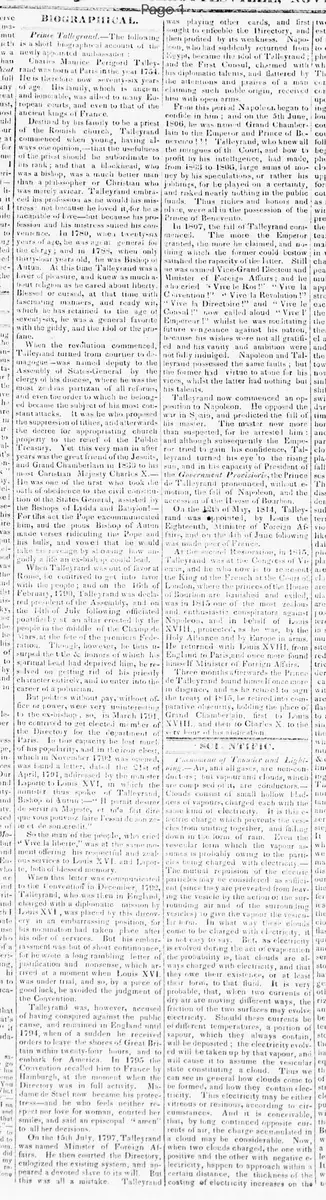
Prince Talleyrand.—The following is a short biographical account of the newly appointed ambassador:
Charles Maurice Perigord Talleyrand was born at Paris in the year 1754. He is therefore now seventy-six years of age. His family, which is ancient and honorable, was allied to many European courts, and even to that of the ancient kings of France.
Destined by his family to be a priest of the Romish church, Talleyrand commenced when young, having always one opinion,—that the usefulness of the priest should be subordinate to his rank: and that a blockhead, who was a bishop, was a much better man than a philosopher or Christian who was merely a vicar. Talleyrand embraced his profession as he would his mistress: not because he loved it,—for he is incapable of love—but because his profession and his mistress suited his convenience. In 1780, when twenty-six years of age, he was agent general for the clergy; and in 1789, when only thirty-four years old, he was Bishop of Autun. At this time Talleyrand was a lover of pleasure, and knew as much about religion as he cared about liberty. Blessed or cursed, at that time with fascinating manners, and ready wit, which he has retained to the age of seventy-six, he was a general favorite with the giddy, and the idol of the profane.
When the revolution commenced, Talleyrand turned from courtier to demagogue—was named deputy to the Assembly of States-General by the clergy of his diocese, where he was the most zealous partizan of all reforms, and even the order to which he belonged became the subject of his most constant attacks. It was he who proposed the suppression of tithes, and afterwards the decree for appropriating church property to the relief of the Public Treasury. Yet this very man in after years was the great friend of the Jesuits, and Grand Chamberlain in 1830 to his most Christian Majesty Charles X.—
He was one of the first who took the oath of obedience to the civil constitution of the States General, assisted by the Bishops of Lydda and Babylon!—For this act the Pope excommunicated him, and the pious Bishop of Autun made verses ridiculing the Pope and his bulls, and vowed that he would take his revenge by showing how ungodly a life an ex-bishop could lead.
When Talleyrand was out of favor at Rome, he contrived to get into favor with the people; and on the 1st of February, 1790, Talleyrand was declared president of the Assembly, and on the 14th of July following officiated pontifically at an altar erected by the people in the middle of the Champ de Mars, at the fete of the premier Federation. Though, however, he thus usurped the title & honors of which his spiritual head had deprived him, he resolved on getting rid of his priestly character entirely, and to enter into the career of a politician.
But politics without pay, without office or power, were very uninteresting to the ex-bishop, so, in March 1791, he contrived to get elected member of the Directory for the department of Paris. In this capacity he lost much of his popularity, and in their iron chest, which in November 1792 was opened, was found a letter, dated the 31st of April, 1791, addressed by the minister Laporte to Louis XVI. in which the minister thus spoke of Talleyrand, Bishop of Autun:—“Il parait desirerer de servir sa Majeste, et m'a fait dire que vous pouviez l'assurer de son zele et de son credit.”
So the man of the people, who cried "Vive la liberte," was at the same moment offering his respectful and zealous services to Louis XVI. and Laporte, both of blessed memory.
When this letter was communicated to the Convention in December, 1792, Talleyrand, who was then in England, charged with a diplomatic mission by Louis XVI, was placed by this discovery in an embarrassing position, for his nomination had taken place after his offer of services. But his embarrassment was but of short continuance. for he wrote a long rambling letter of justification and nonsense, which arrived at a moment when Louis XVI. was under trial, and so, by a piece of good luck, he avoided the judgment of the Convention.
Talleyrand was, however, accused of having conspired against the public cause, and remained in England until 1794, when of a sudden he received orders to leave the shores of Great Britain within twenty-four hours, and to embark for America. In 1795 the Convention recalled him to France by Hamburgh, at the moment when the Directory was in full activity. Madame de Stael now became his protectress—and he who feels neither respect nor love for woman, courted her smiles, and said an episcopal "amen" to all her decisions.
On the 15th July, 1797, Talleyrand was named Minister of Foreign Affairs. He then courted the Directory, eulogized the existing system, and appeared a devoted slave to its will. But this was all a mistake. Talleyrand was playing other cards, and first sought to enfeeble the Directory, and then profited by its weakness. Napoleon, who had suddenly returned from Egypt, became the idol of Talleyrand; and the First Consul, charmed with his diplomatic talents, and flattered by the attentions and praises of a man claiming such noble origin, received him with open arms.
From this period Napoleon began to confide in him: and on the 5th June, 1806, he was named Grand Chamberlain to the Emperor and Prince of Benevento!!! Talleyrand, who knew all the intrigues of the Court, and how to profit by his intelligence, had made, from 1793 to 1806, large sums of money by his speculations, or rather his jobbing, for he played on a certainty, and risked nearly nothing in the public funds. Thus riches and honors and place, were all in the possession of the Prince of Benevento.
In 1807, the fall of Talleyrand commenced. The more the Emperor granted, the more he claimed, and nothing which the former could bestow satisfied the rapacity of the latter. Still he was named Vice-Grand Electeur and Minister of Foreign Affairs: and he who cried "Vive le Roi!" "Vive la Convention!" "Vive la Revolution!" "Vive la Directoire!" and "Vive le Consul!" now called aloud "Vive l'Empereur!" whilst he was meditating future vengeance against his patron, because his wishes were not all gratified and his vanity and ambition were not fully indulged. Napoleon and Talleyrand possessed the same faults; but the former had virtue to atone for his vices, whilst the latter had nothing but his talents.
Talleyrand now commenced an opposition to Napoleon. He opposed the war in Spain, and predicted the fall of his master.
"The master now more than suspected, for he arrested him: and although subsequently the Emperor tried to gain his confidence, Talleyrand turned his eye to the rising sun, and in his capacity of President of the Government Provisional, the Prince de Talleyrand pronounced, without emotion, the fall of Napoleon, and the accession of the House of Bourbon.
On the 12th of May, 1814, Talleyrand was pointed, by Louis the Eighteenth, Minister of Foreign Affairs, and on the 4th of June following was made peer of France.
At the second Restoration, in 1815, Talleyrand was at the Congress of Vienna, and he who now is to represent the King of the French at the Court of London, where the princes of the House of Bourbon are banished and exiled, was in 1815 one of the most zealous and enthusiastic conspirators against Napoleon, and in behalf of Louis XVIII., protected, as he was, by the Holy Alliance and by Europe in arms.
He returned with Louis XVIII. from England to Paris, and once more found himself Minister of Foreign Affairs. Three months afterwards the Prince de Talleyrand found himself once more in disgrace, and as he refused to sign the treaty of 1815, he retired into comparative obscurity, holding the place of Grand Chamberlain, first to Louis XVIII. and then to Charles X. to the very hour of his abdication.
What sub-type of article is it?
What themes does it cover?
What keywords are associated?
What entities or persons were involved?
Where did it happen?
Story Details
Key Persons
Location
Paris, France; England; America; Vienna
Event Date
1754 To 1830
Story Details
Talleyrand, born 1754 into nobility, became a priest and Bishop of Autun in 1789, supported revolutionary reforms including church property seizure, excommunicated by the Pope, shifted allegiances through Revolution, Directory, Napoleon's empire as foreign minister and grand chamberlain, opposed Napoleon, aided Bourbon restoration in 1814, served as foreign minister again in 1815 before retiring as grand chamberlain to Charles X in 1830.