Thank you for visiting SNEWPapers!
Sign up free
Story
August 30, 1865
The Charleston Daily News
Charleston, Charleston County, South Carolina
What is this article about?
Editorial from Philadelphia Age, republished in St. Louis Republican, argues for speedy reorganization of Southern States post-Civil War to restore economic productivity, citing pre-war cotton exports and other Southern products vital to national wealth and debt relief.
Clipping
OCR Quality
98%
Excellent
Full Text
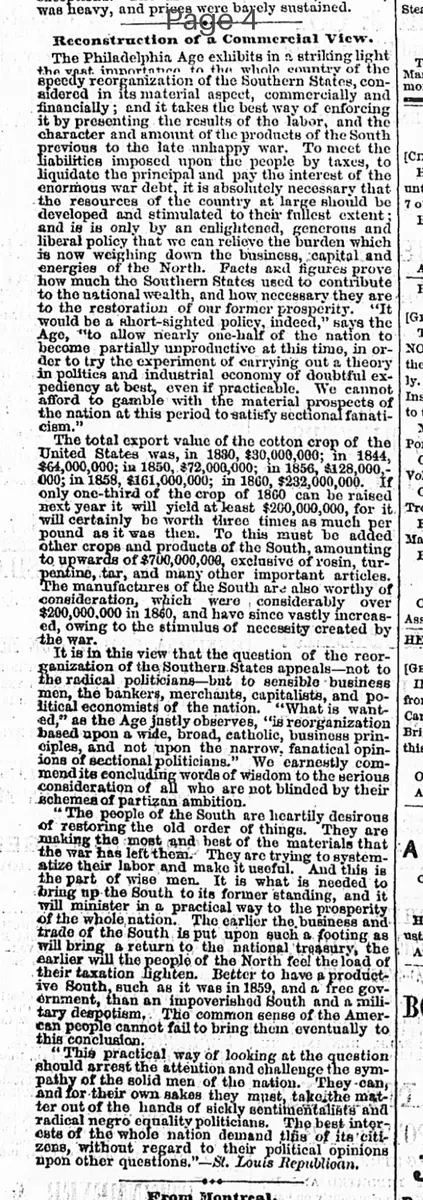
Reconstruction of a Commercial View.
The Philadelphia Age exhibits in a striking light the vast importance to the whole country of the speedy reorganization of the Southern States, considered in its material aspect, commercially and financially; and it takes the best way of enforcing it by presenting the results of the labor, and the character and amount of the products of the South previous to the late unhappy war. To meet the liabilities imposed upon the people by taxes, to liquidate the principal and pay the interest of the enormous war debt, it is absolutely necessary that the resources of the country at large should be developed and stimulated to their fullest extent; and it is only by an enlightened, generous and liberal policy that we can relieve the burden which is now weighing down the business, capital and energies of the North. Facts and figures prove how much the Southern States used to contribute to the national wealth, and how necessary they are to the restoration of our former prosperity. "It would be a short-sighted policy, indeed," says the Age, "to allow nearly one-half of the nation to become partially unproductive at this time, in order to try the experiment of carrying out a theory in politics and industrial economy of doubtful expediency at best, even if practicable. We cannot afford to gamble with the material prospects of the nation at this period to satisfy sectional fanaticism."
The total export value of the cotton crop of the United States was, in 1830, $30,000,000; in 1844, $64,000,000; in 1850, $72,000,000; in 1856, $128,000,000; in 1858, $161,000,000; in 1860, $232,000,000. If only one-third of the crop of 1860 can be raised next year it will yield at least $200,000,000, for it will certainly be worth three times as much per pound as it was then. To this must be added other crops and products of the South, amounting to upwards of $700,000,000, exclusive of rosin, turpentine, tar, and many other important articles.
The manufactures of the South are also worthy of consideration, which were considerably over $200,000,000 in 1860, and have since vastly increased, owing to the stimulus of necessity created by the war.
It is in this view that the question of the reorganization of the Southern States appeals—not to the radical politicians but to sensible business men, the bankers, merchants, capitalists, and political economists of the nation. "What is wanted," as the Age justly observes, "is reorganization based upon a wide, broad, catholic, business principle, and not upon the narrow, fanatical opinions of sectional politicians." We earnestly commend the concluding words of wisdom to the serious consideration of all who are not blinded by their schemes of partizan ambition.
"The people of the South are heartily desirous of restoring the old order of things. They are making the most and best of the materials that the war has left them. They are trying to systematize their labor and make it useful. And this is the part of wise men. It is what is needed to bring up the South to its former standing, and it will minister in a practical way to the prosperity of the whole nation. The earlier the business and trade of the South is put upon such a footing as will bring a return to the national treasury, the earlier will the people of the North feel the load of their taxation lighten. Better to have a productive South, such as it was in 1859, and a free government, than an impoverished South and a military despotism. The common sense of the American people cannot fail to bring them eventually to this conclusion.
"This practical way of looking at the question should arrest the attention and challenge the sympathy of the solid men of the nation. They can and for their own sakes they must, take the matter out of the hands of sickly sentimentalists and radical negro equality politicians. The best interests of the whole nation demand this of its citizens, without regard to their political opinions upon other questions."—St. Louis Republican.
The Philadelphia Age exhibits in a striking light the vast importance to the whole country of the speedy reorganization of the Southern States, considered in its material aspect, commercially and financially; and it takes the best way of enforcing it by presenting the results of the labor, and the character and amount of the products of the South previous to the late unhappy war. To meet the liabilities imposed upon the people by taxes, to liquidate the principal and pay the interest of the enormous war debt, it is absolutely necessary that the resources of the country at large should be developed and stimulated to their fullest extent; and it is only by an enlightened, generous and liberal policy that we can relieve the burden which is now weighing down the business, capital and energies of the North. Facts and figures prove how much the Southern States used to contribute to the national wealth, and how necessary they are to the restoration of our former prosperity. "It would be a short-sighted policy, indeed," says the Age, "to allow nearly one-half of the nation to become partially unproductive at this time, in order to try the experiment of carrying out a theory in politics and industrial economy of doubtful expediency at best, even if practicable. We cannot afford to gamble with the material prospects of the nation at this period to satisfy sectional fanaticism."
The total export value of the cotton crop of the United States was, in 1830, $30,000,000; in 1844, $64,000,000; in 1850, $72,000,000; in 1856, $128,000,000; in 1858, $161,000,000; in 1860, $232,000,000. If only one-third of the crop of 1860 can be raised next year it will yield at least $200,000,000, for it will certainly be worth three times as much per pound as it was then. To this must be added other crops and products of the South, amounting to upwards of $700,000,000, exclusive of rosin, turpentine, tar, and many other important articles.
The manufactures of the South are also worthy of consideration, which were considerably over $200,000,000 in 1860, and have since vastly increased, owing to the stimulus of necessity created by the war.
It is in this view that the question of the reorganization of the Southern States appeals—not to the radical politicians but to sensible business men, the bankers, merchants, capitalists, and political economists of the nation. "What is wanted," as the Age justly observes, "is reorganization based upon a wide, broad, catholic, business principle, and not upon the narrow, fanatical opinions of sectional politicians." We earnestly commend the concluding words of wisdom to the serious consideration of all who are not blinded by their schemes of partizan ambition.
"The people of the South are heartily desirous of restoring the old order of things. They are making the most and best of the materials that the war has left them. They are trying to systematize their labor and make it useful. And this is the part of wise men. It is what is needed to bring up the South to its former standing, and it will minister in a practical way to the prosperity of the whole nation. The earlier the business and trade of the South is put upon such a footing as will bring a return to the national treasury, the earlier will the people of the North feel the load of their taxation lighten. Better to have a productive South, such as it was in 1859, and a free government, than an impoverished South and a military despotism. The common sense of the American people cannot fail to bring them eventually to this conclusion.
"This practical way of looking at the question should arrest the attention and challenge the sympathy of the solid men of the nation. They can and for their own sakes they must, take the matter out of the hands of sickly sentimentalists and radical negro equality politicians. The best interests of the whole nation demand this of its citizens, without regard to their political opinions upon other questions."—St. Louis Republican.
What sub-type of article is it?
Historical Event
Curiosity
What themes does it cover?
Recovery
Misfortune
Triumph
What keywords are associated?
Southern Reconstruction
Cotton Exports
Post War Economy
National Prosperity
Civil War Impact
Where did it happen?
Southern States, United States
Story Details
Location
Southern States, United States
Event Date
Post 1860, Referencing 1830 1860
Story Details
Argues for economic reorganization of Southern States after Civil War to restore productivity, highlighting pre-war cotton exports from $30M in 1830 to $232M in 1860, other products worth $700M, and manufactures over $200M, essential for national debt relief and prosperity.