Thank you for visiting SNEWPapers!
Sign up free
Letter to Editor
July 30, 1836
The Liberator
Boston, Suffolk County, Massachusetts
What is this article about?
The letter argues that the modern church, assimilated to worldly concerns, avoids confronting slavery despite Christianity's principles condemning it. Drawing analogies to temperance reform, it urges preaching the full Gospel against slavery, criticizing selective application and figures like Dr. Ely.
Clipping
OCR Quality
98%
Excellent
Full Text
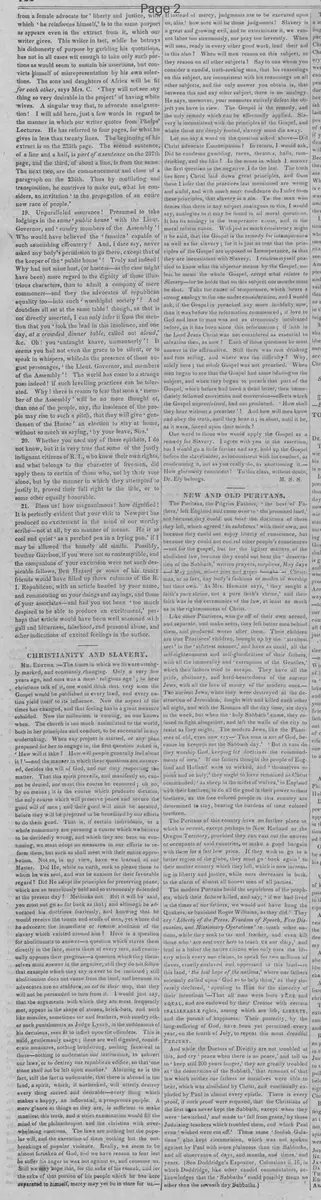
CHRISTIANITY AND SLAVERY.
Mr. Editor:—The times in which we live are strongly marked, and constantly changing. Only a very few years ago, and ours was a most religious age; to hear christians talk of it, one would think that very soon the Gospel would be published in every land, and every nation yield itself to its influence. Now the aspect of the times has changed, and that feeling has in a great measure subsided. Now the millennium is coming, no one knows when. The church is too much assimilated to the world, both in her principles and conduct, to be successful in any undertaking. When any project is started, or any plan proposed for her to engage in, the first question asked is, 'How will it take? How will people generally feel about it?'—and the manner in which these questions are answered, decides the will of God, and our duty respecting the matter. That this spirit prevails, and manifestly so, cannot be denied, nor must this course be censured; oh no, by no means; it is the course which prudence dictates, the only course which will preserve peace and secure the good will of men; and their good will must be secured, before they will be prepared to be benefitted by our efforts to do them good. That is, if certain individuals, or a whole community are pursuing a course which we believe to be decidedly wrong, and which they are bent on continuing, we must adopt no measures in our efforts to reform them, but such as shall meet with their entire approbation. Not so, in my view, have we learned of our Master. Did He, while on earth, seek to please those to whom he was sent, and was he anxious for their favorable regard? Did He adopt the principles for preserving peace, which are so tenaciously held and so strenuously defended at the present day? Methinks not. But it will be said, you must not go so far back as that; and although he advocated his doctrines fearlessly, and knowing that he would receive the taunts and scoffs of men, yet where did he advocate the immediate or remote abolition of the slavery which existed around him? Here is a question for abolitionists to answer—a question which stares them directly in the face, meets them at every turn, and continually opposes their progress—a question which they themselves must answer in the negative, still they do not follow that example which they say is ever to be imitated; still abolitionism does not cease from the land, and because its advocates are so stubborn, so set in their way, that they will not be persuaded to turn from it. I would just say, that the arguments with which they are most frequently met, appear in the shape of stones, brick-bats, and such like missiles, sometimes tar and feathers, with sundry other such punishments as Judge Lynch, in the suddenness of his decisions, sees fit to inflict upon the offenders. This is mild, gentlemanly usage; these are well digested, considerate measures, nothing headstrong, nothing fanatical in these—nothing to undermine our institutions, to subvert our laws, or to destroy our republican edifice, so that one stone shall not be left upon another. Alarming as is the fact, still the fact is undeniable, that there is abroad in the land, a spirit, which, if unchecked, will utterly destroy everything sacred and desirable—everything which makes a happy, an influential, a prosperous people. A mere glance at things as they are, is sufficient to make manifest this truth, and a strict examination would fill the mind of the philanthropist and the christian with overwhelming emotions. 'The laws are nothing but the popular will, and the execution of them nothing but the out-breakings of popular violence. Really, we seem to be almost forsaken of God, and we have reason to fear lest he suffer his anger to wax hot against us, and consume us. Still we may hope that, for the sake of his church, and for the sake of that portion of his people which he has here separated to himself, mercy may yet be in store for us.
If instead of mercy, judgments are to be executed upon us, alas! how sore will be those judgments! Slavery is a great and growing evil, and to exterminate it, we cannot labor too strenuously, nor pray too fervently. When will men, ready in every other good work, lend their aid in this also? When will men reason on this subject, as they reason on all other subjects? Say to one whom you consider a candid, truth-seeking man, that his reasonings on this subject, are inconsistent with his reasonings on all other subjects, and the only answer you obtain is, that between this and any other subject, there is no analogy. He says, moreover, your measures entirely defeat the object you have in view. The Gospel is the remedy, and the only remedy which can be effectually applied. Slavery is inconsistent with the principles of the Gospel, and where these are deeply rooted, slavery must die away.
Let me say a word on the question asked above—Did Christ advocate Emancipation? In return, I would ask, Did he condemn gambling, races, theatres, balls, rum drinking, and the like? In the sense in which I answer the first question in the negative I do the last. The truth lies here; Christ laid down great principles, and from these I infer that the practices last mentioned are wrong and sinful, and with much more confidence do I infer from these principles, that slavery is a sin. To the man who denies that there is any subject analogous to this, I would say, analogies to it may be found in all moral questions. It has its analogy in the temperance cause, and in the moral reform cause. With just as much consistency might it be said, that the Gospel is the remedy for intemperance as well as for slavery; for it is just as true that the principles of the Gospel are opposed to Intemperance, as that they are inconsistent with Slavery. I confess myself puzzled to know what the objector means by the Gospel, unless he mean the whole Gospel, except what relates to Slavery—for he holds that on this subject our mouths must be shut. Take the cause of temperance, which bears a strong analogy to the one under consideration, and I would ask, if the Gospel is preached any more faithfully now than it was before the reformation commenced; if love to God and love to man was not as strenuously inculcated before, as it has been since this reformation; if faith in the Lord Jesus Christ was not considered as essential to salvation then, as now? Each of these questions he must answer in the affirmative. Still there was rum drinking and rum selling, and where was the difficulty? Why, solely here; the whole Gospel was not preached. When men began to see that the Gospel had some bearing on the subject, and when they began to preach that part of the Gospel, which before had been a dead letter, then immediately followed conviction and conversion—effects which the Gospel unproclaimed, had not produced. How shall they hear without a preacher? And how will men know and obey the truth, until they hear it; in short, until it be as it were, forced upon their minds?
One word to those who would apply the Gospel as a remedy for Slavery. I agree with you in the assertion, but I would go a little further and say, hold up the Gospel before the slaveholder, as inconsistent with his conduct, as condemning it, not as you really do, as sanctioning it. How gloriously consistent! To this class, without doubt, Dr. Ely belongs.
M. S. S.
Mr. Editor:—The times in which we live are strongly marked, and constantly changing. Only a very few years ago, and ours was a most religious age; to hear christians talk of it, one would think that very soon the Gospel would be published in every land, and every nation yield itself to its influence. Now the aspect of the times has changed, and that feeling has in a great measure subsided. Now the millennium is coming, no one knows when. The church is too much assimilated to the world, both in her principles and conduct, to be successful in any undertaking. When any project is started, or any plan proposed for her to engage in, the first question asked is, 'How will it take? How will people generally feel about it?'—and the manner in which these questions are answered, decides the will of God, and our duty respecting the matter. That this spirit prevails, and manifestly so, cannot be denied, nor must this course be censured; oh no, by no means; it is the course which prudence dictates, the only course which will preserve peace and secure the good will of men; and their good will must be secured, before they will be prepared to be benefitted by our efforts to do them good. That is, if certain individuals, or a whole community are pursuing a course which we believe to be decidedly wrong, and which they are bent on continuing, we must adopt no measures in our efforts to reform them, but such as shall meet with their entire approbation. Not so, in my view, have we learned of our Master. Did He, while on earth, seek to please those to whom he was sent, and was he anxious for their favorable regard? Did He adopt the principles for preserving peace, which are so tenaciously held and so strenuously defended at the present day? Methinks not. But it will be said, you must not go so far back as that; and although he advocated his doctrines fearlessly, and knowing that he would receive the taunts and scoffs of men, yet where did he advocate the immediate or remote abolition of the slavery which existed around him? Here is a question for abolitionists to answer—a question which stares them directly in the face, meets them at every turn, and continually opposes their progress—a question which they themselves must answer in the negative, still they do not follow that example which they say is ever to be imitated; still abolitionism does not cease from the land, and because its advocates are so stubborn, so set in their way, that they will not be persuaded to turn from it. I would just say, that the arguments with which they are most frequently met, appear in the shape of stones, brick-bats, and such like missiles, sometimes tar and feathers, with sundry other such punishments as Judge Lynch, in the suddenness of his decisions, sees fit to inflict upon the offenders. This is mild, gentlemanly usage; these are well digested, considerate measures, nothing headstrong, nothing fanatical in these—nothing to undermine our institutions, to subvert our laws, or to destroy our republican edifice, so that one stone shall not be left upon another. Alarming as is the fact, still the fact is undeniable, that there is abroad in the land, a spirit, which, if unchecked, will utterly destroy everything sacred and desirable—everything which makes a happy, an influential, a prosperous people. A mere glance at things as they are, is sufficient to make manifest this truth, and a strict examination would fill the mind of the philanthropist and the christian with overwhelming emotions. 'The laws are nothing but the popular will, and the execution of them nothing but the out-breakings of popular violence. Really, we seem to be almost forsaken of God, and we have reason to fear lest he suffer his anger to wax hot against us, and consume us. Still we may hope that, for the sake of his church, and for the sake of that portion of his people which he has here separated to himself, mercy may yet be in store for us.
If instead of mercy, judgments are to be executed upon us, alas! how sore will be those judgments! Slavery is a great and growing evil, and to exterminate it, we cannot labor too strenuously, nor pray too fervently. When will men, ready in every other good work, lend their aid in this also? When will men reason on this subject, as they reason on all other subjects? Say to one whom you consider a candid, truth-seeking man, that his reasonings on this subject, are inconsistent with his reasonings on all other subjects, and the only answer you obtain is, that between this and any other subject, there is no analogy. He says, moreover, your measures entirely defeat the object you have in view. The Gospel is the remedy, and the only remedy which can be effectually applied. Slavery is inconsistent with the principles of the Gospel, and where these are deeply rooted, slavery must die away.
Let me say a word on the question asked above—Did Christ advocate Emancipation? In return, I would ask, Did he condemn gambling, races, theatres, balls, rum drinking, and the like? In the sense in which I answer the first question in the negative I do the last. The truth lies here; Christ laid down great principles, and from these I infer that the practices last mentioned are wrong and sinful, and with much more confidence do I infer from these principles, that slavery is a sin. To the man who denies that there is any subject analogous to this, I would say, analogies to it may be found in all moral questions. It has its analogy in the temperance cause, and in the moral reform cause. With just as much consistency might it be said, that the Gospel is the remedy for intemperance as well as for slavery; for it is just as true that the principles of the Gospel are opposed to Intemperance, as that they are inconsistent with Slavery. I confess myself puzzled to know what the objector means by the Gospel, unless he mean the whole Gospel, except what relates to Slavery—for he holds that on this subject our mouths must be shut. Take the cause of temperance, which bears a strong analogy to the one under consideration, and I would ask, if the Gospel is preached any more faithfully now than it was before the reformation commenced; if love to God and love to man was not as strenuously inculcated before, as it has been since this reformation; if faith in the Lord Jesus Christ was not considered as essential to salvation then, as now? Each of these questions he must answer in the affirmative. Still there was rum drinking and rum selling, and where was the difficulty? Why, solely here; the whole Gospel was not preached. When men began to see that the Gospel had some bearing on the subject, and when they began to preach that part of the Gospel, which before had been a dead letter, then immediately followed conviction and conversion—effects which the Gospel unproclaimed, had not produced. How shall they hear without a preacher? And how will men know and obey the truth, until they hear it; in short, until it be as it were, forced upon their minds?
One word to those who would apply the Gospel as a remedy for Slavery. I agree with you in the assertion, but I would go a little further and say, hold up the Gospel before the slaveholder, as inconsistent with his conduct, as condemning it, not as you really do, as sanctioning it. How gloriously consistent! To this class, without doubt, Dr. Ely belongs.
M. S. S.
What sub-type of article is it?
Persuasive
Religious
Ethical Moral
What themes does it cover?
Slavery Abolition
Religion
Morality
What keywords are associated?
Christianity
Slavery
Abolition
Gospel
Church
Temperance
Moral Reform
Emancipation
What entities or persons were involved?
M. S. S.
Mr. Editor
Letter to Editor Details
Author
M. S. S.
Recipient
Mr. Editor
Main Argument
the church must preach the full gospel, which condemns slavery as a sin, rather than avoiding the topic to appease public opinion; christ's principles imply opposition to slavery, analogous to other vices like intemperance.
Notable Details
Analogy To Temperance Reform
Criticism Of Selective Gospel Preaching
Reference To Dr. Ely As Sanctioning Slavery
Mentions Of Mob Violence Against Abolitionists