Thank you for visiting SNEWPapers!
Sign up free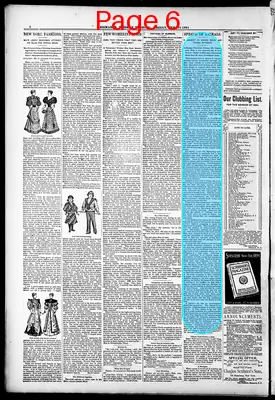
Story
February 16, 1894
Bismarck Weekly Tribune
Bismarck, Burleigh County, North Dakota
What is this article about?
Chicago physician Dr. Howard N. Lyon shares experiences with his pet squirrel Polly, who appears to 'talk' and understand human speech through guttural sounds. He discusses similar communicative abilities in dogs and cats, questioning if animals possess articulate speech.
Clipping

OCR Quality
98%
Excellent
Full Text
SPEECH OF ANIMALS.
SUBJECT IN WHICH MANY ARE TAKING INTEREST.
A Chicago Physician Relates His Experience With a Pet Squirrel-He Is Sure That It "Talks" to Him and Understands Much That He Says-Intelligent Dogs.
That animals have a means of communication among themselves through certain vocal sounds is a well established fact; that these vocal sounds are of sufficient range to express other than mere physical ideas and thus to assume the importance of a language is probable, although as yet unproved.
For the last three years I have had a tame fox squirrel of which I have made a great pet. Polly has occupied a cage in the laboratory where she has been for the most part shut off from the sights and sounds of the outside world. Although at times the laboratory has had other tenants in the shape of squirrels, rabbits and guinea pigs, she has formed no particular attachment for any of them, but when I am about she is usually close to me, either on my shoulder or following me about like a dog.
Unconsciously at first and later with a definite purpose I have talked to her much as one would talk to a young child. About a year ago she began to reply to my conversation. At first it was only in response to my questions as to food, etc., but later her "talk" has assumed larger proportions, until now she will, of her own accord, assume the initiative.
Her vocabulary appears to be quite extensive, and while for the most part it pertains to matters of food and personal comfort there are times when it seems as though she were trying to tell me of other things.
When I first go out where she is in the morning, she immediately asks for food, and until that want is supplied she keeps up a constant muttering. Later when her hunger is appeased she will ask to be let out of the cage. Often when playing about the room she will climb onto my shoulder and "talk" to me for awhile in a low tone and then scamper off. Unless she is sleepy she will always reply to any remark made to her.
Her speech is not the chattering ordinarily observed in squirrels, but a low guttural tone that reminds one both of the low notes of a frog and the cluck of a chicken. Some of the notes I have been able to repeat, and invariably she becomes alert and replies to them. Unfortunately, the effort to reproduce her tones produces an uncomfortable effect on my throat, and I have been obliged to desist from further experiments in that direction. The sounds that she makes are quick and in low tone, so the attempt to isolate words is very difficult, yet there is as much range of inflection as in German.
Another reason why I believe she is endeavoring to communicate with me is that she has used the same sounds toward other squirrels confined in the same cage, and that, while she will answer any one who addresses her, she voluntarily will only talk at length to me. That she understands what is said to her is beyond question, and, furthermore, she will distinguish between a remark made to her and one made to some one else.
When Polly first commenced "talking," I regarded it merely as idle chattering, but further observation shows that it is not such, and that the sounds she makes have a definite meaning. Moreover, the sounds she makes in "talking" are not the shrill notes of anger or alarm, but low, clear sounds that are unmistakably articulate.
In my fondness for my pet have I overestimated the value of the sounds she makes, or am I right in assigning to them the characters of speech? Why should an animal not attempt to communicate with man? The higher animals are possessed of a well formed larynx and vocal chords. Why, then, should we deny or ever question the possibility of articulate speech? And if they can converse among themselves why may they not attempt to communicate with man?
Any one who has owned a well bred dog can relate numerous instances in which his dog has clearly understood what was said to it, and the readiness with which a dog learns a new command shows an intelligence of a high order. Although a dog's vocabulary is of limited range, it has certain definite sounds that possess an unmistakable meaning. There is the short, sharp bark that expresses a want, the low nervous bark that means discomfort, the sharp, quick bark of joy, the low whine of distress, the growl of distrust, the deep growl of anger, the loud bark of warning and the whimper of fright. When to these are added the various movements of the body, cowering in fear, crouching in anger, the stiff bracing of the body in defense, leaping in joy and many special actions, as licking the hand of the master or pulling at his clothes, we find that a dog can express his likes and dislikes, his wants and his feeling as clearly as though he were human. Any one who in a time of sorrow or depression has had his dog come to him and lay its head in his lap and has looked down into those great brown eyes so full of sympathy and love can never doubt that the dog understood all and in its own way was trying to comfort.
A friend's cat has an unmistakable sound for yes and no. The former is low meyouw, while the latter is a short, sharp m'yow. If Tom wants to go out, that fact is made manifest by a quick meyouw. If perchance any one should be in the chair which Tom regards as his especial property, no regard for propriety restrains him from indicating that fact and unceremoniously ordering the obstructor out. His meyouw on such an occasion cannot be mistaken. Instances of this sort are not uncommon and ordinarily fail to attract attention, but is there not here a field that will well repay a careful investigation?
-Dr. Howard N. Lyon in Science.
SUBJECT IN WHICH MANY ARE TAKING INTEREST.
A Chicago Physician Relates His Experience With a Pet Squirrel-He Is Sure That It "Talks" to Him and Understands Much That He Says-Intelligent Dogs.
That animals have a means of communication among themselves through certain vocal sounds is a well established fact; that these vocal sounds are of sufficient range to express other than mere physical ideas and thus to assume the importance of a language is probable, although as yet unproved.
For the last three years I have had a tame fox squirrel of which I have made a great pet. Polly has occupied a cage in the laboratory where she has been for the most part shut off from the sights and sounds of the outside world. Although at times the laboratory has had other tenants in the shape of squirrels, rabbits and guinea pigs, she has formed no particular attachment for any of them, but when I am about she is usually close to me, either on my shoulder or following me about like a dog.
Unconsciously at first and later with a definite purpose I have talked to her much as one would talk to a young child. About a year ago she began to reply to my conversation. At first it was only in response to my questions as to food, etc., but later her "talk" has assumed larger proportions, until now she will, of her own accord, assume the initiative.
Her vocabulary appears to be quite extensive, and while for the most part it pertains to matters of food and personal comfort there are times when it seems as though she were trying to tell me of other things.
When I first go out where she is in the morning, she immediately asks for food, and until that want is supplied she keeps up a constant muttering. Later when her hunger is appeased she will ask to be let out of the cage. Often when playing about the room she will climb onto my shoulder and "talk" to me for awhile in a low tone and then scamper off. Unless she is sleepy she will always reply to any remark made to her.
Her speech is not the chattering ordinarily observed in squirrels, but a low guttural tone that reminds one both of the low notes of a frog and the cluck of a chicken. Some of the notes I have been able to repeat, and invariably she becomes alert and replies to them. Unfortunately, the effort to reproduce her tones produces an uncomfortable effect on my throat, and I have been obliged to desist from further experiments in that direction. The sounds that she makes are quick and in low tone, so the attempt to isolate words is very difficult, yet there is as much range of inflection as in German.
Another reason why I believe she is endeavoring to communicate with me is that she has used the same sounds toward other squirrels confined in the same cage, and that, while she will answer any one who addresses her, she voluntarily will only talk at length to me. That she understands what is said to her is beyond question, and, furthermore, she will distinguish between a remark made to her and one made to some one else.
When Polly first commenced "talking," I regarded it merely as idle chattering, but further observation shows that it is not such, and that the sounds she makes have a definite meaning. Moreover, the sounds she makes in "talking" are not the shrill notes of anger or alarm, but low, clear sounds that are unmistakably articulate.
In my fondness for my pet have I overestimated the value of the sounds she makes, or am I right in assigning to them the characters of speech? Why should an animal not attempt to communicate with man? The higher animals are possessed of a well formed larynx and vocal chords. Why, then, should we deny or ever question the possibility of articulate speech? And if they can converse among themselves why may they not attempt to communicate with man?
Any one who has owned a well bred dog can relate numerous instances in which his dog has clearly understood what was said to it, and the readiness with which a dog learns a new command shows an intelligence of a high order. Although a dog's vocabulary is of limited range, it has certain definite sounds that possess an unmistakable meaning. There is the short, sharp bark that expresses a want, the low nervous bark that means discomfort, the sharp, quick bark of joy, the low whine of distress, the growl of distrust, the deep growl of anger, the loud bark of warning and the whimper of fright. When to these are added the various movements of the body, cowering in fear, crouching in anger, the stiff bracing of the body in defense, leaping in joy and many special actions, as licking the hand of the master or pulling at his clothes, we find that a dog can express his likes and dislikes, his wants and his feeling as clearly as though he were human. Any one who in a time of sorrow or depression has had his dog come to him and lay its head in his lap and has looked down into those great brown eyes so full of sympathy and love can never doubt that the dog understood all and in its own way was trying to comfort.
A friend's cat has an unmistakable sound for yes and no. The former is low meyouw, while the latter is a short, sharp m'yow. If Tom wants to go out, that fact is made manifest by a quick meyouw. If perchance any one should be in the chair which Tom regards as his especial property, no regard for propriety restrains him from indicating that fact and unceremoniously ordering the obstructor out. His meyouw on such an occasion cannot be mistaken. Instances of this sort are not uncommon and ordinarily fail to attract attention, but is there not here a field that will well repay a careful investigation?
-Dr. Howard N. Lyon in Science.
What sub-type of article is it?
Animal Story
Curiosity
What themes does it cover?
Nature
Moral Virtue
What keywords are associated?
Animal Communication
Pet Squirrel
Intelligent Dogs
Cat Sounds
Vocalizations
What entities or persons were involved?
Dr. Howard N. Lyon
Polly
Where did it happen?
Chicago Laboratory
Story Details
Key Persons
Dr. Howard N. Lyon
Polly
Location
Chicago Laboratory
Story Details
A Chicago physician describes his pet fox squirrel Polly, who responds to his conversations, seems to understand speech, and uses distinct vocal sounds to communicate needs and other ideas. He notes similar intelligence in dogs' barks and behaviors expressing emotions, and a friend's cat using sounds for yes/no and demands.