Thank you for visiting SNEWPapers!
Sign up free
Letter to Editor
January 12, 1790
Gazette Of The United States
New York, New York County, New York
What is this article about?
Satirical letter mocking Quaker exemption from U.S. militia service via ironic arguments on tender consciences, biblical defenses of war, and a dream vision of 100,000 exempted from various religious sects amid congressional debate.
Clipping
OCR Quality
95%
Excellent
Full Text
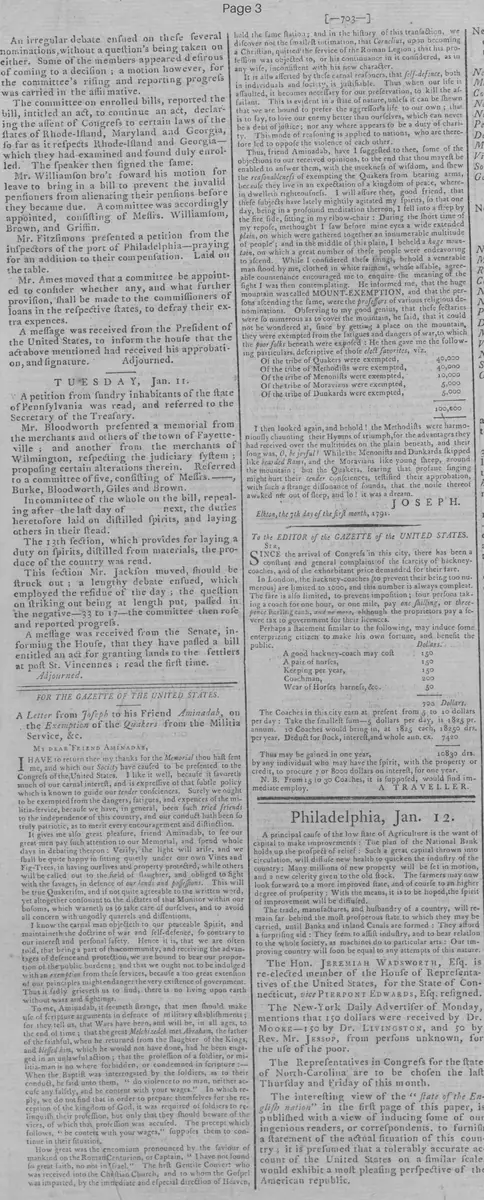
FOR THE GAZETTE OF THE UNITED STATES.
A Letter from Joseph to his Friend Aminadab, on the Exemption of the Quakers from the Militia Service, &c.
My Dear Friend AMINADAB,
I have lately seen an act of the Congress of the United States. I like it well, because it savor eth much of our carnal interest, and is expressive of that subtle policy which is known to guide our tender consciences. Surely we ought to be exempted from the dangers, fatigues, and expenses of the militia-service, because we have, in general, been such tried friends to the independence of this country, and our conduct hath been so truly patriotic, as to merit every encouragement and distinction.
It gives me also great pleasure, friend Aminadab, to see our great men pay such attention to our Memorial, and spend whole days in debating thereon: Verily, the light will arise, and we shall be quite happy in sitting quietly under our own Vines and Fig-Trees, in having our lives and property protected, while others will be called out to the field of slaughter, and obliged to fight with the savages, in defence of our lands and possessions. This will be true Quakerism, and if not quite agreeable to the written word, yet altogether consonant to the dictates of that Monitor within our bosoms, which warneth us to take care of ourselves, and to avoid all concern with ungodly quarrels and dissensions.
I know the carnal man objecteth to our peaceable Spirit, and maintaineth the doctrine of war and self-defence, so contrary to our interest and personal safety. Hence it is, that we are often told, that being a part of the community, and receiving the advantages of defence and protection, we are bound to bear our proportion of the public burdens; and that we ought not to be indulged with an exemption from these services, because a too great extension of our principles might endanger the very existence of government.
Thus it sadly grieveth us to find, there is no living upon earth without wars and fightings.
To me, Aminadab, it seemeth strange, that men should make use of scripture arguments in defence of military establishments; for they tell us, that Wars have been, and will be, in all ages, to the end of time; that the great Melchizedek met Abraham, the father of the faithful, when he returned from the slaughter of the Kings, and blessed him, which he would not have done, had he been engaged in an unlawful action; that the profession of a soldier, or militia-man is no where forbidden, or condemned in scripture:—
When the Baptist was interrogated by the soldiers, as to their conduct, he said unto them, "do violence to no man, neither accuse any falsely, and be content with your wages." In which reply, we do not find that in order to prepare themselves for the reception of the kingdom of God, it was required of soldiers to relinquish their profession, but only that they should beware of the vices, of which that profession was accused. The precept which follows, "be content with your wages," supposes them to continue in their situation.
How great was the encomium pronounced by the saviour of mankind on the Roman Centurion, or Captain, "I have not found so great faith, no not in Israel." The first Gentile Convert who was received into the Christian Church, and to whom the Gospel was imparted, by the immediate and special direction of Heaven, hold the same station; and in the history of this transaction, we discover not the smallest intimation, that Cornelius, upon becoming a Christian, quitted the service of the Roman Legion; that his profession was objected to, or his continuance in it considered, as in any wise, inconsistent with his new character.
It is also asserted by these carnal reasoners, that self-defence, both in individuals and society, is justifiable. Thus when our life is assaulted, it becomes necessary for our preservation, to kill the assailant. This is evident in a state of nature, unless it can be shewn that we are bound to prefer the aggressor's life to our own; that is to say, to love our enemy better than ourselves, which can never be a debt of justice; nor any where appears to be a duty of charity. This mode of reasoning is applied to nations, who are therefore led to oppose the violence of each other.
Thus, friend Aminadab, have I suggested to thee, some of the objections to our received opinions, to the end that thou mayest be enabled to answer them, with the meekness of wisdom, and shew the reasonableness of exempting the Quakers from bearing arms, because they live in an expectation of a kingdom of peace, wherein dwelleth righteousness. I will assure thee, good friend, that these subjects have lately mightily agitated my spirits, so that one day, being in a profound meditation thereon, I fell into a sleep by the fire side, sitting in my elbow-chair: During the short time of my repose, methought I saw before mine eyes a wide extended plain, on which were gathered together an innumerable multitude of people; and in the middle of this plain, I beheld a huge mountain, on which a great number of these people were endeavoring to ascend. While I considered these things, behold a venerable man stood by me, clothed in white raiment, whose affable, agreeable countenance encouraged me to enquire the meaning of the sight I was then contemplating. He informed me, that the huge mountain was called MOUNT-EXEMPTION. and that the persons ascending the same, were the professors of various religious denominations. Observing to my good genius, that these sectaries were so numerous as to cover the mountain, he said, that it could not be wondered at, since by getting a place on the mountain, they were exempted from the fatigues and dangers of war, to which the poor folks beneath were exposed: He then gave me the following particulars, descriptive of those elect favorites, viz.
Of the tribe of Quakers were exempted, 40,000
Of the tribe of Methodists were exempted, 40,000
Of the tribe of Mennonists were exempted, 10,000
Of the tribe of Moravians were exempted, 5,000
Of the tribe of Dunkards were exempted, 5,000
100,000
I then looked again, and behold! the Methodists were harmoniously chaunting their Hymns of triumph, for the advantages they had received over the multitudes on the plain beneath, and their song was, O, be joyful! While the Mennonists and Dunkards skipped like bearded Rams, and the Moravians like young sheep, around the mountain; but the Quakers, fearing that profane singing might hurt their tender consciences, testified their approbation, with such a strange dissonance of sounds, that the noise thereof awaked me out of sleep, and lo! it was a dream.
JOSEPH.
A Letter from Joseph to his Friend Aminadab, on the Exemption of the Quakers from the Militia Service, &c.
My Dear Friend AMINADAB,
I have lately seen an act of the Congress of the United States. I like it well, because it savor eth much of our carnal interest, and is expressive of that subtle policy which is known to guide our tender consciences. Surely we ought to be exempted from the dangers, fatigues, and expenses of the militia-service, because we have, in general, been such tried friends to the independence of this country, and our conduct hath been so truly patriotic, as to merit every encouragement and distinction.
It gives me also great pleasure, friend Aminadab, to see our great men pay such attention to our Memorial, and spend whole days in debating thereon: Verily, the light will arise, and we shall be quite happy in sitting quietly under our own Vines and Fig-Trees, in having our lives and property protected, while others will be called out to the field of slaughter, and obliged to fight with the savages, in defence of our lands and possessions. This will be true Quakerism, and if not quite agreeable to the written word, yet altogether consonant to the dictates of that Monitor within our bosoms, which warneth us to take care of ourselves, and to avoid all concern with ungodly quarrels and dissensions.
I know the carnal man objecteth to our peaceable Spirit, and maintaineth the doctrine of war and self-defence, so contrary to our interest and personal safety. Hence it is, that we are often told, that being a part of the community, and receiving the advantages of defence and protection, we are bound to bear our proportion of the public burdens; and that we ought not to be indulged with an exemption from these services, because a too great extension of our principles might endanger the very existence of government.
Thus it sadly grieveth us to find, there is no living upon earth without wars and fightings.
To me, Aminadab, it seemeth strange, that men should make use of scripture arguments in defence of military establishments; for they tell us, that Wars have been, and will be, in all ages, to the end of time; that the great Melchizedek met Abraham, the father of the faithful, when he returned from the slaughter of the Kings, and blessed him, which he would not have done, had he been engaged in an unlawful action; that the profession of a soldier, or militia-man is no where forbidden, or condemned in scripture:—
When the Baptist was interrogated by the soldiers, as to their conduct, he said unto them, "do violence to no man, neither accuse any falsely, and be content with your wages." In which reply, we do not find that in order to prepare themselves for the reception of the kingdom of God, it was required of soldiers to relinquish their profession, but only that they should beware of the vices, of which that profession was accused. The precept which follows, "be content with your wages," supposes them to continue in their situation.
How great was the encomium pronounced by the saviour of mankind on the Roman Centurion, or Captain, "I have not found so great faith, no not in Israel." The first Gentile Convert who was received into the Christian Church, and to whom the Gospel was imparted, by the immediate and special direction of Heaven, hold the same station; and in the history of this transaction, we discover not the smallest intimation, that Cornelius, upon becoming a Christian, quitted the service of the Roman Legion; that his profession was objected to, or his continuance in it considered, as in any wise, inconsistent with his new character.
It is also asserted by these carnal reasoners, that self-defence, both in individuals and society, is justifiable. Thus when our life is assaulted, it becomes necessary for our preservation, to kill the assailant. This is evident in a state of nature, unless it can be shewn that we are bound to prefer the aggressor's life to our own; that is to say, to love our enemy better than ourselves, which can never be a debt of justice; nor any where appears to be a duty of charity. This mode of reasoning is applied to nations, who are therefore led to oppose the violence of each other.
Thus, friend Aminadab, have I suggested to thee, some of the objections to our received opinions, to the end that thou mayest be enabled to answer them, with the meekness of wisdom, and shew the reasonableness of exempting the Quakers from bearing arms, because they live in an expectation of a kingdom of peace, wherein dwelleth righteousness. I will assure thee, good friend, that these subjects have lately mightily agitated my spirits, so that one day, being in a profound meditation thereon, I fell into a sleep by the fire side, sitting in my elbow-chair: During the short time of my repose, methought I saw before mine eyes a wide extended plain, on which were gathered together an innumerable multitude of people; and in the middle of this plain, I beheld a huge mountain, on which a great number of these people were endeavoring to ascend. While I considered these things, behold a venerable man stood by me, clothed in white raiment, whose affable, agreeable countenance encouraged me to enquire the meaning of the sight I was then contemplating. He informed me, that the huge mountain was called MOUNT-EXEMPTION. and that the persons ascending the same, were the professors of various religious denominations. Observing to my good genius, that these sectaries were so numerous as to cover the mountain, he said, that it could not be wondered at, since by getting a place on the mountain, they were exempted from the fatigues and dangers of war, to which the poor folks beneath were exposed: He then gave me the following particulars, descriptive of those elect favorites, viz.
Of the tribe of Quakers were exempted, 40,000
Of the tribe of Methodists were exempted, 40,000
Of the tribe of Mennonists were exempted, 10,000
Of the tribe of Moravians were exempted, 5,000
Of the tribe of Dunkards were exempted, 5,000
100,000
I then looked again, and behold! the Methodists were harmoniously chaunting their Hymns of triumph, for the advantages they had received over the multitudes on the plain beneath, and their song was, O, be joyful! While the Mennonists and Dunkards skipped like bearded Rams, and the Moravians like young sheep, around the mountain; but the Quakers, fearing that profane singing might hurt their tender consciences, testified their approbation, with such a strange dissonance of sounds, that the noise thereof awaked me out of sleep, and lo! it was a dream.
JOSEPH.
What sub-type of article is it?
Satirical
Persuasive
Social Critique
What themes does it cover?
Religion
Military War
Politics
What keywords are associated?
Quaker Exemption
Militia Service
Religious Sects
Biblical Arguments
Self Defense
Congress Act
Mount Exemption
What entities or persons were involved?
Joseph
Aminadab
Letter to Editor Details
Author
Joseph
Recipient
Aminadab
Main Argument
satirically defends exempting quakers from militia service by ironically citing self-interest, biblical examples supporting soldiers, and self-defense, while envisioning a dream of mass religious exemptions totaling 100,000.
Notable Details
References To John The Baptist's Advice To Soldiers
Praise Of Roman Centurion By Jesus
Cornelius The Centurion
Dream Of Mount Exemption With Exempted Sects: Quakers 40,000, Methodists 40,000, Mennonists 10,000, Moravians 5,000, Dunkards 5,000