Thank you for visiting SNEWPapers!
Sign up free
Daily National Democrat
Marysville, Yuba County, California
What is this article about?
Explanation of the 1795 act allowing the U.S. President to call forth state militias to suppress insurrections or obstructions of federal laws, with historical context from Pennsylvania insurrection and War of 1812, a quoted court ruling affirming presidential authority, and notes on service limits and current administration's approach.
Clipping
OCR Quality
Full Text
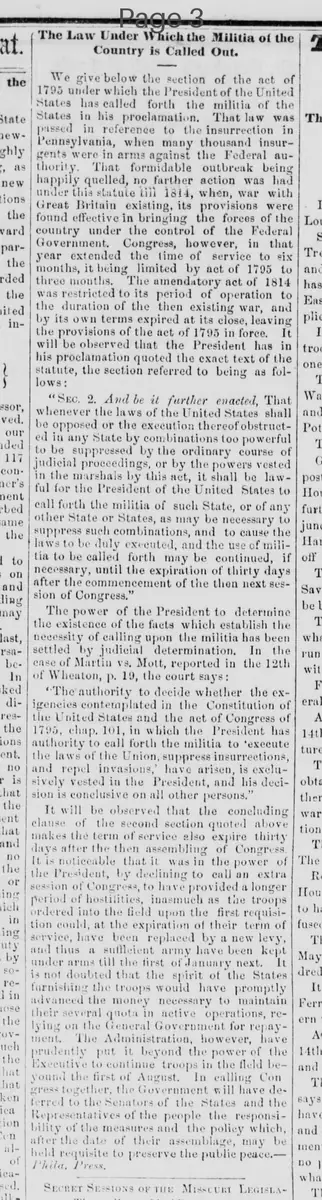
We give below the section of the act of 1795 under which the President of the United States has called forth the militia of the States in his proclamation. That law was passed in reference to the insurrection in Pennsylvania, when many thousand insurgents were in arms against the Federal authority. That formidable outbreak being happily quelled, no farther action was had under this statute till 1814, when, war with Great Britain existing, its provisions were found effective in bringing the forces of the country under the control of the Federal Government. Congress, however, in that year extended the time of service to six months, it being limited by act of 1795 to three months. The amendatory act of 1814 was restricted to its period of operation to the duration of the then existing war, and by its own terms expired at its close, leaving the provisions of the act of 1795 in force. It will be observed that the President has in his proclamation quoted the exact text of the statute, the section referred to being as follows:
"Sec. 2. And be it further enacted, That whenever the laws of the United States shall be opposed or the execution thereof obstructed in any State by combinations too powerful to be suppressed by the ordinary course of judicial proceedings, or by the powers vested in the marshals by this act, it shall be lawful for the President of the United States to call forth the militia of such State, or of any other State or States, as may be necessary to suppress such combinations, and to cause the laws to be duly executed, and the use of militia to be called forth may be continued, if necessary, until the expiration of thirty days after the commencement of the then next session of Congress."
The power of the President to determine the existence of the facts which establish the necessity of calling upon the militia has been settled by judicial determination. In the case of Martin vs. Mott, reported in the 12th of Wheaton, p. 19, the court says:
The authority to decide whether the exigencies contemplated in the Constitution of the United States and the act of Congress of 1795, chap. 101, in which the President has authority to call forth the militia to 'execute the laws of the Union, suppress insurrections, and repel invasions,' have arisen, is exclusively vested in the President, and his decision is conclusive on all other persons.
It will be observed that the concluding clause of the second section quoted above makes the term of service also expire thirty days after the then assembling of Congress. It is noticeable that it was in the power of the President, by declining to call an extra session of Congress, to have provided a longer period of hostilities, inasmuch as the troops ordered into the field upon the first requisition could, at the expiration of their term of service, have been replaced by a new levy, and thus a sufficient army have been kept under arms till the first of January next. It is not doubted that the spirit of the States furnishing the troops would have promptly advanced the money necessary to maintain their several quota in active operations, relying on the General Government for repayment. The Administration, however, have prudently put it beyond the power of the Executive to continue troops in the field beyond the first of August. In calling Congress together, the Government will have deferred to the Senators of the States and the Representatives of the people the responsibility of the measures and the policy which, after the date of their assemblage, may be held requisite to preserve the public peace.—Phila. Press.
What sub-type of article is it?
What keywords are associated?
What entities or persons were involved?
Domestic News Details
Key Persons
Event Details
The article details Section 2 of the 1795 act authorizing the President to call forth militia to suppress combinations obstructing U.S. laws, with service up to 30 days after the next Congress session. Historical uses include 1795 Pennsylvania insurrection and 1814 War with Great Britain (extended to six months then). Court case Martin vs. Mott affirms President's exclusive authority to decide necessity. Discusses potential for extended service via replacements and state funding, but administration limits to August 1 and calls Congress.