Thank you for visiting SNEWPapers!
Sign up free
The New Hampshire Gazette And Historical Chronicle
Portsmouth, Greenland, Rockingham County, New Hampshire
What is this article about?
Dr. Musgrave's reply to Chevalier d'Eon's letter defends his charges against Lord Halifax and critiques the hasty approval of peace preliminaries by Parliament. He proposes rescinding the vote due to suspicions of treason and lost diplomatic papers, urging re-examination.
Clipping
OCR Quality
Full Text
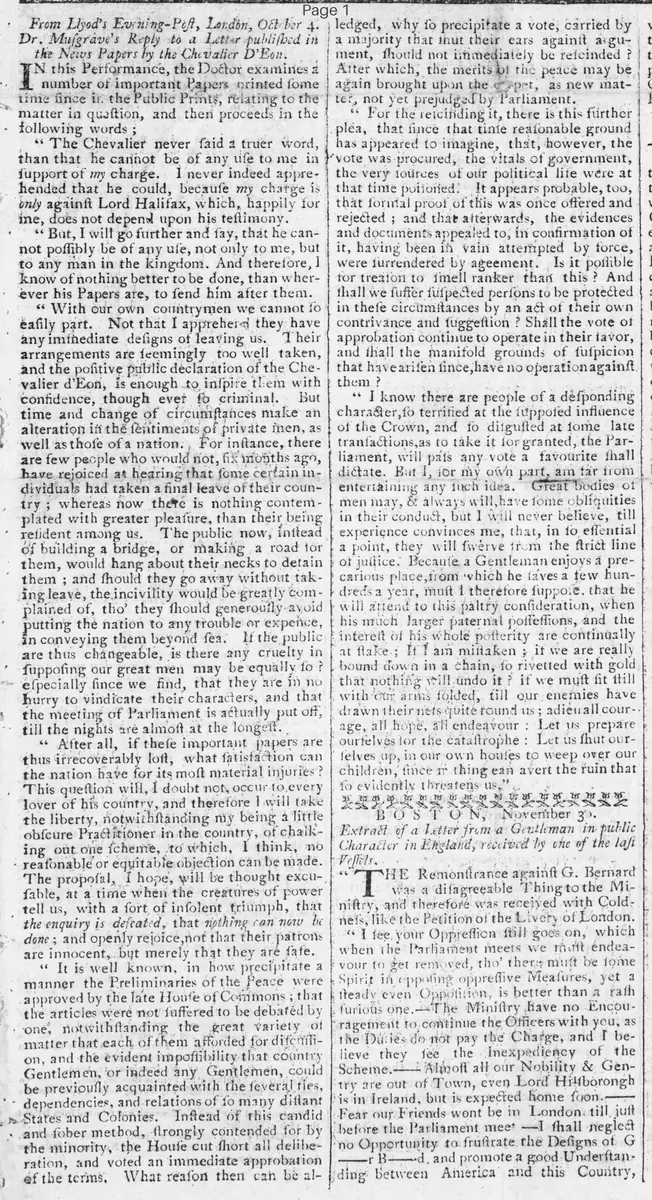
Dr. Musgrave's Reply to a Letter published in the News Papers by the Chevalier D'Eon.
In this Performance, the Doctor examines a number of important Papers printed some time since in the Public Prints, relating to the matter in question, and then proceeds in the following words;
'The Chevalier never said a truer word, than that he cannot be of any use to me in support of my charge. I never indeed apprehended that he could, because my charge is only against Lord Halifax, which, happily for me, does not depend upon his testimony.
But, I will go further and say, that he cannot possibly be of any use, not only to me, but to any man in the kingdom. And therefore, I know of nothing better to be done, than wherever his Papers are, to send him after them.
With our own countrymen we cannot so easily part. Not that I apprehend they have any immediate designs of leaving us. Their arrangements are seemingly too well taken, and the positive public declaration of the Chevalier d'Eon, is enough to inspire them with confidence, though ever so criminal. But time and change of circumstances make an alteration in the sentiments of private men, as well as those of a nation. For instance, there are few people who would not, six months ago, have rejoiced at hearing that some certain individuals had taken a final leave of their country; whereas now there is nothing contemplated with greater pleasure, than their being resident among us. The public now, instead of building a bridge, or making a road for them, would hang about their necks to detain them; and should they go away without taking leave, the incivility would be greatly complained of, tho' they should generously avoid putting the nation to any trouble or expense, in conveying them beyond sea. If the public are thus changeable, is there any cruelty in supposing our great men may be equally so? especially since we find, that they are in no hurry to vindicate their characters, and that the meeting of Parliament is actually put off, till the nights are almost at the longest.
After all, if these important papers are thus irrecoverably lost, what satisfaction can the nation have for its most material injuries? This question will, I doubt not, occur to every lover of his country, and therefore I will take the liberty, notwithstanding my being a little obscure Practitioner in the country, of chalking out one scheme, to which, I think, no reasonable or equitable objection can be made. The proposal, I hope, will be thought excusable, at a time when the creatures of power tell us, with a sort of insolent triumph, that the enquiry is defeated, that nothing can be done; and openly rejoice, not that their patrons are innocent, but merely that they are safe.
It is well known, in how precipitate a manner the Preliminaries of the Peace were approved by the late House of Commons; that the articles were not suffered to be debated by one, notwithstanding the great variety of matter that each of them afforded for discussion, and the evident impossibility that country Gentlemen, or indeed any Gentlemen, could be previously acquainted with the several ties, dependencies, and relations of so many distant States and Colonies. Instead of this candid and sober method, strongly contended for by the minority, the House cut short all deliberation, and voted an immediate approbation of the terms. What reason then can be alledged, why so precipitate a vote, carried by a majority that shut their ears against argument, should not immediately be rescinded?
After which, the merits of the peace may be again brought upon the carpet, as new matter, not yet prejudged by Parliament.
For the rescinding it, there is this further plea, that since that time reasonable ground has appeared to imagine, that, however, the vote was procured, the vitals of government, the very sources of our political life were at that time poisoned. It appears probable, too, that formal proof of this was once offered and rejected: and that afterwards, the evidences and documents appealed to, in confirmation of it, having been in vain attempted by force, were surrendered by agreement. Is it possible for treason to smell ranker than this? And shall we suffer suspected persons to be protected in these circumstances by an act of their own contrivance and suggestion? Shall the vote of approbation continue to operate in their favor, and shall the manifold grounds of suspicion that have arisen since, have no operation against them?
I know there are people of a desponding character so terrified at the supposed influence of the Crown, and so disgusted at some late transactions, as to take it for granted, the Parliament, will pass any vote a favourite shall dictate. But I, for my own part, am far from entertaining any such idea. Great bodies of men may, & always will, have some obliquities in their conduct, but I will never believe, till experience convinces me, that, in so essential a point, they will swerve from the strict line of justice: Because a Gentleman enjoys a precarious place, from which he saves a few hundreds a year, must I therefore suppose, that he will attend to this paltry consideration, when his much larger paternal possessions, and the interest of his whole posterity are continually at stake. If I am mistaken: if we are really bound down in a chain, so rivetted with gold that nothing will undo it? if we must sit still with our arms folded, till our enemies have drawn their nets quite round us: adieu all courage, all hope, all endeavour: Let us prepare ourselves for the catastrophe: Let us shut ourselves up, in our own houses to weep over our children, since nothing can avert the ruin that so evidently threatens us.'
What sub-type of article is it?
What keywords are associated?
What entities or persons were involved?
Where did it happen?
Foreign News Details
Primary Location
London
Event Date
October 4
Key Persons
Outcome
proposal to rescind parliament's hasty approval of peace preliminaries due to suspicions of treason and lost diplomatic papers; no immediate action reported.
Event Details
Dr. Musgrave replies to Chevalier d'Eon's letter, defending his charges against Lord Halifax independent of d'Eon's testimony. He criticizes the loss of important papers, public and political changeability, and the precipitate approval of peace preliminaries by the House of Commons without debate. He proposes rescinding the vote to re-examine the peace merits, citing grounds of suspicion including rejected proofs and surrendered documents suggesting treason.