Thank you for visiting SNEWPapers!
Sign up free
Poem
May 14, 1795
Gazette Of The United States And Daily Evening Advertiser
Philadelphia, Philadelphia County, Pennsylvania
What is this article about?
A lyrical ode invoking the muses to praise immortal British poets: Spenser for fairy enchantments and knightly battles; Shakespeare for tragic and comic genius in characters like Lear, Hamlet, and Romeo; Milton for divine verse exploring chaos and heavenly realms; and Dryden for modulating classical bards into British glory with satire and song.
Clipping
OCR Quality
92%
Excellent
Full Text
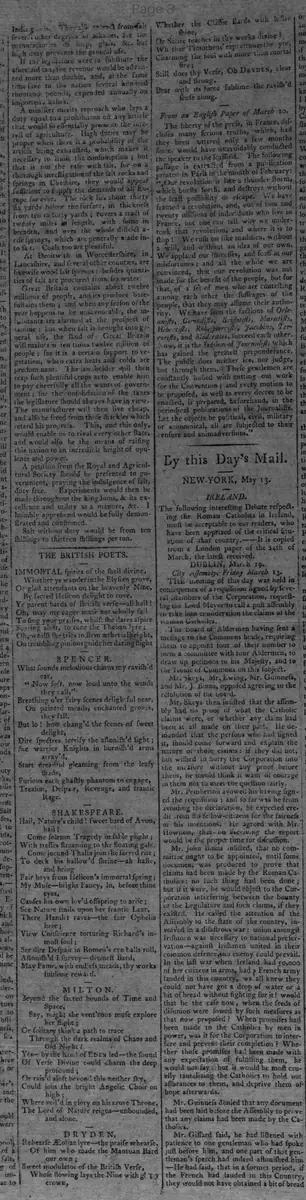
THE BRITISH POETS.
IMMORTAL spirits of the shell divine,
Whether ye wander in the Elysian grove,
Or glad attendants on the heavenly Nine,
By sacred Helicon delight to rove,
Ye parent bards of British verse—all hail!
Oh, may my eager muse not wholly fail
To sing your praises, whilst he dares aspire
Soaring aloft, to tune the Theban lyre;
Oh, whilst he tries to tem aerial height,
On trembling pinions guide her daring flight
SPENCER.
What sounds melodious charm my ravish'd ear,
"Now soft, now loud unto the winds they call,"
Breathing o'er fairy scenes delightful near,
On painted meads, enchanted groves, they fall.
But lo! how chang'd the scenes of sweet delight,
Dire spectres, terrify the astonish'd sight;
Steele warrior Knights in burnish'd arms array'd,
Start dreadful gleaming from the leafy shade,
Furious each ghastly phantom to engage,
Treason, Despair, Revenge, and frantic Rage.
SHAKESPEARE.
Hail, Nature's child! sweet bard of Avon, hail!
Come solemn Tragedy in sable plight;
With tears streaming to the floating gale,
Come jocund Thalia join the sacred rite;
To deck his hallow'd shrine—ah haste, and bring
Fair bays from Helicon's immortal spring;
My Muse—bright Fancy, lo, before thine eyes,
Causes his own lov'd offspring to arise;
See Nature smile upon her frantic Lear,
There Hamlet raves—the fair Ophelia here;
View Conscience torturing Richard's in-most foul;
See dire Despair in Romeo's eye-balls roll,
Astonish'd I survey—divine Bard,
May Fame, with endless meeds, thy works sublime reward.
MILTON.
Beyond the sacred bounds of Time and Say,
Might the vent'rous muse explore her flight;
Or solitary take a path to trace
Through the dark realms of Chaos and Old-Night?
Yes— by the hand of Even led—the sound
Of Verse Divine could harm the deep
Or rais'd aloft beyond this nether sky,
Could join the bright Angelic Choir on high;
Where veil'd in glory on his azure Throne,
The Lord of Nature reigns—unbounded, and alone.
DRYDEN.
Rehearse Eolian lyre—the praise rehearse.
Of him who made the Mantuan Bard our own;
Sweet modulator of the British Verse,
Whose flowing lays the Nine with glory crown,
Whether the Classic Bards which lure
Or Satire teaches in thy works divine!
Charming the soul with more than mortal
Whether Timotheus' rapt attunes the lyre,
Still does thy Verse, Oh Dryden, clear fire;
Bear with its force sublime the ravish'd soul along.
IMMORTAL spirits of the shell divine,
Whether ye wander in the Elysian grove,
Or glad attendants on the heavenly Nine,
By sacred Helicon delight to rove,
Ye parent bards of British verse—all hail!
Oh, may my eager muse not wholly fail
To sing your praises, whilst he dares aspire
Soaring aloft, to tune the Theban lyre;
Oh, whilst he tries to tem aerial height,
On trembling pinions guide her daring flight
SPENCER.
What sounds melodious charm my ravish'd ear,
"Now soft, now loud unto the winds they call,"
Breathing o'er fairy scenes delightful near,
On painted meads, enchanted groves, they fall.
But lo! how chang'd the scenes of sweet delight,
Dire spectres, terrify the astonish'd sight;
Steele warrior Knights in burnish'd arms array'd,
Start dreadful gleaming from the leafy shade,
Furious each ghastly phantom to engage,
Treason, Despair, Revenge, and frantic Rage.
SHAKESPEARE.
Hail, Nature's child! sweet bard of Avon, hail!
Come solemn Tragedy in sable plight;
With tears streaming to the floating gale,
Come jocund Thalia join the sacred rite;
To deck his hallow'd shrine—ah haste, and bring
Fair bays from Helicon's immortal spring;
My Muse—bright Fancy, lo, before thine eyes,
Causes his own lov'd offspring to arise;
See Nature smile upon her frantic Lear,
There Hamlet raves—the fair Ophelia here;
View Conscience torturing Richard's in-most foul;
See dire Despair in Romeo's eye-balls roll,
Astonish'd I survey—divine Bard,
May Fame, with endless meeds, thy works sublime reward.
MILTON.
Beyond the sacred bounds of Time and Say,
Might the vent'rous muse explore her flight;
Or solitary take a path to trace
Through the dark realms of Chaos and Old-Night?
Yes— by the hand of Even led—the sound
Of Verse Divine could harm the deep
Or rais'd aloft beyond this nether sky,
Could join the bright Angelic Choir on high;
Where veil'd in glory on his azure Throne,
The Lord of Nature reigns—unbounded, and alone.
DRYDEN.
Rehearse Eolian lyre—the praise rehearse.
Of him who made the Mantuan Bard our own;
Sweet modulator of the British Verse,
Whose flowing lays the Nine with glory crown,
Whether the Classic Bards which lure
Or Satire teaches in thy works divine!
Charming the soul with more than mortal
Whether Timotheus' rapt attunes the lyre,
Still does thy Verse, Oh Dryden, clear fire;
Bear with its force sublime the ravish'd soul along.
What sub-type of article is it?
Ode
What themes does it cover?
Patriotism
Moral Virtue
What keywords are associated?
British Poets
Spenser
Shakespeare
Milton
Dryden
Muse Invocation
Literary Praise
Poem Details
Title
The British Poets.
Subject
Praise Of British Poets
Form / Style
Rhymed Verse
Key Lines
Immortal Spirits Of The Shell Divine,
Ye Parent Bards Of British Verse—All Hail!
Hail, Nature's Child! Sweet Bard Of Avon, Hail!
Beyond The Sacred Bounds Of Time And Say,
Rehearse Eolian Lyre—The Praise Rehearse.