Thank you for visiting SNEWPapers!
Sign up free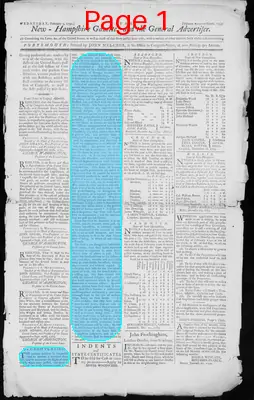
Editorial
February 3, 1790
The New Hampshire Gazette And General Advertiser
Portsmouth, Rockingham County, New Hampshire
What is this article about?
A moralistic editorial condemns card playing as a foolish, time-wasting diversion that offers no intellectual or moral benefit, urging readers to pursue rational and virtuous activities in preparation for life's end and judgment.
Clipping
OCR Quality
98%
Excellent
Full Text
ON CARD PLAYING.
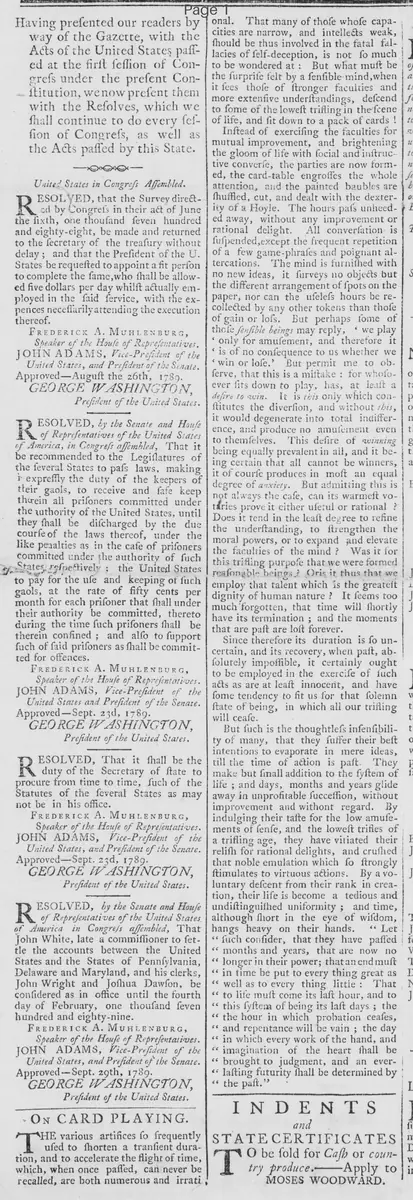
THE various artifices so frequently used to shorten a transient duration, and to accelerate the flight of time, which, when once passed, can never be recalled, are both numerous and irrational. That many of those whose capacities are narrow, and intellects weak, should be thus involved in the fatal fallacies of self-deception, is not so much to be wondered at: But what must be the surprise felt by a sensible mind, when it sees those of stronger faculties and more extensive understandings, descend to some of the lowest trifling in the scene of life, and sit down to a pack of cards! Instead of exercising the faculties for mutual improvement, and brightening the gloom of life with social and instructive converse, the parties are now formed, the card-table engrosses the whole attention, and the painted baubles are shuffled, cut, and dealt with the dexterity of a Hoyle. The hours pass unheeded away, without any improvement or rational delight. All conversation is suspended, except the frequent repetition of a few game-phrases and poignant altercations. The mind is furnished with no new ideas, it surveys no objects but the different arrangement of spots on the paper, nor can the useless hours be recollected by any other tokens than those of gain or loss. But perhaps some of those sensible beings may reply, 'we play only for amusement, and therefore it is of no consequence to us whether we win or lose.' But permit me to observe, that this is a mistake: for whosoever sits down to play, has, at least a desire to win. It is this only which constitutes the diversion, and without this, it would degenerate into total indifference, and produce no amusement even to themselves. This desire of winning being equally prevalent in all, and it being certain that all cannot be winners, it of course produces in most an equal degree of anxiety. But admitting this is not always the case, can its warmest votaries prove it either useful or rational? Does it tend in the least degree to refine the understanding, to strengthen the moral powers, or to expand and elevate the faculties of the mind? Was it for this trifling purpose that we were formed reasonable beings? Or is it thus that we employ that talent which is the greatest dignity of human nature? It seems too much forgotten, that time will shortly have its termination; and the moments that are past are lost forever. Since therefore its duration is so uncertain, and its recovery, when past, absolutely impossible, it certainly ought to be employed in the exercise of such acts as are at least innocent, and have some tendency to fit us for that solemn state of being, in which all our trifling will cease. But such is the thoughtless insensibility of many, that they suffer their best intentions to evaporate in mere ideas, till the time of action is past. They make but small addition to the system of life; and days, months and years glide away in unprofitable succession, without improvement and without regard. By indulging their taste for the low amusements of sense, and the lowest trifles of a trifling age, they have vitiated their relish for rational delights, and crushed that noble emulation which so strongly stimulates to virtuous actions. By a voluntary descent from their rank in creation, their life is become a tedious and undistinguished uniformity; and time, although short in the eye of wisdom, hangs heavy on their hands. Let such consider, that they have passed months and years, that are now no longer in their power; that an end must in time be put to every thing great as well as to every thing little: That to life must come its last hour, and to this system of being its last days; the hour in which probation ceases, and repentance will be vain; the day in which every work of the hand, and imagination of the heart shall be brought to judgment, and an everlasting futurity shall be determined by the past.
THE various artifices so frequently used to shorten a transient duration, and to accelerate the flight of time, which, when once passed, can never be recalled, are both numerous and irrational. That many of those whose capacities are narrow, and intellects weak, should be thus involved in the fatal fallacies of self-deception, is not so much to be wondered at: But what must be the surprise felt by a sensible mind, when it sees those of stronger faculties and more extensive understandings, descend to some of the lowest trifling in the scene of life, and sit down to a pack of cards! Instead of exercising the faculties for mutual improvement, and brightening the gloom of life with social and instructive converse, the parties are now formed, the card-table engrosses the whole attention, and the painted baubles are shuffled, cut, and dealt with the dexterity of a Hoyle. The hours pass unheeded away, without any improvement or rational delight. All conversation is suspended, except the frequent repetition of a few game-phrases and poignant altercations. The mind is furnished with no new ideas, it surveys no objects but the different arrangement of spots on the paper, nor can the useless hours be recollected by any other tokens than those of gain or loss. But perhaps some of those sensible beings may reply, 'we play only for amusement, and therefore it is of no consequence to us whether we win or lose.' But permit me to observe, that this is a mistake: for whosoever sits down to play, has, at least a desire to win. It is this only which constitutes the diversion, and without this, it would degenerate into total indifference, and produce no amusement even to themselves. This desire of winning being equally prevalent in all, and it being certain that all cannot be winners, it of course produces in most an equal degree of anxiety. But admitting this is not always the case, can its warmest votaries prove it either useful or rational? Does it tend in the least degree to refine the understanding, to strengthen the moral powers, or to expand and elevate the faculties of the mind? Was it for this trifling purpose that we were formed reasonable beings? Or is it thus that we employ that talent which is the greatest dignity of human nature? It seems too much forgotten, that time will shortly have its termination; and the moments that are past are lost forever. Since therefore its duration is so uncertain, and its recovery, when past, absolutely impossible, it certainly ought to be employed in the exercise of such acts as are at least innocent, and have some tendency to fit us for that solemn state of being, in which all our trifling will cease. But such is the thoughtless insensibility of many, that they suffer their best intentions to evaporate in mere ideas, till the time of action is past. They make but small addition to the system of life; and days, months and years glide away in unprofitable succession, without improvement and without regard. By indulging their taste for the low amusements of sense, and the lowest trifles of a trifling age, they have vitiated their relish for rational delights, and crushed that noble emulation which so strongly stimulates to virtuous actions. By a voluntary descent from their rank in creation, their life is become a tedious and undistinguished uniformity; and time, although short in the eye of wisdom, hangs heavy on their hands. Let such consider, that they have passed months and years, that are now no longer in their power; that an end must in time be put to every thing great as well as to every thing little: That to life must come its last hour, and to this system of being its last days; the hour in which probation ceases, and repentance will be vain; the day in which every work of the hand, and imagination of the heart shall be brought to judgment, and an everlasting futurity shall be determined by the past.
What sub-type of article is it?
Moral Or Religious
Social Reform
What keywords are associated?
Card Playing
Time Waste
Moral Improvement
Rational Amusement
Virtuous Actions
Life Judgment
Editorial Details
Primary Topic
Critique Of Card Playing As Time Wasting And Immoral
Stance / Tone
Moral Exhortation Against Trivial Amusements
Key Arguments
Card Playing Wastes Time Without Rational Improvement Or Delight.
It Involves Desire To Win, Leading To Anxiety.
It Does Not Refine Understanding Or Strengthen Moral Powers.
Time Is Precious And Irrecoverable; Should Be Used For Innocent, Preparatory Acts.
Such Amusements Vitiate Taste For Rational Delights And Virtuous Actions.
Life Ends In Judgment; Past Actions Determine Eternity.