Thank you for visiting SNEWPapers!
Sign up free
Jenks's Portland Gazette
Portland, Cumberland County, Maine
What is this article about?
Translation from a French paper describes the light, fashionable attire and newfound independence of Parisian women post-revolution, contrasting with past modesty; they indulge in pleasures without work, leading to concerns over debauchery and weak future generations.
Clipping
OCR Quality
Full Text
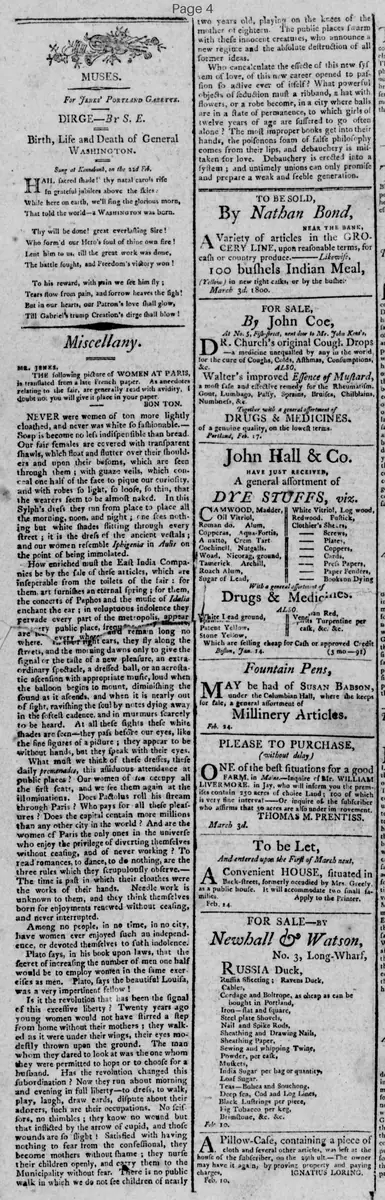
MR. JENKS,
THE following picture of WOMEN AT PARIS,
is translated from a late French paper. As anecdotes
relating to the fair, are generally read with avidity, I
doubt not you will give it place in your paper.
BON TON.
NEVER were women of ton more lightly
cloathed, and never was white so fashionable.-
Soap is become no less indispensable than bread.
Our fair females are covered with transparent
shawls, which float and flutter over their shoulders
and upon their bosoms, which are seen
through them; with gauze veils, which con-
ceal one half of the face to pique our curiosity,
and with robes so light, so loose, so thin, that
the wearers seem to be almost naked. In this
Sylph's dress they run from place to place all
the morning, noon, and night; one sees noth-
ing but white shades flitting through every
street; it is the dress of the ancient vestals;
and our women resemble Iphigenia in Aulis on
the point of being immolated.
- How enriched must the East India Compa-
nies be by the sale of these articles, which are
inseparable from the toilets of the fair: for
them, art furnishes an eternal spring; for them,
the concerts of Paphos and the music of Idalia
enchant the ear; in voluptuous indolence they
pervade every part of the metropolis, appear
in every
public place, dregs remain long nowhere.
where.
In their light cars, they fly along the
streets, and the morning dawns only to give the
signal for the taste of a new pleasure, an extraordinary spectacle, a dressed ball, or an aerostatic
ascension with appropriate music, loud when
the balloon begins to mount, diminishing the
sound as it ascends, and when it is nearly out
of sight, ravishing the soul by notes dying away
in the softest cadence, and in murmurs scarcely
to be heard. At all these sights these white
shades are seen-they pass before our eyes, like
the fine figures of a picture; they appear to be
without hands, but they speak with their eyes.
What must we think of these dresses, these
daily promenades, this assiduous attendance at
public places? Our women of ton occupy all
the first seats, and we see them again at the
illuminations. Does Pactolus roll his stream
through Paris? Who pays for all these plea-
sures? Does the capital contain more millions
than any other city in the world? And are the
women of Paris the only ones in the universe
who enjoy the privilege of diverting themselves
without ceasing, and of never working? To
read romances, to dance, to do nothing, are the
three rules which they scrupulously observe.-
The time is past in which their clothes were
the works of their hands. Needle work is
unknown to them, and they think themselves
born for enjoyments renewed without ceasing,
and never interrupted.
Among no people, in no time, in no city.
have women ever enjoyed such an independ-
ence, or devoted themselves to such indolence.
Plato says, in his book upon laws, that the
secret of increasing the number of men one half
would be to employ women in the same exer-
cises as men. Plato, says the beautiful Louisa,
was a very impertinent fellow!
Is it the revolution that has been the signal
of this excessive liberty? Twenty years ago
young women would not have stirred a step
from home without their mothers; they walked.
ed as it were under their wings, their eyes mo-
destly thrown upon the ground. The man
whom they dared to look at was the one whom
they were permitted to hope or to choose for a
husband. Has the revolution changed this
subordination? Now they run about morning
and evening in full liberty to dress, to walk,
play, laugh, draw cards, dispute about their
admirers, such are their occupations. No scissors, no thimbles; they know no wound but
that inflicted by the arrow of Cupid, and those
wounds are so light! Satisfied with having
nothing to fear from the conventional, they
become mothers without shame; they nurse
their children openly, and carry them to the
Municipality without fear. There is no public
walk in which we do not see children of nearly
two years old, playing on the knees of the
mother of eighteen. The public places swarm
with these innocent creatures, who announce a
new regime and the absolute destruction of all
former ideas.
Who can calculate the effects of this new sys-
tem of love, of this new career opened to pas-
sion so active ever of itself? What powerful
objects of seduction must a ribband, a hat with
flowers, or a robe become, in a city where balls
are in a state of permanence, to which girls of
twelve years of age are suffered to go often
alone? The most improper books get into their
hands, the poisonous foam of false philosophy
comes from their lips, and debauchery is mis-
taken for love. Debauchery is erected into a
system; and untimely unions can only promise
and prepare a weak and feeble generation.
What sub-type of article is it?
What keywords are associated?
What entities or persons were involved?
Where did it happen?
Foreign News Details
Primary Location
Paris
Key Persons
Outcome
excessive liberty leading to debauchery, mistaken for love, and preparation of a weak and feeble generation.
Event Details
Description of Parisian women's light, transparent fashion and indulgent, independent lifestyle post-revolution, contrasting with past modesty; they attend public pleasures without work, nurse children openly, and embrace a new regime destroying former ideas.