Thank you for visiting SNEWPapers!
Sign up free
Letter to Editor
February 26, 1852
The National Era
Washington, District Of Columbia
What is this article about?
Grace Greenwood's letter from Washington on February 21, 1852, criticizes naval officers' attacks on Kossuth, reports a Senate debate on printing his thanks, praises Senator Soulé's eloquent defense of public opinion, describes Healy's painting of Webster, notes social events, and satirizes presidential candidates' moral campaigning.
Clipping
OCR Quality
95%
Excellent
Full Text
LETTERS FROM THE CAPITAL
Washington. February 21. 1852.
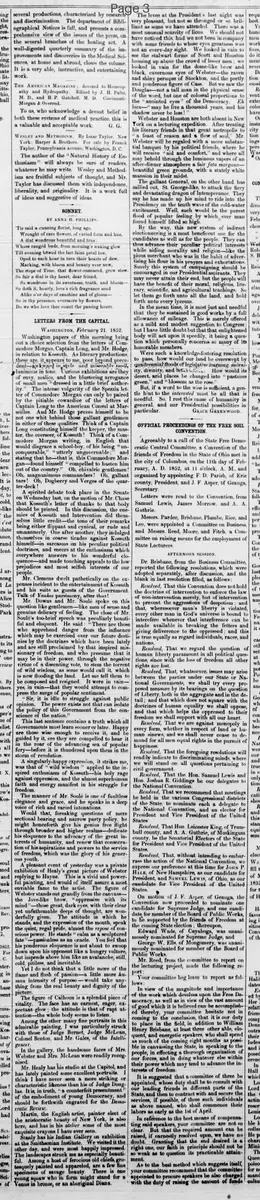
Washington papers of this morning bring out a choice selection from the letters of Commodore Morgan, Captain Long, and Mr. Hodge in relation to Kossuth. As literary productions, these are, it appears to me, poor beyond precedent-awkward in style and miserably pusillanimous in tone. Curious exhibitions are they of envy, malice, and the blustering arrogance of small men "dressed in a little brief authority." The intense vulgarity of the Spezzia letter of Commodore Morgan can only be paired by the pitiable cowardice of the letters of Captain Long to the American Consul at Marseilles. And Mr. Hodge proves himself to be not one whit behind those gallant gentlemen in either of these qualities. Think of a Captain Long constituting himself the keeper, the master, the overseer, of Kossuth! Think of a Commodore Morgan writing, in English that would disgrace a school-boy, of his being "unconquerable," "utterly ungovernable;" and stating that he-that is. this Commodore Morgan-found himself "compelled to hasten him out of the country." Oh, chivalric gentlemen! Oh, magnanimous commanders! Oh, gallant tars! Oh, Dogberry and Verges of the quarter-deck!
A spirited debate took place in the Senate on Wednesday last, on the motion of Mr. Chase that Kossuth's letter of thanks to that body should be printed. In this discussion, the enemies of Kossuth and Intervention did themselves little credit-the tone of their remarks being either flippant and cynical, or rude and unmannerly. One after another, they indulged themselves in coarse tirades against Kossuth himself-in sarcasms on his peculiar political doctrines, and sneers at the enthusiasm which everywhere answers to his wonderful eloquence—and made touching appeals to the low prejudices and most selfish interests of our people.
Mr. Clemens dwelt pathetically on the expenses incident to the entertainment of Kossuth and his suite as guests of the Government. Talk of Yankee parsimony, after that!
Mr. Downs and Mr. Soulé spoke on this question like gentlemen-like men of sense and genuine delicacy of feeling. The close of Mr. Soulé's too-brief speech was peculiarly beautiful and eloquent. He said: "There are those who apprehend danger from the influence which may be exercised over our future destinies by the doctrines which have been lately and are still proclaimed by that inspired missionary of freedom, and who presume that it may be in their power, through the negative virtue of a dissenting vote, to stem the torrent of wild wisdom, as some would call it, which is now flooding the land. Let me tell them to be composed and resigned. It were in vain— yes, in vain-that they would attempt to compress the surge of popular sentiment.
"Sir, it is idle to struggle against public opinion. The power exists not that can isolate the policy of this Government from the conscience of the nation."
This last sentence contains a truth which all Governments must learn sooner or later. Happy are those wise enough to receive it, and be guided by it, ere they are compelled to hear it in the roar of the advancing sea of popular fury-before it is thundered upon them in the storm of revolution.
A singularly-happy expression, it strikes me, was that of "wild wisdom" applied to the inspired enthusiasm of Kossuth-his holy rage against oppression, and the almost superhuman faith and energy manifest in his struggle for freedom.
The manner of Mr. Soulé is one of faultless elegance and grace, and he speaks in a deep voice of rich and varied intonations. Would that, forsaking questions of mere sectional bearing and narrow party policy. he might henceforth give his genius free flight through broader and higher realms-dedicate his eloquence to the advocacy of the great interests of humanity, and renew that consecration of his aspirations and powers to the service of freedom, which was the glory of his generous youth.
A pleasant event of yesterday was a private exhibition of Healy's great picture of Webster replying to Hayne. This is a vivid and powerful painting, and would of itself assure a most enviable fame to the artist. The figure of Webster stands out grandly from the canvass- the Jove-like brow, "oppressive with its mind"-those great, dark eyes, with their clear yet unfathomable deeps of thought, are wonderfully given. The attitude in which he stands, and the expression of the mouth, speak the quiet, regal pride, almost the repose of conscious power. He stands "calm as a sculptured fate"-passionless as an oracle. You feel that his ponderous eloquence is not about to swoop down upon his opponent like a hungry vulture but impends above him like an avalanche, still cold, pitiless, and inevitable.
Yet I do not think that a little more of the flame and flash of passion-a little more human intensity of purpose-would take anything from the real beauty and dignity of the picture.
The figure of Calhoun is a splendid piece of vitality. The face has an earnest, eager, expectant glow; the attitude is that of rapt attention-the whole body seems to listen.
Among the other many fine portraits in this admirable painting, I was particularly struck with those of Judge Burnet, Judge McLean, Colonel Benton, and Mr. Gales, of the Intelligencer.
In the gallery, the handsome faces of Mrs. Webster and Mrs. McLean were readily recognised.
Mr. Healy has his studio at the Capitol, and has lately painted some excellent portraits. I think I have never seen a more striking or characteristic likeness than his of Judge Douglas. It is, in truth, "a counterfeit presentment of the embodiment of young Democracy, and should be forthwith engraved for the Democratic Review.
Martin, the English artist, painter elect of the aristocratic beauty of New York, is also here, and has in his atelier some of the most exquisite crayons I have ever seen.
Stanly has his Indian Gallery on exhibition at the Smithsonian Institute. We visited it the other day, and were most happily impressed. The landscapes struck me as especially beautiful. Among a host of ferocious old chiefs, grotesquely painted and appareled, are a few fine specimens of savage beauty. There is one young squaw who in form might stand for a Venus in bronze, or an aboriginal Diana.
The levee at the President's last night was very pleasant, but not so thronged or so brilliant as some we have attended. There was a most unusual scarcity of lions. We should not have noticed this, had we not been in company with some friends to whose eyes greatness was not an every-day sight. We looked in vain to see the stalwart forms of Scott and Houston looming up above the crowd of lesser men; we looked in vain for the dome-like brow and black, cavernous eyes of Webster-the raven and shiny peruque of Stockton, and the portly and ponderous figure of Cass. But we saw the Douglas-not a tall man in the physical sense of the word, but one of colossal proportions to the "anointed eyes" of the Democracy. Eh bien—"may he live a thousand years, and his shadow never be less!"
Webster and Houston are both absent in New York on a lecturing expedition. After treating his literary friends in that great metropolis to "a feast of reason and a flow of soul," Mr Webster will be regaled with a more substantial banquet by his political friends, where he will receive "aid and comfort," and where all may behold through the luminous vapors of an after-dinner atmosphere a fair fata morgana— beautiful green grounds, with a stately white mansion in their midst.
The gallant General, on the other hand. has sallied out, St. George-like, to attack the fiery and devastating dragon of Intemperance. They say he has made up his mind to ride into the Presidency on the tenth wave of the cold-water excitement. Well, such would be the purest flood of popular feeling by which ever man found himself lifted so high.
By the way, this new system of indirect electioneering is a most beneficent one for the candidates as well as for the people. They can thus advance their peculiar political interests while aiding morality and religion-like the pious merchant who was in the habit of advertising his flour in his prayers and exhortations.
Surely this system of campaigning should be encouraged in our Presidential aspirants. They may never attain their end. but the people will have the benefit of their moral, religious. literary. scientific, and agricultural teachings. So let them go forth unto all the land, and hold forth unto every lyceum.
In the mean time, it is most just and needful that they be sustained in good works by a full allowance of mileage. This is merely offered as a mild and modest suggestion to Congress: but I have little doubt but that that enlightened body will act upon it speedily, it being a question which personally concerns so many of its honorable members.
Were such a knowledge-fostering resolution to pass, how would our land be overswept by quadrennial floods of legislative learning. morality, divinity, and beke& serves. How would its desert, arid places be changed into "pastures green,"and"blossom as the rose."
But, if a word to the wise is sufficient, a gentle hint to the interested must be all that is needful. So, I rest this cause of humanity in general, and our Presidential possibilities in particular.
Grace Greenwood.
Washington. February 21. 1852.
Washington papers of this morning bring out a choice selection from the letters of Commodore Morgan, Captain Long, and Mr. Hodge in relation to Kossuth. As literary productions, these are, it appears to me, poor beyond precedent-awkward in style and miserably pusillanimous in tone. Curious exhibitions are they of envy, malice, and the blustering arrogance of small men "dressed in a little brief authority." The intense vulgarity of the Spezzia letter of Commodore Morgan can only be paired by the pitiable cowardice of the letters of Captain Long to the American Consul at Marseilles. And Mr. Hodge proves himself to be not one whit behind those gallant gentlemen in either of these qualities. Think of a Captain Long constituting himself the keeper, the master, the overseer, of Kossuth! Think of a Commodore Morgan writing, in English that would disgrace a school-boy, of his being "unconquerable," "utterly ungovernable;" and stating that he-that is. this Commodore Morgan-found himself "compelled to hasten him out of the country." Oh, chivalric gentlemen! Oh, magnanimous commanders! Oh, gallant tars! Oh, Dogberry and Verges of the quarter-deck!
A spirited debate took place in the Senate on Wednesday last, on the motion of Mr. Chase that Kossuth's letter of thanks to that body should be printed. In this discussion, the enemies of Kossuth and Intervention did themselves little credit-the tone of their remarks being either flippant and cynical, or rude and unmannerly. One after another, they indulged themselves in coarse tirades against Kossuth himself-in sarcasms on his peculiar political doctrines, and sneers at the enthusiasm which everywhere answers to his wonderful eloquence—and made touching appeals to the low prejudices and most selfish interests of our people.
Mr. Clemens dwelt pathetically on the expenses incident to the entertainment of Kossuth and his suite as guests of the Government. Talk of Yankee parsimony, after that!
Mr. Downs and Mr. Soulé spoke on this question like gentlemen-like men of sense and genuine delicacy of feeling. The close of Mr. Soulé's too-brief speech was peculiarly beautiful and eloquent. He said: "There are those who apprehend danger from the influence which may be exercised over our future destinies by the doctrines which have been lately and are still proclaimed by that inspired missionary of freedom, and who presume that it may be in their power, through the negative virtue of a dissenting vote, to stem the torrent of wild wisdom, as some would call it, which is now flooding the land. Let me tell them to be composed and resigned. It were in vain— yes, in vain-that they would attempt to compress the surge of popular sentiment.
"Sir, it is idle to struggle against public opinion. The power exists not that can isolate the policy of this Government from the conscience of the nation."
This last sentence contains a truth which all Governments must learn sooner or later. Happy are those wise enough to receive it, and be guided by it, ere they are compelled to hear it in the roar of the advancing sea of popular fury-before it is thundered upon them in the storm of revolution.
A singularly-happy expression, it strikes me, was that of "wild wisdom" applied to the inspired enthusiasm of Kossuth-his holy rage against oppression, and the almost superhuman faith and energy manifest in his struggle for freedom.
The manner of Mr. Soulé is one of faultless elegance and grace, and he speaks in a deep voice of rich and varied intonations. Would that, forsaking questions of mere sectional bearing and narrow party policy. he might henceforth give his genius free flight through broader and higher realms-dedicate his eloquence to the advocacy of the great interests of humanity, and renew that consecration of his aspirations and powers to the service of freedom, which was the glory of his generous youth.
A pleasant event of yesterday was a private exhibition of Healy's great picture of Webster replying to Hayne. This is a vivid and powerful painting, and would of itself assure a most enviable fame to the artist. The figure of Webster stands out grandly from the canvass- the Jove-like brow, "oppressive with its mind"-those great, dark eyes, with their clear yet unfathomable deeps of thought, are wonderfully given. The attitude in which he stands, and the expression of the mouth, speak the quiet, regal pride, almost the repose of conscious power. He stands "calm as a sculptured fate"-passionless as an oracle. You feel that his ponderous eloquence is not about to swoop down upon his opponent like a hungry vulture but impends above him like an avalanche, still cold, pitiless, and inevitable.
Yet I do not think that a little more of the flame and flash of passion-a little more human intensity of purpose-would take anything from the real beauty and dignity of the picture.
The figure of Calhoun is a splendid piece of vitality. The face has an earnest, eager, expectant glow; the attitude is that of rapt attention-the whole body seems to listen.
Among the other many fine portraits in this admirable painting, I was particularly struck with those of Judge Burnet, Judge McLean, Colonel Benton, and Mr. Gales, of the Intelligencer.
In the gallery, the handsome faces of Mrs. Webster and Mrs. McLean were readily recognised.
Mr. Healy has his studio at the Capitol, and has lately painted some excellent portraits. I think I have never seen a more striking or characteristic likeness than his of Judge Douglas. It is, in truth, "a counterfeit presentment of the embodiment of young Democracy, and should be forthwith engraved for the Democratic Review.
Martin, the English artist, painter elect of the aristocratic beauty of New York, is also here, and has in his atelier some of the most exquisite crayons I have ever seen.
Stanly has his Indian Gallery on exhibition at the Smithsonian Institute. We visited it the other day, and were most happily impressed. The landscapes struck me as especially beautiful. Among a host of ferocious old chiefs, grotesquely painted and appareled, are a few fine specimens of savage beauty. There is one young squaw who in form might stand for a Venus in bronze, or an aboriginal Diana.
The levee at the President's last night was very pleasant, but not so thronged or so brilliant as some we have attended. There was a most unusual scarcity of lions. We should not have noticed this, had we not been in company with some friends to whose eyes greatness was not an every-day sight. We looked in vain to see the stalwart forms of Scott and Houston looming up above the crowd of lesser men; we looked in vain for the dome-like brow and black, cavernous eyes of Webster-the raven and shiny peruque of Stockton, and the portly and ponderous figure of Cass. But we saw the Douglas-not a tall man in the physical sense of the word, but one of colossal proportions to the "anointed eyes" of the Democracy. Eh bien—"may he live a thousand years, and his shadow never be less!"
Webster and Houston are both absent in New York on a lecturing expedition. After treating his literary friends in that great metropolis to "a feast of reason and a flow of soul," Mr Webster will be regaled with a more substantial banquet by his political friends, where he will receive "aid and comfort," and where all may behold through the luminous vapors of an after-dinner atmosphere a fair fata morgana— beautiful green grounds, with a stately white mansion in their midst.
The gallant General, on the other hand. has sallied out, St. George-like, to attack the fiery and devastating dragon of Intemperance. They say he has made up his mind to ride into the Presidency on the tenth wave of the cold-water excitement. Well, such would be the purest flood of popular feeling by which ever man found himself lifted so high.
By the way, this new system of indirect electioneering is a most beneficent one for the candidates as well as for the people. They can thus advance their peculiar political interests while aiding morality and religion-like the pious merchant who was in the habit of advertising his flour in his prayers and exhortations.
Surely this system of campaigning should be encouraged in our Presidential aspirants. They may never attain their end. but the people will have the benefit of their moral, religious. literary. scientific, and agricultural teachings. So let them go forth unto all the land, and hold forth unto every lyceum.
In the mean time, it is most just and needful that they be sustained in good works by a full allowance of mileage. This is merely offered as a mild and modest suggestion to Congress: but I have little doubt but that that enlightened body will act upon it speedily, it being a question which personally concerns so many of its honorable members.
Were such a knowledge-fostering resolution to pass, how would our land be overswept by quadrennial floods of legislative learning. morality, divinity, and beke& serves. How would its desert, arid places be changed into "pastures green,"and"blossom as the rose."
But, if a word to the wise is sufficient, a gentle hint to the interested must be all that is needful. So, I rest this cause of humanity in general, and our Presidential possibilities in particular.
Grace Greenwood.
What sub-type of article is it?
Informative
Political
Reflective
What themes does it cover?
Politics
Morality
What keywords are associated?
Kossuth
Senate Debate
Intervention
Soulé Speech
Healy Painting
Webster Hayne
Presidential Campaigning
Temperance
What entities or persons were involved?
Grace Greenwood
Letter to Editor Details
Author
Grace Greenwood
Main Argument
criticizes naval officers' pusillanimous attacks on kossuth and praises senator soulé's eloquent defense of aligning government policy with public sentiment in favor of freedom during the senate debate on printing kossuth's letter.
Notable Details
Quotes From Mr. Soulé'S Speech On Public Opinion
Description Of Healy's Painting Of Webster Replying To Hayne
Satirical Comments On Presidential Candidates' Indirect Electioneering Via Lectures On Temperance And Morality