Thank you for visiting SNEWPapers!
Sign up free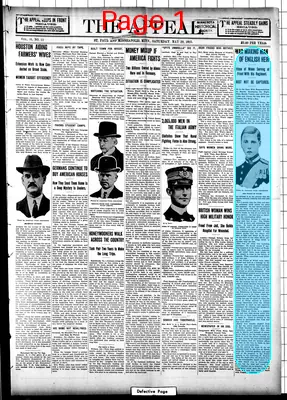
The Appeal
Saint Paul, Minnesota
What is this article about?
The twenty-year-old Prince of Wales, after persistent requests, was allowed by Earl Kitchener to join the British Expeditionary Force in France as a dispatch rider starting November 16, 1914. He performed arduous duties until April 10, 1915, when he returned to London with dispatches. During a March 1915 leave, he visited Paris incognito and lunched with President Poincare.
Merged-components note: Image overlaps spatially with the article on the Prince of Wales in the war; fits foreign_news as it covers British military involvement.
Clipping

OCR Quality
Full Text
This is Event 1 of 2. The full text below covers all events in this component.
OF ENGLISH HEIR
Prince of Wales Serving at Front With His Regiment.
MUST NOT BE CAPTURED.
Life In the Open With Responsibilities Is Rapidly Developing the Slight, Rosy, Boyish, Twenty-year-old Prince.
Lithe and Young, He Has Done His Twenty-five Miles a Day.
London.—The Prince of Wales, the twenty-year-old future king of England, faced Earl Kitchener in the war office one day last November and demanded that he be allowed to go to the front at once. Three months previously, at the very outbreak of the war, within a week of receiving his commission as a lieutenant in the First Grenadier Guards, he had made the same request, but the secretary of war had refused it on the ground that the prince's military training had only just begun.
For a second time the lithe and slender subaltern stood before the great field marshal. He had thrown himself into his work with such enthusiasm and patriotic fervor that now, after only twelve weeks, he was fit and ready for active service. He had been so reported by his commanding officer.
Earl Kitchener listened to what the young man had to say. The British war lord is stern and unbending, but human. He knew the prince's spirit and talked with him as one soldier with another, not from a personal but from a national point of view. It went without saying that the prince was eager to fight and would do his duty just the same as any other officer, taking his chances of being killed or wounded with the rest.
That was not what was worrying Kitchener. He would mourn if anything happened to the Prince of Wales, but he knew that if the heir apparent did get killed there were plenty of other people to come to the throne of England. What concerned Lord Kitchener was this:
If the Prince of Wales were taken prisoner and held as a hostage by the Germans very serious embarrassment might be caused to the allies, and their plans for the final settlement of the war would be gravely hampered. This Earl Kitchener pointed out in his usual direct and forcible manner, but the young prince was not to be denied, and when he left the war office it was with the promise that he would be attached to Field Marshal French's staff at the headquarters of the British expeditionary force in France. On Nov. 16 the Prince of Wales crossed over from Folkestone to Boulogne and proceeded at once to St. Omer, where the headquarters' staff was then located.
From that day till April 10, when the Prince of Wales arrived in London bearing dispatches from the British commander in chief, he has regularly performed the arduous and dangerous duties of a dispatch rider.
The Prince of Wales is a slightly built and very high strung youth who looks two or three years younger than he really is. There is nothing in his uniform to distinguish him from any other staff officer.
Nearly four months elapsed from the day the prince reported for duty till Field Marshal French gave him twenty-four hours' leave. This was early in March, and instead of spending his time in the big white house in which he lives the prince ordered his car and, leaving the noncommissioned officer behind, took his brother officer and was on his way to Paris as fast as his car could carry him.
On his arrival he went to an old fashioned hotel in the Rue de Rivoli, facing the Tuileries gardens, and sent word of his presence to the British embassy in the Faubourg St. Honore.
When the Right Hon. Sir Francis Bertie, the ambassador, heard about it he at once wired over to Buckingham palace, but the king and queen evidently decided not to interfere. So the ambassador called upon the Prince of Wales and took him round to lunch with President Poincare.
What sub-type of article is it?
What keywords are associated?
What entities or persons were involved?
Where did it happen?
Foreign News Details
Primary Location
France
Event Date
November 1914 To April 1915
Key Persons
Outcome
the prince served as a dispatch rider without capture; brief leave in paris for lunch with president poincare.
Event Details
The twenty-year-old Prince of Wales, after persistent requests, was allowed by Earl Kitchener to join the British Expeditionary Force in France as a dispatch rider starting November 16, 1914. He performed arduous duties until April 10, 1915, when he returned to London with dispatches. During a March 1915 leave, he visited Paris incognito and lunched with President Poincare.