Thank you for visiting SNEWPapers!
Sign up free
Editorial
June 7, 1780
The Virginia Gazette
Richmond, Williamsburg, Richmond County, Virginia
What is this article about?
Editorial in Boston's Independent Chronicle, April 27, 1780, criticizes rumored British proposals to treat the United States like Ireland with limited self-governance under Crown control, viewing them as a disguised attempt at subjugation after five years of war, and affirms American resolve for full independence, alliances like with France, and rejection of any subjection.
Clipping
OCR Quality
98%
Excellent
Full Text
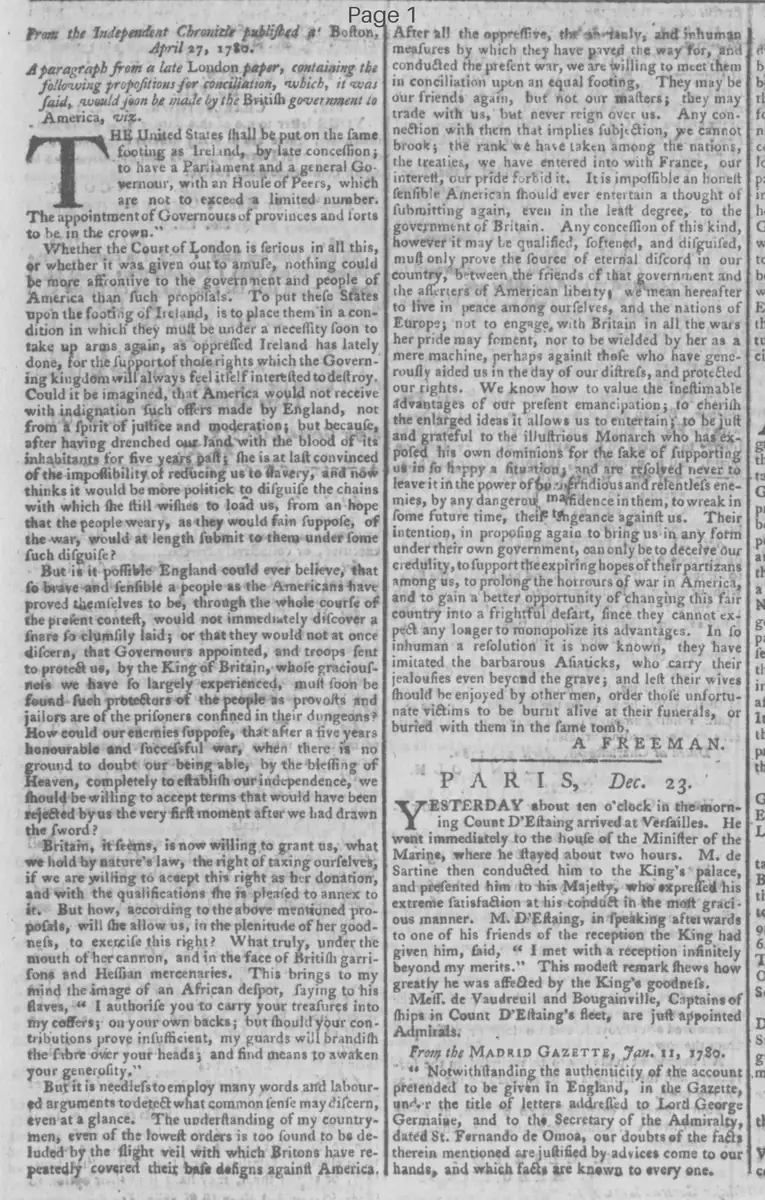
From the Independent Chronicle published at Boston, April 27, 1780.
A paragraph from a late London paper, containing the following propositions for conciliation, which, it was said, would soon be made by the British government to America, viz.
The United States shall be put on the same footing as Ireland, by late concession; to have a Parliament and a general Governor, with a House of Peers, which are not to exceed a limited number.
The appointment of Governors of provinces and forts to be in the crown."
Whether the Court of London is serious in all this, or whether it was given out to amuse, nothing could be more affrontive to the government and people of America than such proposals. To put these States upon the footing of Ireland, is to place them in a condition in which they must be under a necessity soon to take up arms again, as oppressed Ireland has lately done, for the support of those rights which the Governing kingdom will always feel itself interested to destroy.
Could it be imagined, that America would not receive with indignation such offers made by England, not from a spirit of justice and moderation; but because, after having drenched our land with the blood of its inhabitants for five years past; she is at last convinced of the impossibility of reducing us to slavery, and now thinks it would be more politic to disguise the chains with which she still wishes to load us, from an hope that the people weary, as they would fain suppose, of the war, would at length submit to them under some such disguise?
But is it possible England could ever believe, that so brave and sensible a people as the Americans have proved themselves to be, through the whole course of the present contest, would not immediately discover a snare so clumsily laid; or that they would not at once discern, that Governors appointed, and troops sent to protect us, by the King of Britain, whose graciousness we have so largely experienced, must soon be found such protectors of the people as provosts and jailors are of the prisoners confined in their dungeons?
How could our enemies suppose, that after a five years honourable and successful war, when there is no ground to doubt our being able, by the blessing of Heaven, completely to establish our independence, we should be willing to accept terms that would have been rejected by us the very first moment after we had drawn the sword?
Britain, it seems, is now willing to grant us, what we hold by nature's law, the right of taxing ourselves, if we are willing to accept this right as her donation, and with the qualifications he is pleased to annex to it. But how, according to the above mentioned proposals, will she allow us, in the plenitude of her goodness, to exercise this right? What truly, under the mouth of her cannon, and in the face of British garrisons and Hessian mercenaries. This brings to my mind the image of an African despot, saying to his slaves, "I authorize you to carry your treasures into my coffers; on your own backs; but should your contributions prove insufficient, my guards will brandish the sabre over your heads; and find means to awaken your generosity."
But it is needless to employ many words and labored arguments to detect what common sense may discern, even at a glance. The understanding of my countrymen, even of the lowest orders is too sound to be deluded by the slight veil with which Britons have repeatedly covered their base designs against America.
After all the oppressive, tyrannically, and inhuman measures by which they have paved the way for, and conducted the present war, we are willing to meet them in conciliation upon an equal footing, They may be our friends again, but not our masters; they may trade with us, but never reign over us. Any connection with them that implies subjection, we cannot brook; the rank we have taken among the nations, the treaties, we have entered into with France, our interest, our pride forbid it. It is impossible an honest sensible American should ever entertain a thought of submitting again, even in the least degree, to the government of Britain. Any concession of this kind, however it may be qualified, softened, and disguised, must only prove the source of eternal discord in our country, between the friends of that government and the asserters of American liberty we mean hereafter to live in peace among ourselves, and the nations of Europe; not to engage, with Britain in all the wars her pride may foment, nor to be wielded by her as a mere machine, perhaps against those who have generously aided us in the day of our distress, and protected our rights. We know how to value the inestimable advantages of our present emancipation; to cherish the enlarged ideas it allows us to entertain; to be just and grateful to the illustrious Monarch who has exposed his own dominions for the sake of supporting us in so happy a situation; and are resolved never to leave it in the power of perfidious and relentless enemies, by any dangerous confidence in them, to wreak in some future time, their savage vengeance against us. Their intention, in proposing again to bring us in any form under their own government, can only be to deceive our credulity, to support the expiring hopes of their partizans among us, to prolong the horrors of war in America, and to gain a better opportunity of changing this fair country into a frightful desert, since they cannot expect any longer to monopolize its advantages. In so inhuman a resolution it is now known, they have imitated the barbarous Asiatics, who carry their jealousies even beyond the grave; and lest their wives should be enjoyed by other men, order those unfortunate victims to be burnt alive at their funerals, or buried with them in the same tomb.
A FREEMAN.
A paragraph from a late London paper, containing the following propositions for conciliation, which, it was said, would soon be made by the British government to America, viz.
The United States shall be put on the same footing as Ireland, by late concession; to have a Parliament and a general Governor, with a House of Peers, which are not to exceed a limited number.
The appointment of Governors of provinces and forts to be in the crown."
Whether the Court of London is serious in all this, or whether it was given out to amuse, nothing could be more affrontive to the government and people of America than such proposals. To put these States upon the footing of Ireland, is to place them in a condition in which they must be under a necessity soon to take up arms again, as oppressed Ireland has lately done, for the support of those rights which the Governing kingdom will always feel itself interested to destroy.
Could it be imagined, that America would not receive with indignation such offers made by England, not from a spirit of justice and moderation; but because, after having drenched our land with the blood of its inhabitants for five years past; she is at last convinced of the impossibility of reducing us to slavery, and now thinks it would be more politic to disguise the chains with which she still wishes to load us, from an hope that the people weary, as they would fain suppose, of the war, would at length submit to them under some such disguise?
But is it possible England could ever believe, that so brave and sensible a people as the Americans have proved themselves to be, through the whole course of the present contest, would not immediately discover a snare so clumsily laid; or that they would not at once discern, that Governors appointed, and troops sent to protect us, by the King of Britain, whose graciousness we have so largely experienced, must soon be found such protectors of the people as provosts and jailors are of the prisoners confined in their dungeons?
How could our enemies suppose, that after a five years honourable and successful war, when there is no ground to doubt our being able, by the blessing of Heaven, completely to establish our independence, we should be willing to accept terms that would have been rejected by us the very first moment after we had drawn the sword?
Britain, it seems, is now willing to grant us, what we hold by nature's law, the right of taxing ourselves, if we are willing to accept this right as her donation, and with the qualifications he is pleased to annex to it. But how, according to the above mentioned proposals, will she allow us, in the plenitude of her goodness, to exercise this right? What truly, under the mouth of her cannon, and in the face of British garrisons and Hessian mercenaries. This brings to my mind the image of an African despot, saying to his slaves, "I authorize you to carry your treasures into my coffers; on your own backs; but should your contributions prove insufficient, my guards will brandish the sabre over your heads; and find means to awaken your generosity."
But it is needless to employ many words and labored arguments to detect what common sense may discern, even at a glance. The understanding of my countrymen, even of the lowest orders is too sound to be deluded by the slight veil with which Britons have repeatedly covered their base designs against America.
After all the oppressive, tyrannically, and inhuman measures by which they have paved the way for, and conducted the present war, we are willing to meet them in conciliation upon an equal footing, They may be our friends again, but not our masters; they may trade with us, but never reign over us. Any connection with them that implies subjection, we cannot brook; the rank we have taken among the nations, the treaties, we have entered into with France, our interest, our pride forbid it. It is impossible an honest sensible American should ever entertain a thought of submitting again, even in the least degree, to the government of Britain. Any concession of this kind, however it may be qualified, softened, and disguised, must only prove the source of eternal discord in our country, between the friends of that government and the asserters of American liberty we mean hereafter to live in peace among ourselves, and the nations of Europe; not to engage, with Britain in all the wars her pride may foment, nor to be wielded by her as a mere machine, perhaps against those who have generously aided us in the day of our distress, and protected our rights. We know how to value the inestimable advantages of our present emancipation; to cherish the enlarged ideas it allows us to entertain; to be just and grateful to the illustrious Monarch who has exposed his own dominions for the sake of supporting us in so happy a situation; and are resolved never to leave it in the power of perfidious and relentless enemies, by any dangerous confidence in them, to wreak in some future time, their savage vengeance against us. Their intention, in proposing again to bring us in any form under their own government, can only be to deceive our credulity, to support the expiring hopes of their partizans among us, to prolong the horrors of war in America, and to gain a better opportunity of changing this fair country into a frightful desert, since they cannot expect any longer to monopolize its advantages. In so inhuman a resolution it is now known, they have imitated the barbarous Asiatics, who carry their jealousies even beyond the grave; and lest their wives should be enjoyed by other men, order those unfortunate victims to be burnt alive at their funerals, or buried with them in the same tomb.
A FREEMAN.
What sub-type of article is it?
War Or Peace
Foreign Affairs
Constitutional
What keywords are associated?
British Conciliation
American Independence
Revolutionary War
Subjugation Proposals
Ireland Comparison
French Alliance
What entities or persons were involved?
Britain
King Of Britain
United States
Ireland
France
Hessian Mercenaries
Editorial Details
Primary Topic
Rejection Of British Conciliation Proposals
Stance / Tone
Strongly Pro Independence And Anti British Subjugation
Key Figures
Britain
King Of Britain
United States
Ireland
France
Hessian Mercenaries
Key Arguments
Proposals To Treat America Like Ireland Are Insulting And Would Lead To Renewed Oppression
British Offers Stem From Inability To Conquer, Not Justice, Disguising Chains Of Slavery
Americans Are Too Sensible To Fall For Such Clumsy Snares
After Five Years Of Successful War, America Rejects Terms Implying Subjection
True Conciliation Must Be On Equal Footing Without Mastery
Alliances Like With France And National Pride Forbid Submission
British Intent Is To Deceive, Prolong War, And Destroy America