Thank you for visiting SNEWPapers!
Sign up free
Gazette Of The United States & Evening Advertiser
Philadelphia, Philadelphia County, Pennsylvania
What is this article about?
Reports from the French National Convention detail anti-clerical triumphs in L'Allier, decrees on provisions and property, suppression of religious ceremonies, republican army actions in Bordeaux and against rebels, and rehabilitation of historical victims of fanaticism like Labarre and Calas.
Merged-components note: Continuation of foreign intelligence from France's National Convention across pages 2 and 3.
Clippings
1 of 2
OCR Quality
Full Text
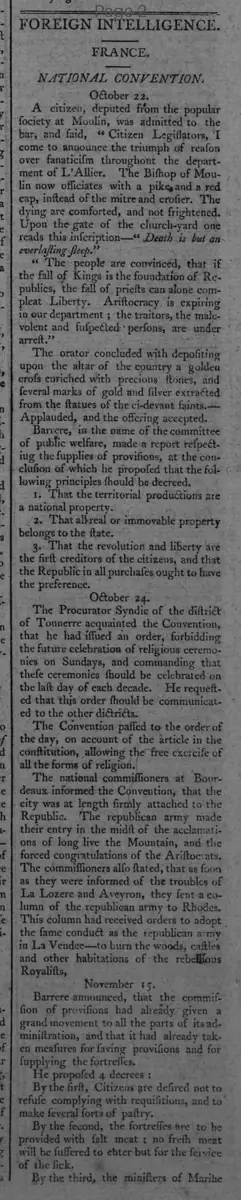
FRANCE.
NATIONAL CONVENTION.
October 22.
A citizen, deputed from the popular society at Moulins, was admitted to the bar, and said, "Citizen Legislators, I come to announce the triumph of reason over fanaticism throughout the department of L'Allier. The Bishop of Moulins now officiates with a pike and a red cap, instead of the mitre and crozier. The dying are comforted, and not frightened. Upon the gate of the church-yard one reads this inscription—"Death is but an everlasting sleep."
"The people are convinced, that if the fall of Kings is the foundation of Republics, the fall of priests can alone complete Liberty. Aristocracy is expiring in our department; the traitors, the malevolent and suspected persons, are under arrest."
The orator concluded with depositing upon the altar of the country a golden cross enriched with precious stones, and several marks of gold and silver extracted from the statues of the ci-devant saints.— Applauded, and the offering accepted.
Barrere, in the name of the committee of public welfare, made a report respecting the supplies of provisions, at the conclusion of which he proposed that the following principles should be decreed.
I. That the territorial productions are a national property.
2. That all real or immovable property belongs to the state.
3. That the revolution and liberty are the first creditors of the citizens, and that the Republic in all purchases ought to have the preference.
October 24.
The Procurator Syndic of the district of Tonnerre acquainted the Convention, that he had issued an order, forbidding the future celebration of religious ceremonies on Sundays, and commanding that these ceremonies should be celebrated on the last day of each decade. He requested that this order should be communicated to the other districts.
The Convention passed to the order of the day, on account of the article in the constitution, allowing the free exercise of all the forms of religion.
The national commissioners at Bourdeaux informed the Convention, that the city was at length firmly attached to the Republic. The republican army made their entry in the midst of the acclamations of long live the Mountain, and the forced congratulations of the Aristocrats. The commissioners also stated, that as soon as they were informed of the troubles of La Lozere and Aveyron, they sent a column of the republican army to Rhodes. This column had received orders to adopt the same conduct as the republican army in La Vendee—to burn the woods, castles and other habitations of the rebellious Royalists.
November 15.
Barrere announced, that the commission of provisions had already given a grand movement to all the parts of its administration, and that it had already taken measures for saving provisions and for supplying the fortresses.
He proposed 4 decrees:
By the first, Citizens are desired not to refuse complying with requisitions, and to make several sorts of pastry.
By the second, the fortresses are to be provided with salt meat; no fresh meat will be suffered to enter but for the service of the sick.
By the third, the ministers of Marine
and Foreign Affairs, are bound to transmit to the convention a statement of the foreign ships which have entered into the ports of the Republic, and of the quantity of their cargoes in raw materials.
By the fourth, the Convention grants the commission the use of a particular counter-sign.
November 17.
Prieur, representative of the people, wrote from Pantivi, dated the 13th inst. that he was going to the relief of the department of the coasts of the North, threatened with an invasion of the rebels. "I have left behind me," said he, "only the companies de Veterans, and de l'Epoir de la Patrie, all the other citizens having advanced to Dinant. I expect this night to receive intelligence from our armies. I am going to assist in the destruction of the banditti, who I hope will not this time escape the avenging steel of the republicans, who pursue and surround them on all sides. The levy of the young citizens of the first requisition, has been peaceably made; in almost all the districts it is nearly completed. The young men of the country, wait only for the end of their labours, to range themselves under the standards of liberty."
Thuriot read the plan of a decree respecting Labarre, which was adopted as follows:
I. The sentence pronounced by the Parliament of Paris on the 5th of June, 1776, against Labarre and Etallon, called de Moreval, confirming the sentence of Abbeville, past on the 28th of February preceding, is annulled.
2. The memory of Labarre and Etallon, called Moreval, the victims of superstition and ignorance, is restored.
3. Their heirs are authorized to take possession of the property which belonged to them.
4. In case it has been sold, a sum equal to it shall be paid to the said heirs from the national treasury.
Barrere—"Calas was also the victim of fanaticism; why is not he included in the decree which you have passed? It was priests and ecclesiastics, known under the titles of white, blue or black penitents who fanaticized the parliament, already fanaticized enough—and induced it to pass such an unjust sentence, so well known by its object, and by the strong remonstrances made against it by the philosopher of Ferney. I move, therefore, that you pass a decree respecting Calas, and that to do honor to our new manners, you will cause a column, with the following inscription to be erected on the spot where Calas was executed: 'The National Convention—to Nature—to paternal love.' Applauses."
The latter part of Barrere's motion was decreed.
What sub-type of article is it?
What keywords are associated?
What entities or persons were involved?
Where did it happen?
Foreign News Details
Primary Location
France
Event Date
October 22, 24, November 15, 17
Key Persons
Outcome
decrees on property and provisions; suppression of sunday religious ceremonies; republican army entry into bordeaux and orders to burn rebel habitations; rehabilitation of labarre, etallon, and motion for calas with proposed monument.
Event Details
Citizen from Moulins reports triumph over fanaticism in L'Allier, bishop's change, arrests, and offers church treasures. Barrere proposes decrees on national property and provisions. Order against Sunday ceremonies rejected. Commissioners report Bordeaux's attachment to Republic and army actions against rebels in La Lozere, Aveyron, and La Vendee. Further provision decrees. Prieur reports on relief against northern rebels and levies. Decree rehabilitates Labarre and Etallon; Barrere moves for Calas.