Thank you for visiting SNEWPapers!
Sign up free
Story
July 10, 1866
Spirit Of Jefferson
Charles Town, Jefferson County, West Virginia
What is this article about?
In the US Senate, debate on a bill to repeal the 1846 retrocession of Alexandria County to Virginia. Senators Wade and others argue the original cession was permanent and unconstitutional to reverse, while Davis and Cowan view it as a judicial matter. The bill is postponed.
Clipping
OCR Quality
98%
Excellent
Full Text
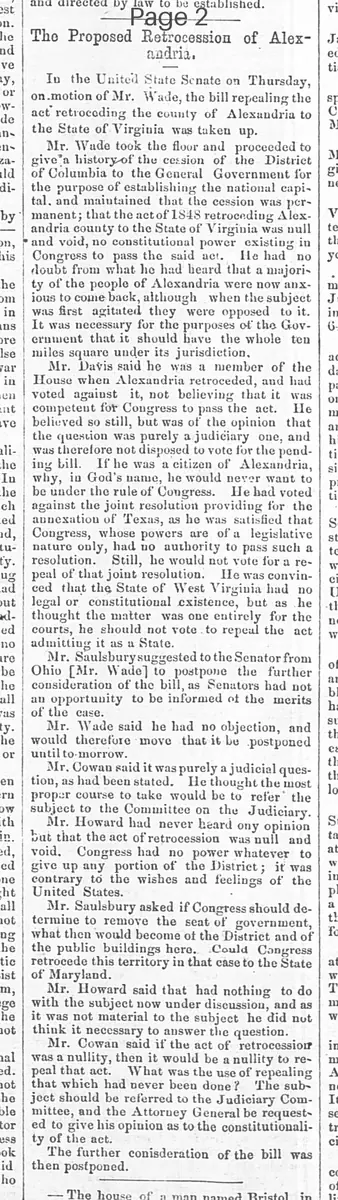
The Proposed Retrocession of Alexandria.
In the United States Senate on Thursday, on motion of Mr. Wade, the bill repealing the act retroceding the county of Alexandria to the State of Virginia was taken up. Mr. Wade took the floor and proceeded to give a history of the cession of the District of Columbia to the General Government for the purpose of establishing the national capital, and maintained that the cession was permanent; that the act of 1846 retroceding Alexandria county to the State of Virginia was null and void, no constitutional power existing in Congress to pass the said act. He had no doubt from what he had heard that a majority of the people of Alexandria were now anxious to come back, although when the subject was first agitated they were opposed to it. It was necessary for the purposes of the Government that it should have the whole ten miles square under its jurisdiction.
Mr. Davis said he was a member of the House when Alexandria retroceded, and had voted against it, not believing that it was competent for Congress to pass the act. He believed so still, but was of the opinion that the question was purely a judiciary one, and was therefore not disposed to vote for the pending bill. If he was a citizen of Alexandria, why, in God's name, he would never want to be under the rule of Congress. He had voted against the joint resolution providing for the annexation of Texas, as he was satisfied that Congress, whose powers are of a legislative nature only, had no authority to pass such a resolution. "Still, he would not vote for a repeal of that joint resolution. He was convinced that the State of West Virginia had no legal or constitutional existence, but as he thought the matter was one entirely for the courts, he should not vote to repeal the act admitting it as a State."
Mr. Saulsbury suggested to the Senator from Ohio [Mr. Wade] to postpone the further consideration of the bill, as Senators had not an opportunity to be informed of the merits of the case.
Mr. Wade said he had no objection, and would therefore move that it be postponed until to-morrow.
Mr. Cowan said it was purely a judicial question, as had been stated. "He thought the most proper course to take would be to refer the subject to the Committee on the Judiciary."
Mr. Howard had never heard any opinion but that the act of retrocession was null and void. Congress had no power whatever to give up any portion of the District; it was contrary to the wishes and feelings of the United States.
Mr. Saulsbury asked if Congress should determine to remove the seat of government, what then would become of the District and of the public buildings here. Could Congress retrocede this territory in that case to the State of Maryland.
Mr. Howard said that had nothing to do with the subject now under discussion, and as it was not material to the subject he did not think it necessary to answer the question.
Mr. Cowan said if the act of retrocession was a nullity, then it would be a nullity to repeal that act. What was the use of repealing that which had never been done? The subject should be referred to the Judiciary Committee, and the Attorney General be requested to give his opinion as to the constitutionality of the act.
The further consideration of the bill was then postponed.
In the United States Senate on Thursday, on motion of Mr. Wade, the bill repealing the act retroceding the county of Alexandria to the State of Virginia was taken up. Mr. Wade took the floor and proceeded to give a history of the cession of the District of Columbia to the General Government for the purpose of establishing the national capital, and maintained that the cession was permanent; that the act of 1846 retroceding Alexandria county to the State of Virginia was null and void, no constitutional power existing in Congress to pass the said act. He had no doubt from what he had heard that a majority of the people of Alexandria were now anxious to come back, although when the subject was first agitated they were opposed to it. It was necessary for the purposes of the Government that it should have the whole ten miles square under its jurisdiction.
Mr. Davis said he was a member of the House when Alexandria retroceded, and had voted against it, not believing that it was competent for Congress to pass the act. He believed so still, but was of the opinion that the question was purely a judiciary one, and was therefore not disposed to vote for the pending bill. If he was a citizen of Alexandria, why, in God's name, he would never want to be under the rule of Congress. He had voted against the joint resolution providing for the annexation of Texas, as he was satisfied that Congress, whose powers are of a legislative nature only, had no authority to pass such a resolution. "Still, he would not vote for a repeal of that joint resolution. He was convinced that the State of West Virginia had no legal or constitutional existence, but as he thought the matter was one entirely for the courts, he should not vote to repeal the act admitting it as a State."
Mr. Saulsbury suggested to the Senator from Ohio [Mr. Wade] to postpone the further consideration of the bill, as Senators had not an opportunity to be informed of the merits of the case.
Mr. Wade said he had no objection, and would therefore move that it be postponed until to-morrow.
Mr. Cowan said it was purely a judicial question, as had been stated. "He thought the most proper course to take would be to refer the subject to the Committee on the Judiciary."
Mr. Howard had never heard any opinion but that the act of retrocession was null and void. Congress had no power whatever to give up any portion of the District; it was contrary to the wishes and feelings of the United States.
Mr. Saulsbury asked if Congress should determine to remove the seat of government, what then would become of the District and of the public buildings here. Could Congress retrocede this territory in that case to the State of Maryland.
Mr. Howard said that had nothing to do with the subject now under discussion, and as it was not material to the subject he did not think it necessary to answer the question.
Mr. Cowan said if the act of retrocession was a nullity, then it would be a nullity to repeal that act. What was the use of repealing that which had never been done? The subject should be referred to the Judiciary Committee, and the Attorney General be requested to give his opinion as to the constitutionality of the act.
The further consideration of the bill was then postponed.
What sub-type of article is it?
Historical Event
What themes does it cover?
Justice
What keywords are associated?
Alexandria Retrocession
Us Senate
Constitutional Debate
District Of Columbia
Virginia Cession
What entities or persons were involved?
Mr. Wade
Mr. Davis
Mr. Saulsbury
Mr. Cowan
Mr. Howard
Where did it happen?
United States Senate
Story Details
Key Persons
Mr. Wade
Mr. Davis
Mr. Saulsbury
Mr. Cowan
Mr. Howard
Location
United States Senate
Event Date
Thursday
Story Details
Senate debate on bill to repeal 1846 retrocession of Alexandria County to Virginia; Wade argues cession permanent and retrocession unconstitutional; others see it as judicial issue; bill postponed.