Thank you for visiting SNEWPapers!
Sign up free
Domestic News
November 24, 1774
The Massachusetts Spy, Or, Thomas's Boston Journal
Boston, Suffolk County, Massachusetts
What is this article about?
Extract of a 1774 letter from Holland sympathizing with American colonies over British taxation disputes, critiquing government policy, praising non-importation efforts, and discussing European despotism and the Quebec Act.
Clipping
OCR Quality
95%
Excellent
Full Text
Extract of a letter from Holland, 1774.
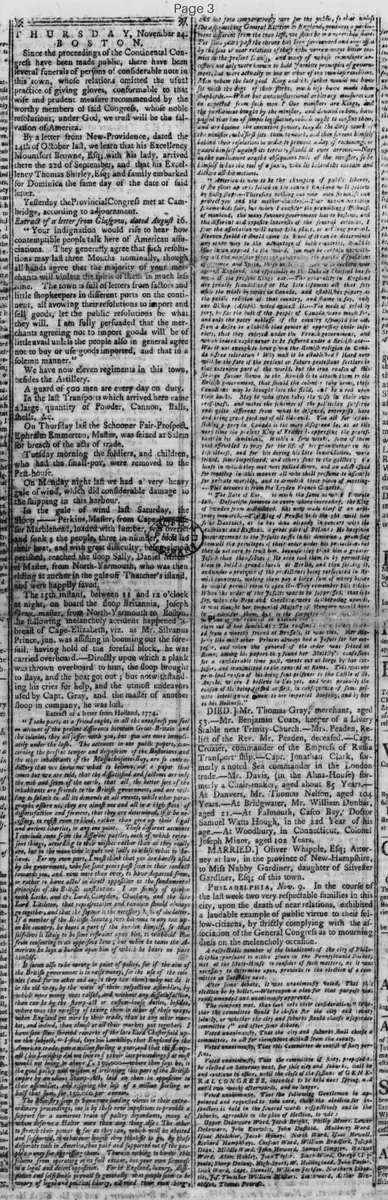
"I take part, as a friend ought, in all the uneasiness you feel on account of the present difference between Great-Britain and the colonies, they all suffer with you, but you are more immediately under the lash. The accounts in our public papers, concerning the present temper and disposition of the Bostonians and the other inhabitants of the Massachusetts-Bay, are so contradictory that we know not what to believe, not a paper comes but we are told, that the dissatisfied and seditious are only the mob and scum of the earth, that all, the better sort of the inhabitants are friends to the British government, and are willing to submit to all its demands at all events, while other paragraphs assure us, they are almost one and all in a high state of dissatisfaction and ferment, that they are determined, if it be necessary, to resist even bloodshed, rather than give up their legal and ancient liberties, in any one point. These different accounts I conclude come from the different parties, each of which represent things, according to their wishes rather than as they really are, but in the mean time it puts one sadly to a loss what to believe. For my own part, I must think that you are hardly used by the government, who for some years past seem in their conduct towards you, and not more than ever, to have departed from, or rather to have acted in direct opposition to the fundamental principles of the British constitution. I am firmly of opinion with Locke, and the Lords Camden, Chatham, and the late Lord Littleton, that representation and taxation should always go together, and that the former is the necessary condition of the latter. If a member of the British Senate gives his vote to any tax upon his country, he bears a part of the burden himself, so that self-love is likely to be one restraint upon him, to withhold him from consenting to an oppressive law; but when he taxes the American he lays a burden upon him of which he bears no part himself.
It seems also to be wrong in point of policy. for if the aim of the British government is to raise money, for the use of the colonies (and for no other end ought they tax them) why not do it in the old way, by the votes of their respective assemblies, by which more money was raised, and without any dissatisfaction, than can be by the stamp-act or custom-house duties, besides, where was the necessity of taxing them in either of these ways, when England got more by their trade, than by any other market, and indeed, than almost at all their markets put together. I have seen some shrewd remarks of the late Lord Chesterfield upon this subject, 'as I find', says his Lordship, 'that England by the American trade, gets a million sterling a year, and that the stamp-act (his Lordship did not live to see their late proceedings) at most would not bring in above 150,000--where then', says he, 'is the good policy and wisdom of irritating this part of the British empire by an odious Stamp-Act, laid on them in opposition to their assemblies, and risking the loss of a million sterling or half that sum, or 150,000 per annum.'
The Ministry seem to have two leading views in their extraordinary proceedings, one is by these new impositions to provide a support for a numerous train of paltry dependents, many of whom deserve a halter more than any thing else: The other to stretch their power as far as they can, which will be abetted and supported, to whatever length they think fit to go, by these desperate tools in America, thus paid and supported out of the people's money for oppressing them. There is nothing to hinder this scheme from operating at its full extent, but your own firmness in a legal and decent opposition. For in England, luxury, dissipation and selfishness prevail so generally that people seem to be weary of legal and political liberty, as minding their own things, and but few comparatively care for the public, so that unless the approaching General Election in England, produce a parliament different from the two last, we have but a wretched state. For some years past the throne has been surrounded and engrossed by the sons of near relations of those who were always bitter enemies to the present family, and many of whose immediate ancestors not only were known to hold Jacobite principles of government, but were actually in one or other of the two last rebellions. Men whom the late good King and his father would not have set with the dogs of their flocks, much less have made them shepherds. What but unconstitutional arbitrary measures can be expected from such men? Our ministers are Kings, and the parliament bought by the minister, and devoted to him, have passed that line of simple legislation, which ought to check them, and we become the executive power, they do the dirty work of the minister, who first sets them to work, and then screens himself behind their resolutions in order to prevent a day of reckoning, or guard himself against its terror, should it ever arrive.--Nay as the parliament are the obsequious tools of the minister, so he himself is but the tool of a junta, who lie behind the curtain and dictate all his motions.
"America is now to be the champion of public liberty. if she gives up or is foiled in the contest England will follow by hasty steps--Therefore nothing but your own firmness can protect you and the mother-country.--Your non-importation scheme bodes fair, but when I consider the prevailing dispositions of mankind, the many favors government has to bestow, and the different and opposite interests of the several colonies, I fear the association will never take place, or not long prevail. Heaven forbid it should come to blood if it can be determined any other way to the advantage of both countries, should it thus issue in an appeal to the sword, you may be certain notwithstanding all the minister gives out concerning the pacific dispositions of France and Spain. the whole world declares war against England, and especially as the Duke de Choiseul has one of the present King's ears.---The generality in England are greatly scandalized at the late infamous act that sets aside trials by juries in Canada, and establishes popery as the public religion of that country, and same say, only one Bishop (Asaph) voted against it.--The mode of trial by jury, by far the bulk of the people of Canada were much for, and only the petty nobility of the country espoused the act, from a desire to establish that power of oppressing their inferiors, that they enjoyed under the French government, and which indeed ought never to be suffered under a British one--- Was it not enough to have given the Romish religion in Canada a free toleration! Why must it be established? Hard now will be the fate of the present or future protestant settlers in that extensive part of the world, but the true reason of this large favour shown to the Romish is to attach them to the British government, that should the colonies take arms, these Canadians may be brought into the field, and be a rod upon their backs. But he who often takes the wise in their own craftiness, and makes the schemes of the politician subserve ends quite different from what he designed, enterpose here and bring great good out of all this evil. The act for establishing popery in Canada is the more disagreeable as at this very time the present King of France is oppressing the protestants in his dominions. Within a few weeks, some of them that assembled to pray for the life of his grandfather in his last illness, and for his during his late inoculation, were seized. Some imprisoned; and others sent to the galleys; the house in which they met was pulled down, and an edict issued for treating in others manner all who shall presume to assemble for private worship and to demolish their place of meeting--
This account is from the Leyden French Gazette.
The state of Europe is much the same as when I wrote last. Despotism seems to be every where increasing. the King of Sweden from a limited, has now made himself an arbitrary monarch,--The King of Prussia it is thought will soon seize Dantzick, as he has done already in concert with the Austrians and Russians, a great part of Poland: He has given encouragement to the Jesuits to fix in his dominion, promising them all the privileges of their order under his protection. but they do not care to trust him. because they think him a greater Jesuit than themselves : He once took them in by permitting them to build a grand church at Berlin, and then seizing it. and under a pretence of the protestants being persecuted in Romish countries, making them pay a large sum of money before he would permit them to open it--They remember this trick-- When the order of the Jesuits was to be suppressed, that is to say, when the Pope and Conclave were deliberating upon it, it was thought her imperial Majesty of Hungary would go in and depend them. but to the surprise of all she joined with those who were for suppressing them, and turned them out of her dominions : The reasons we here lately learned from a worthy friend at Brussels. it was thus. Her Majesty like most other Princes always had a Jesuit for her confessor, and when the general of the order was seized at Rome. among his papers they found her Majesty's confessions for a considerable time past, wrote out at large by her confessor, and transmitted to the general at Rome. This was one principal reason of his being sent prisoner to the Castle of St. Angelo, where I believe he lies yet, and was probably the reason of his being seized at first, in consequence of some private intelligence sent to her imperial Majesty, and by her to his Holiness."
"I take part, as a friend ought, in all the uneasiness you feel on account of the present difference between Great-Britain and the colonies, they all suffer with you, but you are more immediately under the lash. The accounts in our public papers, concerning the present temper and disposition of the Bostonians and the other inhabitants of the Massachusetts-Bay, are so contradictory that we know not what to believe, not a paper comes but we are told, that the dissatisfied and seditious are only the mob and scum of the earth, that all, the better sort of the inhabitants are friends to the British government, and are willing to submit to all its demands at all events, while other paragraphs assure us, they are almost one and all in a high state of dissatisfaction and ferment, that they are determined, if it be necessary, to resist even bloodshed, rather than give up their legal and ancient liberties, in any one point. These different accounts I conclude come from the different parties, each of which represent things, according to their wishes rather than as they really are, but in the mean time it puts one sadly to a loss what to believe. For my own part, I must think that you are hardly used by the government, who for some years past seem in their conduct towards you, and not more than ever, to have departed from, or rather to have acted in direct opposition to the fundamental principles of the British constitution. I am firmly of opinion with Locke, and the Lords Camden, Chatham, and the late Lord Littleton, that representation and taxation should always go together, and that the former is the necessary condition of the latter. If a member of the British Senate gives his vote to any tax upon his country, he bears a part of the burden himself, so that self-love is likely to be one restraint upon him, to withhold him from consenting to an oppressive law; but when he taxes the American he lays a burden upon him of which he bears no part himself.
It seems also to be wrong in point of policy. for if the aim of the British government is to raise money, for the use of the colonies (and for no other end ought they tax them) why not do it in the old way, by the votes of their respective assemblies, by which more money was raised, and without any dissatisfaction, than can be by the stamp-act or custom-house duties, besides, where was the necessity of taxing them in either of these ways, when England got more by their trade, than by any other market, and indeed, than almost at all their markets put together. I have seen some shrewd remarks of the late Lord Chesterfield upon this subject, 'as I find', says his Lordship, 'that England by the American trade, gets a million sterling a year, and that the stamp-act (his Lordship did not live to see their late proceedings) at most would not bring in above 150,000--where then', says he, 'is the good policy and wisdom of irritating this part of the British empire by an odious Stamp-Act, laid on them in opposition to their assemblies, and risking the loss of a million sterling or half that sum, or 150,000 per annum.'
The Ministry seem to have two leading views in their extraordinary proceedings, one is by these new impositions to provide a support for a numerous train of paltry dependents, many of whom deserve a halter more than any thing else: The other to stretch their power as far as they can, which will be abetted and supported, to whatever length they think fit to go, by these desperate tools in America, thus paid and supported out of the people's money for oppressing them. There is nothing to hinder this scheme from operating at its full extent, but your own firmness in a legal and decent opposition. For in England, luxury, dissipation and selfishness prevail so generally that people seem to be weary of legal and political liberty, as minding their own things, and but few comparatively care for the public, so that unless the approaching General Election in England, produce a parliament different from the two last, we have but a wretched state. For some years past the throne has been surrounded and engrossed by the sons of near relations of those who were always bitter enemies to the present family, and many of whose immediate ancestors not only were known to hold Jacobite principles of government, but were actually in one or other of the two last rebellions. Men whom the late good King and his father would not have set with the dogs of their flocks, much less have made them shepherds. What but unconstitutional arbitrary measures can be expected from such men? Our ministers are Kings, and the parliament bought by the minister, and devoted to him, have passed that line of simple legislation, which ought to check them, and we become the executive power, they do the dirty work of the minister, who first sets them to work, and then screens himself behind their resolutions in order to prevent a day of reckoning, or guard himself against its terror, should it ever arrive.--Nay as the parliament are the obsequious tools of the minister, so he himself is but the tool of a junta, who lie behind the curtain and dictate all his motions.
"America is now to be the champion of public liberty. if she gives up or is foiled in the contest England will follow by hasty steps--Therefore nothing but your own firmness can protect you and the mother-country.--Your non-importation scheme bodes fair, but when I consider the prevailing dispositions of mankind, the many favors government has to bestow, and the different and opposite interests of the several colonies, I fear the association will never take place, or not long prevail. Heaven forbid it should come to blood if it can be determined any other way to the advantage of both countries, should it thus issue in an appeal to the sword, you may be certain notwithstanding all the minister gives out concerning the pacific dispositions of France and Spain. the whole world declares war against England, and especially as the Duke de Choiseul has one of the present King's ears.---The generality in England are greatly scandalized at the late infamous act that sets aside trials by juries in Canada, and establishes popery as the public religion of that country, and same say, only one Bishop (Asaph) voted against it.--The mode of trial by jury, by far the bulk of the people of Canada were much for, and only the petty nobility of the country espoused the act, from a desire to establish that power of oppressing their inferiors, that they enjoyed under the French government, and which indeed ought never to be suffered under a British one--- Was it not enough to have given the Romish religion in Canada a free toleration! Why must it be established? Hard now will be the fate of the present or future protestant settlers in that extensive part of the world, but the true reason of this large favour shown to the Romish is to attach them to the British government, that should the colonies take arms, these Canadians may be brought into the field, and be a rod upon their backs. But he who often takes the wise in their own craftiness, and makes the schemes of the politician subserve ends quite different from what he designed, enterpose here and bring great good out of all this evil. The act for establishing popery in Canada is the more disagreeable as at this very time the present King of France is oppressing the protestants in his dominions. Within a few weeks, some of them that assembled to pray for the life of his grandfather in his last illness, and for his during his late inoculation, were seized. Some imprisoned; and others sent to the galleys; the house in which they met was pulled down, and an edict issued for treating in others manner all who shall presume to assemble for private worship and to demolish their place of meeting--
This account is from the Leyden French Gazette.
The state of Europe is much the same as when I wrote last. Despotism seems to be every where increasing. the King of Sweden from a limited, has now made himself an arbitrary monarch,--The King of Prussia it is thought will soon seize Dantzick, as he has done already in concert with the Austrians and Russians, a great part of Poland: He has given encouragement to the Jesuits to fix in his dominion, promising them all the privileges of their order under his protection. but they do not care to trust him. because they think him a greater Jesuit than themselves : He once took them in by permitting them to build a grand church at Berlin, and then seizing it. and under a pretence of the protestants being persecuted in Romish countries, making them pay a large sum of money before he would permit them to open it--They remember this trick-- When the order of the Jesuits was to be suppressed, that is to say, when the Pope and Conclave were deliberating upon it, it was thought her imperial Majesty of Hungary would go in and depend them. but to the surprise of all she joined with those who were for suppressing them, and turned them out of her dominions : The reasons we here lately learned from a worthy friend at Brussels. it was thus. Her Majesty like most other Princes always had a Jesuit for her confessor, and when the general of the order was seized at Rome. among his papers they found her Majesty's confessions for a considerable time past, wrote out at large by her confessor, and transmitted to the general at Rome. This was one principal reason of his being sent prisoner to the Castle of St. Angelo, where I believe he lies yet, and was probably the reason of his being seized at first, in consequence of some private intelligence sent to her imperial Majesty, and by her to his Holiness."
What sub-type of article is it?
Politics
Economic
What keywords are associated?
British Colonies
Taxation Dispute
Stamp Act
Non Importation
Quebec Act
Political Liberty
European Despotism
What entities or persons were involved?
Locke
Lord Camden
Lord Chatham
Lord Littleton
Lord Chesterfield
Duke De Choiseul
Bishop Asaph
Where did it happen?
Massachusetts Bay
Domestic News Details
Primary Location
Massachusetts Bay
Event Date
1774
Key Persons
Locke
Lord Camden
Lord Chatham
Lord Littleton
Lord Chesterfield
Duke De Choiseul
Bishop Asaph
Event Details
Letter from Holland expressing sympathy for American colonies amid tensions with Britain over taxation without representation, critiquing Stamp Act and policies, discussing non-importation, Quebec Act establishing popery, and European political developments including despotism and Jesuit suppression.