Thank you for visiting SNEWPapers!
Sign up free
Editorial
June 24, 1915
The Taney County Republican
Forsyth, Taney County, Missouri
What is this article about?
This editorial defends the Republican Party's role in enacting the 1910 postal savings bank law over Democratic opposition, highlighting party-line votes and now Democratic acknowledgment of its success, countering President Wilson's claim that Republicans lack new ideas.
Clipping
OCR Quality
98%
Excellent
Full Text
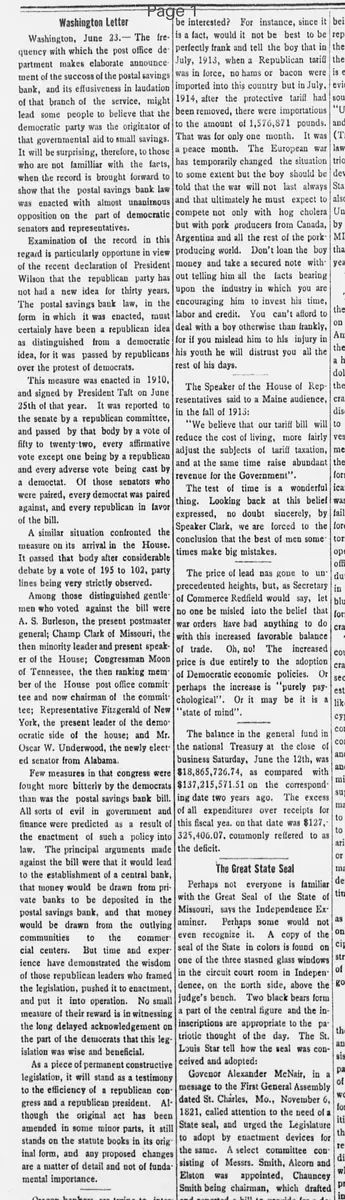
Washington, June 23. - The frequency with which the post office department makes elaborate announcement of the success of the postal savings bank, and its effusiveness in laudation of that branch of the service, might lead some people to believe that the democratic party was the originator of that governmental aid to small savings. It will be surprising, therefore, to those who are not familiar with the facts, when the record is brought forward to show that the postal savings bank law was enacted with almost unanimous opposition on the part of democratic senators and representatives.
Examination of the record in this regard is particularly opportune in view of the recent declaration of President Wilson that the republican party has not had a new idea for thirty years. The postal savings bank law, in the form in which it was enacted, must certainly have been a republican idea as distinguished from a democratic idea, for it was passed by republicans over the protest of democrats.
This measure was enacted in 1910, and signed by President Taft on June 25th of that year. It was reported to the senate by a republican committee, and passed by that body by a vote of fifty to twenty-two, every affirmative vote except one being by a republican and every adverse vote being cast by a democrat. Of those senators who were paired, every democrat was paired against, and every republican in favor of the bill.
A similar situation confronted the measure on its arrival in the House. It passed that body after considerable debate by a vote of 195 to 102, party lines being very strictly observed. Among those distinguished gentlemen who voted against the bill were A. S. Burleson, the present postmaster general; Champ Clark of Missouri, the then minority leader and present speaker of the House; Congressman Moon of Tennessee, the then ranking member of the House post office committee and now chairman of the committee; Representative Fitzgerald of New York, the present leader of the democratic side of the house; and Mr. Oscar W. Underwood, the newly elected senator from Alabama.
Few measures in that congress were fought more bitterly by the democrats than was the postal savings bank bill. All sorts of evil in government and finance were predicted as a result of the enactment of such a policy into law. The principal arguments made against the bill were that it would lead to the establishment of a central bank, that money would be drawn from private banks to be deposited in the postal savings bank, and that money would be drawn from the outlying communities to the commercial centers.
But time and experience have demonstrated the wisdom of those republican leaders who framed the legislation, pushed it to enactment, and put it into operation. No small measure of their reward is in witnessing the long delayed acknowledgement on the part of the democrats that this legislation was wise and beneficial.
As a piece of permanent constructive legislation, it will stand as a testimony to the efficiency of a republican congress and a republican president. Although the original act has been amended in some minor parts, it still stands on the statute books in its original form, and any proposed changes are a matter of detail and not of fundamental importance.
Examination of the record in this regard is particularly opportune in view of the recent declaration of President Wilson that the republican party has not had a new idea for thirty years. The postal savings bank law, in the form in which it was enacted, must certainly have been a republican idea as distinguished from a democratic idea, for it was passed by republicans over the protest of democrats.
This measure was enacted in 1910, and signed by President Taft on June 25th of that year. It was reported to the senate by a republican committee, and passed by that body by a vote of fifty to twenty-two, every affirmative vote except one being by a republican and every adverse vote being cast by a democrat. Of those senators who were paired, every democrat was paired against, and every republican in favor of the bill.
A similar situation confronted the measure on its arrival in the House. It passed that body after considerable debate by a vote of 195 to 102, party lines being very strictly observed. Among those distinguished gentlemen who voted against the bill were A. S. Burleson, the present postmaster general; Champ Clark of Missouri, the then minority leader and present speaker of the House; Congressman Moon of Tennessee, the then ranking member of the House post office committee and now chairman of the committee; Representative Fitzgerald of New York, the present leader of the democratic side of the house; and Mr. Oscar W. Underwood, the newly elected senator from Alabama.
Few measures in that congress were fought more bitterly by the democrats than was the postal savings bank bill. All sorts of evil in government and finance were predicted as a result of the enactment of such a policy into law. The principal arguments made against the bill were that it would lead to the establishment of a central bank, that money would be drawn from private banks to be deposited in the postal savings bank, and that money would be drawn from the outlying communities to the commercial centers.
But time and experience have demonstrated the wisdom of those republican leaders who framed the legislation, pushed it to enactment, and put it into operation. No small measure of their reward is in witnessing the long delayed acknowledgement on the part of the democrats that this legislation was wise and beneficial.
As a piece of permanent constructive legislation, it will stand as a testimony to the efficiency of a republican congress and a republican president. Although the original act has been amended in some minor parts, it still stands on the statute books in its original form, and any proposed changes are a matter of detail and not of fundamental importance.
What sub-type of article is it?
Partisan Politics
Economic Policy
What keywords are associated?
Postal Savings Bank
Republican Legislation
Democratic Opposition
Party Line Votes
1910 Enactment
Government Savings
What entities or persons were involved?
President Wilson
President Taft
A. S. Burleson
Champ Clark
Congressman Moon
Representative Fitzgerald
Oscar W. Underwood
Republican Party
Democratic Party
Editorial Details
Primary Topic
Republican Origins And Democratic Opposition To The Postal Savings Bank Law
Stance / Tone
Pro Republican Defense Against Democratic Claims
Key Figures
President Wilson
President Taft
A. S. Burleson
Champ Clark
Congressman Moon
Representative Fitzgerald
Oscar W. Underwood
Republican Party
Democratic Party
Key Arguments
Postal Savings Bank Law Enacted In 1910 With Republican Support Over Democratic Opposition
Senate Vote 50 22 Along Party Lines
House Vote 195 102 With Strict Party Adherence
Democrats Predicted Evils Like Central Bank And Money Drain From Private Banks
Time Has Proven The Law's Wisdom And Benefits
Counters Wilson's Claim Of No New Republican Ideas