Thank you for visiting SNEWPapers!
Sign up free
Story
July 19, 1805
The Enquirer
Richmond, Henrico County, Virginia
What is this article about?
Satirical account of an inquest into the 'death' of Lord Melville, metaphorically depicting his political downfall due to financial scandals and corruption in naval administration, with medical and legal testimonies.
Clipping
OCR Quality
96%
Excellent
Full Text
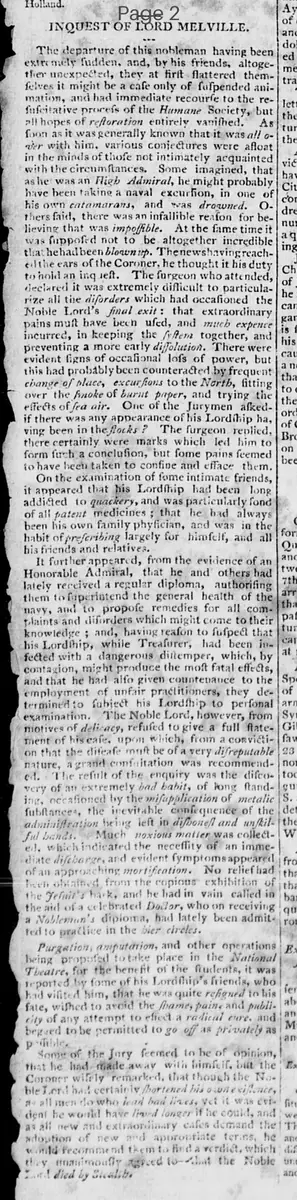
INQUEST OF LORD MELVILLE.
The departure of this nobleman having been extremely sudden, and, by his friends, altogether unexpected, they at first flattered themselves it might be a case only of suspended animation, and had immediate recourse to the resuscitative process of the Humane Society, but all hopes of restoration entirely vanished. As soon as it was generally known that it was all over with him, various conjectures were afloat in the minds of those not intimately acquainted with the circumstances. Some imagined, that as he was an High Admiral, he might probably have been taking a naval excursion, in one of his own catamarans, and was drowned. Others said, there was an infallible reason for believing that was impossible. At the same time it was supposed not to be altogether incredible that he had been blown up. The news having reached the ears of the Coroner, he thought it his duty to hold an inquest. The surgeon who attended, declared it was extremely difficult to particularize all the disorders which had occasioned the Noble Lord's final exit: that extraordinary pains must have been used, and much expense incurred, in keeping the system together, and preventing a more early dissolution. There were evident signs of occasional loss of power, but this had probably been counteracted by frequent change of place, excursions to the North, sitting over the smoke of burnt paper, and trying the effects of sea air. One of the Jurymen asked—if there was any appearance of his Lordship having been in the stocks? The surgeon replied, there certainly were marks which led him to form such a conclusion, but some pains seemed to have been taken to confine and efface them.
On the examination of some intimate friends, it appeared that his Lordship had been long addicted to quackery, and was particularly fond of all patent medicines; that he had always been his own family physician, and was in the habit of prescribing largely for himself, and all his friends and relatives.
It further appeared, from the evidence of an Honorable Admiral, that he and others had lately received a regular diploma, authorising them to superintend the general health of the navy, and to propose remedies for all complaints and disorders which might come to their knowledge; and, having reason to suspect that his Lordship, while Treasurer, had been infected with a dangerous distemper, which, by contagion, might produce the most fatal effects, and that he had also given countenance to the employment of unfair practitioners, they determined to subject his Lordship to personal examination. The Noble Lord, however, from motives of delicacy, refused to give a full statement of his case, upon which, from a conviction that the disease must be of a very disreputable nature, a grand consultation was recommended. The result of the enquiry was the discovery of an extremely bad habit, of long standing, occasioned by the misapplication of metallic substances, the inevitable consequence of the administration being left in dishonest and unskillful hands. Much noxious matter was collected, which indicated the necessity of an immediate discharge, and evident symptoms appeared of an approaching mortification. No relief had been obtained from the copious exhibition of the Jesuit's bark, and he had in vain called in the aid of a celebrated Doctor, who on receiving a Nobleman's diploma, had lately been admitted to practice in the higher circles.
Purgation, amputation, and other operations being proposed to take place in the National Theatre, for the benefit of the students, it was reported by some of his Lordship's friends, who had visited him, that he was quite resigned to his fate, wished to avoid the shame, pain, and publicity of any attempt to effect a radical cure, and begged to be permitted to go off as privately as possible.
Some of the Jury seemed to be of opinion, that he had made away with himself, but the Coroner wisely remarked, that though the Noble Lord had certainly shortened his own existence, as all men do who lead bad lives, yet it was evident he would have lived longer if he could, and as all new and extraordinary cases demand the adoption of new and appropriate terms, he would recommend them to find a verdict, which they unanimously agreed to—that the Noble Lord died by Sualh.
The departure of this nobleman having been extremely sudden, and, by his friends, altogether unexpected, they at first flattered themselves it might be a case only of suspended animation, and had immediate recourse to the resuscitative process of the Humane Society, but all hopes of restoration entirely vanished. As soon as it was generally known that it was all over with him, various conjectures were afloat in the minds of those not intimately acquainted with the circumstances. Some imagined, that as he was an High Admiral, he might probably have been taking a naval excursion, in one of his own catamarans, and was drowned. Others said, there was an infallible reason for believing that was impossible. At the same time it was supposed not to be altogether incredible that he had been blown up. The news having reached the ears of the Coroner, he thought it his duty to hold an inquest. The surgeon who attended, declared it was extremely difficult to particularize all the disorders which had occasioned the Noble Lord's final exit: that extraordinary pains must have been used, and much expense incurred, in keeping the system together, and preventing a more early dissolution. There were evident signs of occasional loss of power, but this had probably been counteracted by frequent change of place, excursions to the North, sitting over the smoke of burnt paper, and trying the effects of sea air. One of the Jurymen asked—if there was any appearance of his Lordship having been in the stocks? The surgeon replied, there certainly were marks which led him to form such a conclusion, but some pains seemed to have been taken to confine and efface them.
On the examination of some intimate friends, it appeared that his Lordship had been long addicted to quackery, and was particularly fond of all patent medicines; that he had always been his own family physician, and was in the habit of prescribing largely for himself, and all his friends and relatives.
It further appeared, from the evidence of an Honorable Admiral, that he and others had lately received a regular diploma, authorising them to superintend the general health of the navy, and to propose remedies for all complaints and disorders which might come to their knowledge; and, having reason to suspect that his Lordship, while Treasurer, had been infected with a dangerous distemper, which, by contagion, might produce the most fatal effects, and that he had also given countenance to the employment of unfair practitioners, they determined to subject his Lordship to personal examination. The Noble Lord, however, from motives of delicacy, refused to give a full statement of his case, upon which, from a conviction that the disease must be of a very disreputable nature, a grand consultation was recommended. The result of the enquiry was the discovery of an extremely bad habit, of long standing, occasioned by the misapplication of metallic substances, the inevitable consequence of the administration being left in dishonest and unskillful hands. Much noxious matter was collected, which indicated the necessity of an immediate discharge, and evident symptoms appeared of an approaching mortification. No relief had been obtained from the copious exhibition of the Jesuit's bark, and he had in vain called in the aid of a celebrated Doctor, who on receiving a Nobleman's diploma, had lately been admitted to practice in the higher circles.
Purgation, amputation, and other operations being proposed to take place in the National Theatre, for the benefit of the students, it was reported by some of his Lordship's friends, who had visited him, that he was quite resigned to his fate, wished to avoid the shame, pain, and publicity of any attempt to effect a radical cure, and begged to be permitted to go off as privately as possible.
Some of the Jury seemed to be of opinion, that he had made away with himself, but the Coroner wisely remarked, that though the Noble Lord had certainly shortened his own existence, as all men do who lead bad lives, yet it was evident he would have lived longer if he could, and as all new and extraordinary cases demand the adoption of new and appropriate terms, he would recommend them to find a verdict, which they unanimously agreed to—that the Noble Lord died by Sualh.
What sub-type of article is it?
Historical Event
Deception Fraud
Crime Story
What themes does it cover?
Deception
Crime Punishment
Justice
What keywords are associated?
Lord Melville
Inquest
Political Scandal
Naval Corruption
Financial Misconduct
Satire
What entities or persons were involved?
Lord Melville
Coroner
Surgeon
Honorable Admiral
Story Details
Key Persons
Lord Melville
Coroner
Surgeon
Honorable Admiral
Story Details
Satirical inquest portrays Lord Melville's political resignation as death from corruption and mismanagement in naval treasury, with testimonies revealing quackery, bad habits from metallic misapplication, and failed remedies, leading to a verdict of death by 'Sualh'.