Thank you for visiting SNEWPapers!
Sign up free
Nogales International
Nogales, Santa Cruz County, Arizona
What is this article about?
Arizona's cost of living fell over 16% in the past year compared to October 1929, boosting dollar's purchasing power and aiding winter tourism, per state officials. Examples include cheaper sugar, beans, flour, and meats.
Clipping
OCR Quality
Full Text
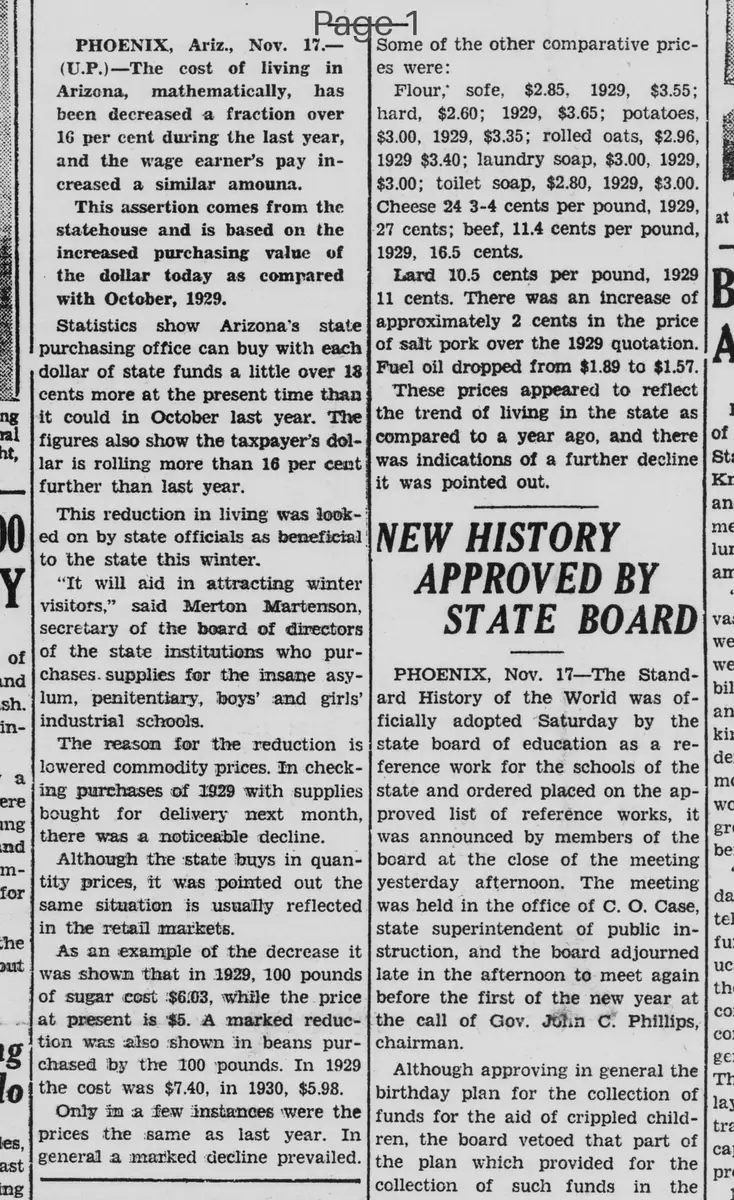
This assertion comes from the statehouse and is based on the increased purchasing value of the dollar today as compared with October, 1929.
Statistics show Arizona's state purchasing office can buy with each dollar of state funds a little over 16 cents more at the present time than it could in October last year. The figures also show the taxpayer's dollar is rolling more than 16 per cent further than last year.
This reduction in living was looked on by state officials as beneficial to the state this winter.
"It will aid in attracting winter visitors," said Merton Martenson, secretary of the board of directors of the state institutions who purchases supplies for the insane asylum, penitentiary, boys' and girls industrial schools.
The reason for the reduction is lowered commodity prices. In checking purchases of 1929 with supplies bought for delivery next month, there was a noticeable decline.
Although the state buys in quantity prices, it was pointed out the same situation is usually reflected in the retail markets.
As an example of the decrease it was shown that in 1929, 100 pounds of sugar cost $6.03, while the price at present is $5. A marked reduction was also shown in beans purchased by the 100 pounds. In 1929 the cost was $7.40, in 1930, $5.98.
Only in a few instances were the prices the same as last year. In general a marked decline prevailed.
Some of the other comparative prices were:
Flour, soft, $2.85, 1929, $3.55; hard, $2.60; 1929, $3.65; potatoes, $3.00, 1929, $3.35; rolled oats, $2.96, 1929 $3.40; laundry soap, $3.00, 1929, $3.00; toilet soap, $2.80, 1929, $3.00.
Cheese 24 3-4 cents per pound, 1929, 27 cents; beef, 11.4 cents per pound, 1929, 16.5 cents.
Lard 10.5 cents per pound, 1929 11 cents. There was an increase of approximately 2 cents in the price of salt pork over the 1929 quotation.
Fuel oil dropped from $1.89 to $1.57.
These prices appeared to reflect the trend of living in the state as compared to a year ago, and there was indications of a further decline it was pointed out.
What sub-type of article is it?
What keywords are associated?
What entities or persons were involved?
Where did it happen?
Domestic News Details
Primary Location
Arizona
Event Date
Nov. 17
Key Persons
Outcome
cost of living decreased over 16 percent; wage earner's pay increased similarly; beneficial for attracting winter visitors
Event Details
The cost of living in Arizona has decreased by over 16 percent in the last year compared to October 1929, based on increased purchasing power of the dollar. State purchasing office can buy 16 cents more per dollar. Lowered commodity prices shown in examples: sugar from $6.03 to $5 per 100 pounds, beans from $7.40 to $5.98, flour soft from $3.55 to $2.85, hard from $3.65 to $2.60, potatoes from $3.35 to $3.00, rolled oats from $3.40 to $2.96, cheese from 27 to 24.75 cents per pound, beef from 16.5 to 11.4 cents per pound, lard from 11 to 10.5 cents per pound, fuel oil from $1.89 to $1.57. Indications of further decline.