Thank you for visiting SNEWPapers!
Sign up free
Editorial
June 1, 1859
The Lancaster Ledger
Lancaster, Lancaster County, South Carolina
What is this article about?
The editorial criticizes Alphonse Lamartine's appeal to the world's ingratitude for his poetry, contrasting him with philanthropist Thomas Holloway, who provides life-saving remedies without seeking extra gratitude. It mocks self-laudation as a vice, especially among second-rate figures.
Clipping
OCR Quality
95%
Excellent
Full Text
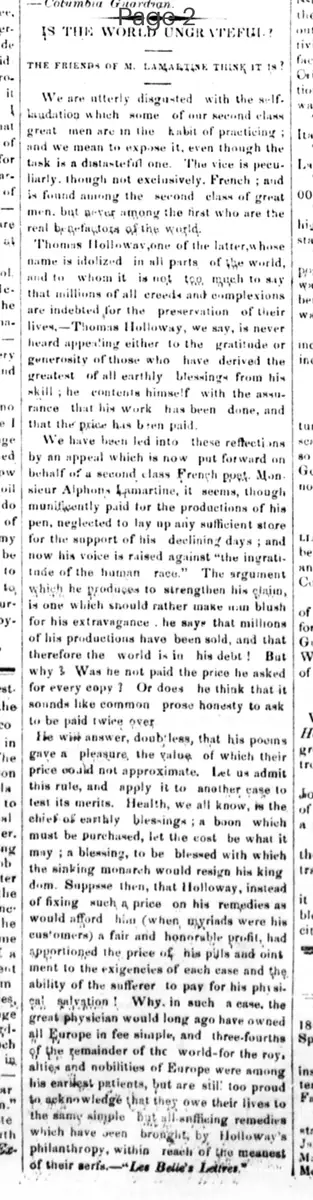
IS THE WORLD UNGRATEFUL?
THE FRIENDS OF M. LAMARTINE THINK IT IS?
We are utterly disgusted with the self-laudation which some of our second class great men are in the habit of practicing; and we mean to expose it, even though the task is a distasteful one. The vice is peculiarly, though not exclusively, French: and is found among the second class of great men, but never among the first who are the real benefactors of the world.
Thomas Holloway, one of the latter, whose name is idolized in all parts of the world, and to whom it is not too much to say that millions of all creeds and complexions are indebted for the preservation of their lives,—Thomas Holloway, we say, is never heard appealing either to the gratitude or generosity of those who have derived the greatest of all earthly blessings from his skill: he contents himself with the assurance that his work has been done, and that the price has been paid.
We have been led into these reflections by an appeal which is now put forward on behalf of a second class French poet. Monsieur Alphonse Lamartine, it seems, though munificently paid for the productions of his pen, neglected to lay by any sufficient store for the support of his declining days; and now his voice is raised against "the ingratitude of the human race." The argument which he produces to strengthen his claim, is one which should rather make one blush for his extravagance. he says that millions of his productions have been sold, and that therefore the world is in his debt! But why? Was he not paid the price he asked for every copy? Or does he think that it sounds like common prose honesty to ask to be paid twice over?
He will answer, doubtless, that his poems gave a pleasure, the value of which their price could not approximate. Let us admit this rule, and apply it to another case to test its merits. Health, we all know, is the chief of earthly blessings; a boon which must be purchased, let the cost be what it may; a blessing, to be blessed with which the sinking monarch would resign his kingdom. Suppose then, that Holloway, instead of fixing such a price on his remedies as would afford him (when myriads were his customers) a fair and honorable profit, had apportioned the price of his pills and ointment to the exigencies of each case and the ability of the sufferer to pay for his physical salvation! Why, in such a case, the great physician would long ago have owned all Europe in fee simple, and three-fourths of the remainder of the world—for the royalties and nobilities of Europe were among his earliest patients, but are still too proud to acknowledge that they owe their lives to the same simple but all-sufficing remedies which have been brought, by Holloway's philanthropy, within reach of the meanest of their serfs.—"Lee Belie's Lettres."
THE FRIENDS OF M. LAMARTINE THINK IT IS?
We are utterly disgusted with the self-laudation which some of our second class great men are in the habit of practicing; and we mean to expose it, even though the task is a distasteful one. The vice is peculiarly, though not exclusively, French: and is found among the second class of great men, but never among the first who are the real benefactors of the world.
Thomas Holloway, one of the latter, whose name is idolized in all parts of the world, and to whom it is not too much to say that millions of all creeds and complexions are indebted for the preservation of their lives,—Thomas Holloway, we say, is never heard appealing either to the gratitude or generosity of those who have derived the greatest of all earthly blessings from his skill: he contents himself with the assurance that his work has been done, and that the price has been paid.
We have been led into these reflections by an appeal which is now put forward on behalf of a second class French poet. Monsieur Alphonse Lamartine, it seems, though munificently paid for the productions of his pen, neglected to lay by any sufficient store for the support of his declining days; and now his voice is raised against "the ingratitude of the human race." The argument which he produces to strengthen his claim, is one which should rather make one blush for his extravagance. he says that millions of his productions have been sold, and that therefore the world is in his debt! But why? Was he not paid the price he asked for every copy? Or does he think that it sounds like common prose honesty to ask to be paid twice over?
He will answer, doubtless, that his poems gave a pleasure, the value of which their price could not approximate. Let us admit this rule, and apply it to another case to test its merits. Health, we all know, is the chief of earthly blessings; a boon which must be purchased, let the cost be what it may; a blessing, to be blessed with which the sinking monarch would resign his kingdom. Suppose then, that Holloway, instead of fixing such a price on his remedies as would afford him (when myriads were his customers) a fair and honorable profit, had apportioned the price of his pills and ointment to the exigencies of each case and the ability of the sufferer to pay for his physical salvation! Why, in such a case, the great physician would long ago have owned all Europe in fee simple, and three-fourths of the remainder of the world—for the royalties and nobilities of Europe were among his earliest patients, but are still too proud to acknowledge that they owe their lives to the same simple but all-sufficing remedies which have been brought, by Holloway's philanthropy, within reach of the meanest of their serfs.—"Lee Belie's Lettres."
What sub-type of article is it?
Satire
Moral Or Religious
What keywords are associated?
Self Laudation
Ingratitude
Lamartine
Holloway
Philanthropy
French Poet
Remedies
Gratitude
What entities or persons were involved?
Alphonse Lamartine
Thomas Holloway
Editorial Details
Primary Topic
Critique Of Alphonse Lamartine's Appeal For Public Gratitude
Stance / Tone
Disgusted With Self Laudation And Extravagance, Praising True Benefactors Like Thomas Holloway
Key Figures
Alphonse Lamartine
Thomas Holloway
Key Arguments
Self Laudation Is A Vice Peculiar To Second Class Great Men, Not True Benefactors
Thomas Holloway Provides Life Saving Remedies Without Appealing To Gratitude
Lamartine Was Paid For His Poetry But Now Claims Ingratitude From The World
Demanding Extra Payment Beyond The Agreed Price Is Dishonest
Poetry's Pleasure Does Not Justify Double Payment, Unlike Holloway's Fixed Pricing For Health
Holloway's Philanthropy Makes Remedies Accessible To All, Including The Poor