Thank you for visiting SNEWPapers!
Sign up free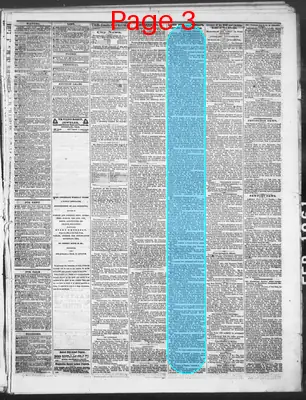
Cincinnati Daily Press
Cincinnati, Hamilton County, Ohio
What is this article about?
On February 4, 1861, the U.S. Senate debated Louisiana's secession ordinance, with Senators Slidell and Benjamin delivering farewell speeches asserting the South's right to form a new Confederacy. Various petitions and resolutions on compromise were presented. The House discussed seizures in New Orleans and rejected the Chiriqui appropriation.
Clipping

OCR Quality
Full Text
THIRTY-SIXTH CONGRESS--SECOND SESSION.
WASHINGTON, February 4.
SENATE Mr. Crittenden presented several memorials in favor of his proposition.
Mr. Wilson offered a resolution of inquiry, asking the President to communicate to the Senate whether any public property has been seized by persons in Louisiana, and especially as to the mint at New Orleans. Laid over.
Mr. Chandler presented a petition from the citizens of Michigan against any change in the Constitution.
Mr. Bigler presented petitions in favor of the Crittenden resolutions.
Mr. Foster presented a petition from the citizens of Connecticut in favor of the Border-State resolutions.
Mr. Slidell sent to the Clerk the ordinance of Secession of Louisiana, to be read.
Mr. Slidell said the document just read places on official record that Louisiana ceased to be a component part of the United States, and terminates the connection of himself and colleague with this body. The occasion calls for some words in parting with those whom we leave, some of whom we hope to meet again, in the noble task of forming a new Confederacy.
The new Confederacy will not attempt to improve the Constitution of the United States; it will recognize the obligations of all existing treaties-those respecting the African slave-trade included! It will be willing to assume just proportion of the public debt, and account for all the property of the United States which they were compelled to take for self defense. They would recognize the right of the inhabitants of the valley of the Mississippi to the free navigation of the Mississippi River without tax or toll of any kind. They hoped for peace, but the decision of this depends upon the free States. He had no doubt, if the issue was fairly presented to the people of the States, they might have a peaceful separation, with a probability of a complete or partial reconstruction; but with the present representation in either branch of Congress, he could indulge in no such hope, and they must be prepared to resist coercion under any pretext.
The North might, if it chose, consider them bound to the Union, and deny the right-he would not say of secession, but of revolution or rebellion, if I choose to call it so; it might ignore the Declaration of Independence, and attempt to reduce the South to subjection, but the South would meet them, and permit no introduction of commerce or manufactures from the North, and would meet them on the sea, under the old flag, for they did not intend to give up the flag; it belonged to the South as much as to the North. They could get vessels from the same places that now carry on the slave-trade New York and New England. He denied that this movement was but the consummation of a long-contemplated plot; it was the calm and deliberate action of the people.
He referred to the many kindnesses they had received in the Senate Chamber, and bade the Senate farewell.
Mr. Benjamin argued against the assertion that Louisiana could not go out of the Union because she was bought, as the property of the United States. Louisiana was acquired under treaty, which guaranteed to the citizens of the Territory protection to property. He claimed that she had special reasons for going out, because the treaty stipulations under which she was acquired were broken entirely by the Government.
He claimed that the charge of rebellion against the South was an admission of oppression, for never in the history of the world did millions rise in rebellion against honor and justice, and when the people with common consent revolt, it must be criminal against whom the revolt is aimed. The people of the South glory in such treason as glowed in the soul of Hampden, burst from the lips of Henry, and shed a halo of light around the name of Washington. He concluded with a tribute to the friends of the South in the Northern States, and bade the Senate farewell. [Applause in the galleries].
The President's Message came up.
Mr. Clingman commended its tone. He would do most any thing to save the country-vote for the Crittenden proposition, and others, to accomplish peace. He argued against coercion. He disclaimed any knowledge of an intimation to make war on the Capital, but war might as likely come here as elsewhere.
The passage of the Pacific Railroad Bill, attempting to make three routes, and a Tariff Bill directly against the interests of the South, and the Homestead Bill, giving away the public lands, drive many sensible men in the South into separation. The Republicans carry with them peace or war. Which will they give the country? If war, the South will meet them, and rather than submit, would go down like Sampson, taking the edifice and the leaders of the Philistines with them.
Mr. Hale protested against the assertion that the North was making war; on the contrary, their position was such as would subject them to the charge of cowardice. If war comes, we shall first take care of Northern traitors.
Mr. Lane wanted to know who he called traitors.
Mr. Hale-"Exactly those men who are fighting against their own State."
Mr. Lane-"They are fighting for their constitutional rights as States. I'll allow no man to call them traitors."
Mr. Hale wished to define no man's position, but repeated, if forced into war, the North would first take care of treason at home.
The message was postponed until to-morrow.
The bill to provide for the Government of Idaho came up, and Mr. Green's amendment changing the boundary was adopted.
On motion of Mr. Wilson, the name was changed to Colorado, and the bill passed.
Mr. Pearce, from the Finance Committee, reported a loan-bill, which was made the special order for to-morrow.
Mr. Bigler offered a resolution to admit the Commissioners to the floor of the Senate. Laid over. Adjourned.
HOUSE -Mr. McClernand asked leave to offer a preamble setting forth the reports relative to the seizure of the mint and money at New Orleans, and the refusal to pay drafts drawn by the United States on their own money, and concluding with a resolution, calling on the President to communicate to the House at an early day, if, in his judgment, not incompatible with the public interest, all the facts on the subject; and what steps, if any, have been taken to restore the Government possession of said property and treasure.
Mr. Burnett would vote for the resolutions with cheerfulness, but objected to the preamble.
Mr. McClernand said that he had therein only reiterated what was reported. He affirmed nothing.
Mr. Craige, of North Carolina, objected to the repetition of the resolutions, and expressed his surprise that any one should make allegations on newspaper reports.
Mr. McClernand expressed his surprise that any one should object to a mere resolution of inquiry. It made no allegations.
Mr. Branch asked leave to introduce a resolution allowing the Commissioners from the States admission to the floor of the House.
Mr. Kunkel proposed to amend that the use of the Hall of the House or other suitable apartment be tendered them for their meeting.
Mr. Lovejoy and others objected.
Mr. John Cochrane gave notice that at an early day he would call up the bill reported by him from the Committee of Five, the further to provide for the collection of duties on imports.
A motion for night sessions this week was adopted.
Mr. Wilson presented a petition from Indiana in favor of the Crittenden resolutions, but said he could not vote for it.
The House went into Committee on the Senate amendments to the Deficiency Bill.
Mr. Morse advocated the Chiriqui appropriation.
Mr. Stevens, of Penna., opposed it.
It was rejected.
The amendment to appropriate $135,000 for Wendell’s establishment, for a public printing office, was debated and adopted.
What sub-type of article is it?
What keywords are associated?
What entities or persons were involved?
Where did it happen?
Foreign News Details
Primary Location
Washington
Event Date
February 4
Key Persons
Outcome
louisiana secession ordinance read; senators slidell and benjamin bid farewell; idaho bill passed as colorado; chiriqui appropriation rejected; printing office appropriation adopted; various resolutions laid over.
Event Details
Senate proceedings included presentations of memorials and petitions favoring Crittenden and Border-State resolutions, a resolution on seized property in Louisiana, reading of Louisiana's secession ordinance, farewell speeches by Slidell and Benjamin defending secession and new Confederacy, debate on President's Message, passage of Colorado Territory bill, reporting of loan-bill. House discussed seizure of New Orleans mint, resolutions on commissioners, notice on duties bill, adoption of night sessions, committee on Deficiency Bill rejecting Chiriqui appropriation but adopting printing office funding.