Thank you for visiting SNEWPapers!
Sign up free
Literary
April 17, 1840
Vermont Phœnix
Brattleboro, Bellows Falls, Ludlow, Windham County, Windsor County, Vermont
What is this article about?
Excerpt from Joseph de Geramb's travelogue 'A Pilgrimage to Palestine, Egypt and Syria' describes the melancholic approach to the Dead Sea, its sterile surroundings, salty waters, and biblical associations with divine vengeance. The author notes the lack of life, oily yet limpid water, and crumbling stones.
Clipping
OCR Quality
95%
Excellent
Full Text
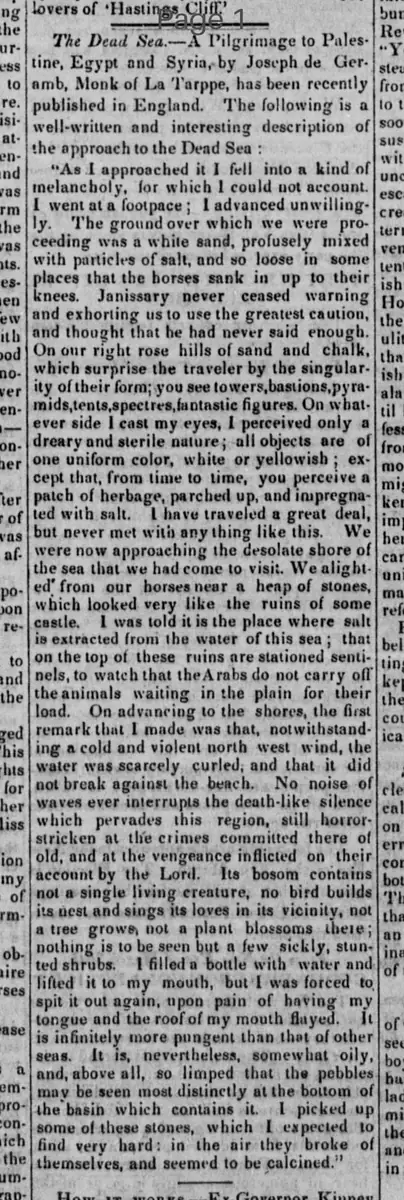
The Dead Sea.—A Pilgrimage to Palestine, Egypt and Syria, by Joseph de Geramb, Monk of La Trappe, has been recently published in England. The following is a well-written and interesting description of the approach to the Dead Sea:
"As I approached it I fell into a kind of melancholy, for which I could not account. I went at a footpace; I advanced unwillingly. The ground over which we were proceeding was a white sand, profusely mixed with particles of salt, and so loose in some places that the horses sank in up to their knees. Janissary never ceased warning and exhorting us to use the greatest caution, and thought that he had never said enough. On our right rose hills of sand and chalk, which surprise the traveler by the singularity of their form; you see towers, bastions, pyramids, tents, spectres, fantastic figures. On whatever side I cast my eyes, I perceived only a dreary and sterile nature; all objects are of one uniform color, white or yellowish; except that, from time to time, you perceive a patch of herbage, parched up, and impregnated with salt. I have traveled a great deal, but never met with anything like this. We were now approaching the desolate shore of the sea that we had come to visit. We alighted from our horses near a heap of stones, which looked very like the ruins of some castle. I was told it is the place where salt is extracted from the water of this sea; that on the top of these ruins are stationed sentinels, to watch that the Arabs do not carry off the animals waiting in the plain for their load. On advancing to the shores, the first remark that I made was that, notwithstanding a cold and violent north west wind, the water was scarcely curled; and that it did not break against the beach. No noise of waves ever interrupts the death-like silence which pervades this region, still horror-stricken at the crimes committed there of old, and at the vengeance inflicted on their account by the Lord. Its bosom contains not a single living creature, no bird builds its nest and sings its loves in its vicinity, not a tree grows, not a plant blossoms there; nothing is to be seen but a few sickly, stunted shrubs. I filled a bottle with water and lifted it to my mouth, but I was forced to spit it out again, upon pain of having my tongue and the roof of my mouth laved. It is infinitely more pungent than that of other seas. It is, nevertheless, somewhat oily, and, above all, so limpid that the pebbles may be seen most distinctly at the bottom of the basin which contains it. I picked up some of these stones, which I expected to find very hard: in the air they broke of themselves, and seemed to be calcined."
"As I approached it I fell into a kind of melancholy, for which I could not account. I went at a footpace; I advanced unwillingly. The ground over which we were proceeding was a white sand, profusely mixed with particles of salt, and so loose in some places that the horses sank in up to their knees. Janissary never ceased warning and exhorting us to use the greatest caution, and thought that he had never said enough. On our right rose hills of sand and chalk, which surprise the traveler by the singularity of their form; you see towers, bastions, pyramids, tents, spectres, fantastic figures. On whatever side I cast my eyes, I perceived only a dreary and sterile nature; all objects are of one uniform color, white or yellowish; except that, from time to time, you perceive a patch of herbage, parched up, and impregnated with salt. I have traveled a great deal, but never met with anything like this. We were now approaching the desolate shore of the sea that we had come to visit. We alighted from our horses near a heap of stones, which looked very like the ruins of some castle. I was told it is the place where salt is extracted from the water of this sea; that on the top of these ruins are stationed sentinels, to watch that the Arabs do not carry off the animals waiting in the plain for their load. On advancing to the shores, the first remark that I made was that, notwithstanding a cold and violent north west wind, the water was scarcely curled; and that it did not break against the beach. No noise of waves ever interrupts the death-like silence which pervades this region, still horror-stricken at the crimes committed there of old, and at the vengeance inflicted on their account by the Lord. Its bosom contains not a single living creature, no bird builds its nest and sings its loves in its vicinity, not a tree grows, not a plant blossoms there; nothing is to be seen but a few sickly, stunted shrubs. I filled a bottle with water and lifted it to my mouth, but I was forced to spit it out again, upon pain of having my tongue and the roof of my mouth laved. It is infinitely more pungent than that of other seas. It is, nevertheless, somewhat oily, and, above all, so limpid that the pebbles may be seen most distinctly at the bottom of the basin which contains it. I picked up some of these stones, which I expected to find very hard: in the air they broke of themselves, and seemed to be calcined."
What sub-type of article is it?
Journey Narrative
Essay
What themes does it cover?
Nature
Religious
What keywords are associated?
Dead Sea
Pilgrimage
Palestine
Sterile Landscape
Salt Extraction
Biblical Vengeance
Travel Description
What entities or persons were involved?
Joseph De Geramb, Monk Of La Trappe
Literary Details
Title
The Dead Sea
Author
Joseph De Geramb, Monk Of La Trappe
Subject
Approach To The Dead Sea
Key Lines
As I Approached It I Fell Into A Kind Of Melancholy, For Which I Could Not Account.
No Noise Of Waves Ever Interrupts The Death Like Silence Which Pervades This Region, Still Horror Stricken At The Crimes Committed There Of Old, And At The Vengeance Inflicted On Their Account By The Lord.
Its Bosom Contains Not A Single Living Creature, No Bird Builds Its Nest And Sings Its Loves In Its Vicinity, Not A Tree Grows, Not A Plant Blossoms There;
It Is Infinitely More Pungent Than That Of Other Seas. It Is, Nevertheless, Somewhat Oily, And, Above All, So Limpid That The Pebbles May Be Seen Most Distinctly At The Bottom Of The Basin Which Contains It.