Thank you for visiting SNEWPapers!
Sign up free
Toledo Union Journal
Toledo, Lucas County, Ohio
What is this article about?
At the Great Lakes' Conference of Railroad and Utility Commissioners in White Sulphur Springs, W. Va., Solomon Barkin of the Textile Workers' Union predicted a public debate on inadequate utility regulation amid rising rates and corruption. He proposed measures like competitive utilities, rate targets, and bans on political expenditures.
Clipping
OCR Quality
Full Text
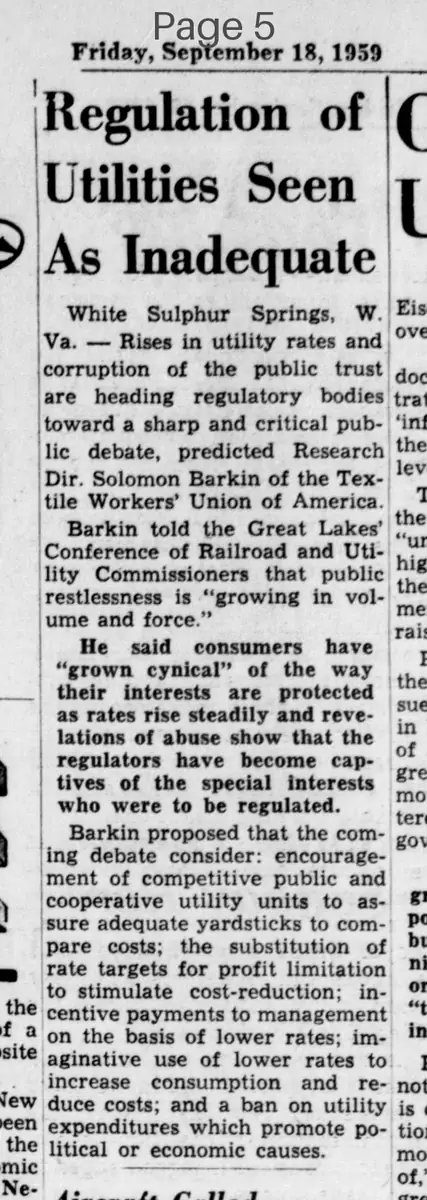
Regulation of Utilities Seen As Inadequate
White Sulphur Springs, W. Va. - Rises in utility rates and corruption of the public trust are heading regulatory bodies toward a sharp and critical public debate, predicted Research Dir. Solomon Barkin of the Textile Workers' Union of America.
Barkin told the Great Lakes' Conference of Railroad and Utility Commissioners that public restlessness is "growing in volume and force."
He said consumers have grown cynical of the way their interests are protected as rates rise steadily and revelations of abuse show that the regulators have become captives of the special interests who were to be regulated.
Barkin proposed that the coming debate consider: encouragement of competitive public and cooperative utility units to assure adequate yardsticks to compare costs; the substitution of rate targets for profit limitation to stimulate cost-reduction; incentive payments to management on the basis of lower rates; imaginative use of lower rates to increase consumption and reduce costs; and a ban on utility expenditures which promote political or economic causes.
What sub-type of article is it?
What keywords are associated?
What entities or persons were involved?
Where did it happen?
Domestic News Details
Primary Location
White Sulphur Springs, W. Va.
Event Date
1959 09 18
Key Persons
Event Details
Research Dir. Solomon Barkin of the Textile Workers' Union of America predicted at the Great Lakes' Conference of Railroad and Utility Commissioners that rising utility rates and corruption in regulatory bodies would lead to a sharp public debate. He noted growing public restlessness and consumer cynicism due to regulators being captives of special interests. Barkin proposed considering competitive public and cooperative utilities for cost comparison, rate targets instead of profit limits, incentive payments for lower rates, using lower rates to boost consumption and cut costs, and banning utility spending on political or economic causes.