Thank you for visiting SNEWPapers!
Sign up free
Editorial
July 7, 1827
Phenix Gazette
Alexandria, Virginia
What is this article about?
Editorial from the Democratic Press praises Mr. Everett's speech clarifying that the woollens bill seeks to restore 1824 tariff protections for wool manufacturers and growers, undermined by British reductions and frauds, rather than excessive aid. It advocates equitable protection and anticipates the Harrisburg convention.
Clipping
OCR Quality
95%
Excellent
Full Text
[From the Democratic Press.]
TARIFF QUESTION.
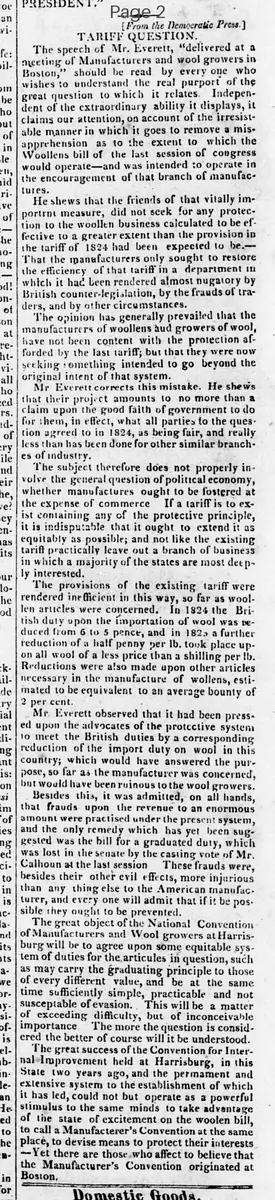
The speech of Mr. Everett, "delivered at a meeting of Manufacturers and wool growers in Boston," should be read by every one who wishes to understand the real purport of the great question to which it relates. Independent of the extraordinary ability it displays, it claims our attention, on account of the irresistible manner in which it goes to remove a misapprehension as to the extent to which the Woollens bill of the last session of congress would operate—and was intended to operate in the encouragement of that branch of manufactures.
He shews that the friends of that vitally important measure, did not seek or any protection to the woollen business calculated to be effective to a greater extent than the provision in the tariff of 1824 had been expected to be.— That the manufacturers only sought to restore the efficiency of that tariff in a department in which it had been rendered almost nugatory by British counter-legislation, by the frauds of traders, and by other circumstances.
The opinion has generally prevailed that the manufacturers of woollens and growers of wool have not been content with the protection afforded by the last tariff; but that they were now seeking something intended to go beyond the original intent of that system.
Mr Everett corrects this mistake. He shews that their project amounts to no more than a claim upon the good faith of government to do for them, in effect, what all parties to the question agreed to in 1824, as being fair, and really less than has been done for other similar branches of industry.
The subject therefore does not properly involve the general question of political economy, whether manufactures ought to be fostered at the expense of commerce If a tariff is to exist containing any of the protective principle, it is indisputable that it ought to extend it as equitably as possible; and not like the existing tariff practically leave out a branch of business in which a majority of the states are most deeply interested.
The provisions of the existing tariff were rendered inefficient in this way, so far as woollen articles were concerned. In 1824 the British duty upon the importation of wool was reduced from 6 to 5 pence, and in 1825 a further reduction of a half penny per lb. took place upon all wool of a less price than a shilling per lb. Reductions were also made upon other articles necessary in the manufacture of woollens, estimated to be equivalent to an average bounty of 2 per cent.
Mr. Everett observed that it had been pressed upon the advocates of the protective system to meet the British duties by a corresponding reduction of the import duty on wool in this country; which would have answered the purpose, so far as the manufacturer was concerned, but would have been ruinous to the wool growers. Besides this, it was admitted, on all hands, that frauds upon the revenue to an enormous amount were practised under the present system, and the only remedy which has yet been suggested was the bill for a graduated duty, which was lost in the senate by the casting vote of Mr. Calhoun at the last session These frauds were, besides their other evil effects, more injurious than any thing else to the American manufacturer, and every one will admit that if it be possible they ought to be prevented.
The great object of the National Convention of Manufacturers and Wool growers at Harrisburg will be to agree upon some equitable system of duties for the articles in question, such as may carry the graduating principle to those of every different value, and be at the same time sufficiently simple, practicable and not susceptible of evasion. This will be a matter of exceeding difficulty, but of inconceivable importance The more the question is considered the better of course will it be understood. The great success of the Convention for Internal Improvement held at Harrisburg, in this State two years ago, and the permanent and extensive system to the establishment of which it has led, could not but operate as a powerful stimulus to the same minds to take advantage of the state of excitement on the woolen bill, to call a Manufacturer's Convention at the same place, to devise means to protect their interests -Yet there are those who affect to believe that the Manufacturer's Convention originated at Boston.
TARIFF QUESTION.
The speech of Mr. Everett, "delivered at a meeting of Manufacturers and wool growers in Boston," should be read by every one who wishes to understand the real purport of the great question to which it relates. Independent of the extraordinary ability it displays, it claims our attention, on account of the irresistible manner in which it goes to remove a misapprehension as to the extent to which the Woollens bill of the last session of congress would operate—and was intended to operate in the encouragement of that branch of manufactures.
He shews that the friends of that vitally important measure, did not seek or any protection to the woollen business calculated to be effective to a greater extent than the provision in the tariff of 1824 had been expected to be.— That the manufacturers only sought to restore the efficiency of that tariff in a department in which it had been rendered almost nugatory by British counter-legislation, by the frauds of traders, and by other circumstances.
The opinion has generally prevailed that the manufacturers of woollens and growers of wool have not been content with the protection afforded by the last tariff; but that they were now seeking something intended to go beyond the original intent of that system.
Mr Everett corrects this mistake. He shews that their project amounts to no more than a claim upon the good faith of government to do for them, in effect, what all parties to the question agreed to in 1824, as being fair, and really less than has been done for other similar branches of industry.
The subject therefore does not properly involve the general question of political economy, whether manufactures ought to be fostered at the expense of commerce If a tariff is to exist containing any of the protective principle, it is indisputable that it ought to extend it as equitably as possible; and not like the existing tariff practically leave out a branch of business in which a majority of the states are most deeply interested.
The provisions of the existing tariff were rendered inefficient in this way, so far as woollen articles were concerned. In 1824 the British duty upon the importation of wool was reduced from 6 to 5 pence, and in 1825 a further reduction of a half penny per lb. took place upon all wool of a less price than a shilling per lb. Reductions were also made upon other articles necessary in the manufacture of woollens, estimated to be equivalent to an average bounty of 2 per cent.
Mr. Everett observed that it had been pressed upon the advocates of the protective system to meet the British duties by a corresponding reduction of the import duty on wool in this country; which would have answered the purpose, so far as the manufacturer was concerned, but would have been ruinous to the wool growers. Besides this, it was admitted, on all hands, that frauds upon the revenue to an enormous amount were practised under the present system, and the only remedy which has yet been suggested was the bill for a graduated duty, which was lost in the senate by the casting vote of Mr. Calhoun at the last session These frauds were, besides their other evil effects, more injurious than any thing else to the American manufacturer, and every one will admit that if it be possible they ought to be prevented.
The great object of the National Convention of Manufacturers and Wool growers at Harrisburg will be to agree upon some equitable system of duties for the articles in question, such as may carry the graduating principle to those of every different value, and be at the same time sufficiently simple, practicable and not susceptible of evasion. This will be a matter of exceeding difficulty, but of inconceivable importance The more the question is considered the better of course will it be understood. The great success of the Convention for Internal Improvement held at Harrisburg, in this State two years ago, and the permanent and extensive system to the establishment of which it has led, could not but operate as a powerful stimulus to the same minds to take advantage of the state of excitement on the woolen bill, to call a Manufacturer's Convention at the same place, to devise means to protect their interests -Yet there are those who affect to believe that the Manufacturer's Convention originated at Boston.
What sub-type of article is it?
Economic Policy
Trade Or Commerce
Taxation
What keywords are associated?
Tariff Protection
Woollen Manufactures
Wool Growers
Economic Policy
Graduated Duties
Harrisburg Convention
What entities or persons were involved?
Mr. Everett
Manufacturers And Wool Growers
British
Congress
Mr. Calhoun
National Convention At Harrisburg
Editorial Details
Primary Topic
Defense Of Woollens Tariff Protection
Stance / Tone
Supportive Of Equitable Tariff Restoration
Key Figures
Mr. Everett
Manufacturers And Wool Growers
British
Congress
Mr. Calhoun
National Convention At Harrisburg
Key Arguments
Woollens Bill Restores 1824 Tariff Efficiency Undermined By British Counter Legislation And Frauds
Not Seeking Protection Beyond Original 1824 Intent
Equitable Extension Of Protective Principle To Woollens As Done For Other Industries
British Duty Reductions On Wool Harmed American Manufacturers
Reducing Us Import Duty On Wool Would Ruin Growers
Graduated Duty Bill Lost Due To Calhoun's Vote
Harrisburg Convention To Devise Equitable, Evasion Proof Duties