Thank you for visiting SNEWPapers!
Sign up free
Mcallen Daily Press
Mcallen, Hidalgo County, Texas
What is this article about?
In Austin, Texas, the state highway department uses a new electrical resistivity device developed by the federal Public Roads Administration to detect subsurface soil and base materials for road construction, saving thousands of dollars. E.J. Amey described examples including discoveries that avoided long-distance transport, with savings of $5,150, $1,136 per mile, and access to 200,000 cubic yards of material.
Clipping
OCR Quality
Full Text
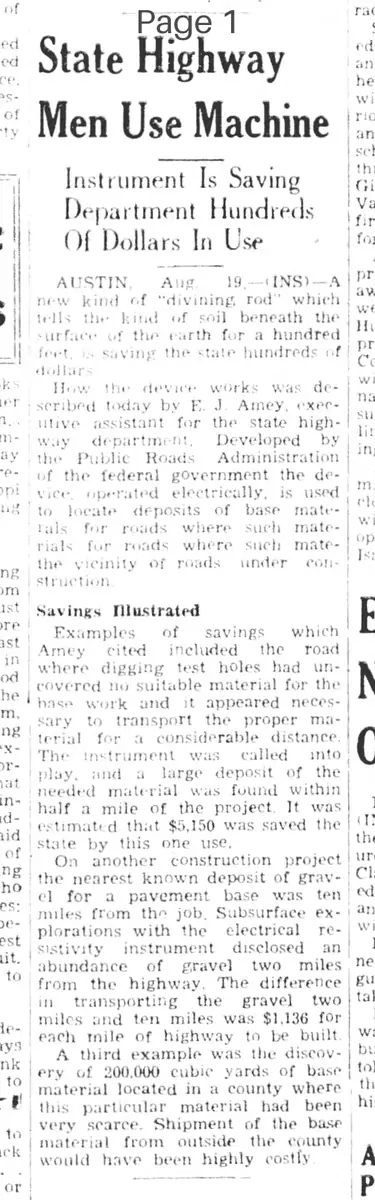
Instrument Is Saving Department Hundreds Of Dollars In Use
AUSTIN Aug 19(INS)-A new kind of "divining rod" which tells the kind of soil beneath the surface of the earth for a hundred feet is saving the state hundreds of dollars. How the device works was described today by E J Amey, executive assistant for the state highway department. Developed by the Public Roads Administration of the federal government, the device, operated electrically, is used to locate deposits of base materials for roads where such materials are not known to exist in the vicinity of roads under construction.
Savings Illustrated
Examples of savings which Amey cited included the road where digging test holes had uncovered no suitable material for the base work and it appeared necessary to transport the proper material for a considerable distance. The instrument was called into play, and a large deposit of the needed material was found within half a mile of the project. It was estimated that $5,150 was saved the state by this one use.
On another construction project, the nearest known deposit of gravel for a pavement base was ten miles from the job. Subsurface explorations with the electrical resistivity instrument disclosed an abundance of gravel two miles from the highway. The difference in transporting the gravel two miles and ten miles was $1,136 for each mile of highway to be built.
A third example was the discovery of 200,000 cubic yards of base material located in a county where this particular material had been very scarce. Shipment of the base material from outside the county would have been highly costly.
What sub-type of article is it?
What keywords are associated?
What entities or persons were involved?
Where did it happen?
Domestic News Details
Primary Location
Austin
Event Date
Aug 19
Key Persons
Outcome
savings of $5,150 on one project by finding material half a mile away; $1,136 per mile saved on another by reducing transport from 10 to 2 miles; discovery of 200,000 cubic yards of scarce base material in a county, avoiding costly shipments.
Event Details
The state highway department uses an electrical resistivity device, developed by the federal Public Roads Administration, to detect soil types and base material deposits up to 100 feet underground for road construction where materials are not known nearby. E J Amey described its operation and cited three examples of cost savings from locating closer deposits.